PSYCH 289 (Spring 2014)
STUDY QUESTIONS SECTION 2
Chapter 4 and related classes
1. What does it mean that cortical organization is lateralized and plastic?
Lateralized – each hemisphere takes on different tasks (can’t return to 100% if
damaged)
Plastic – ability of brain to take on new functions (> in first six months)
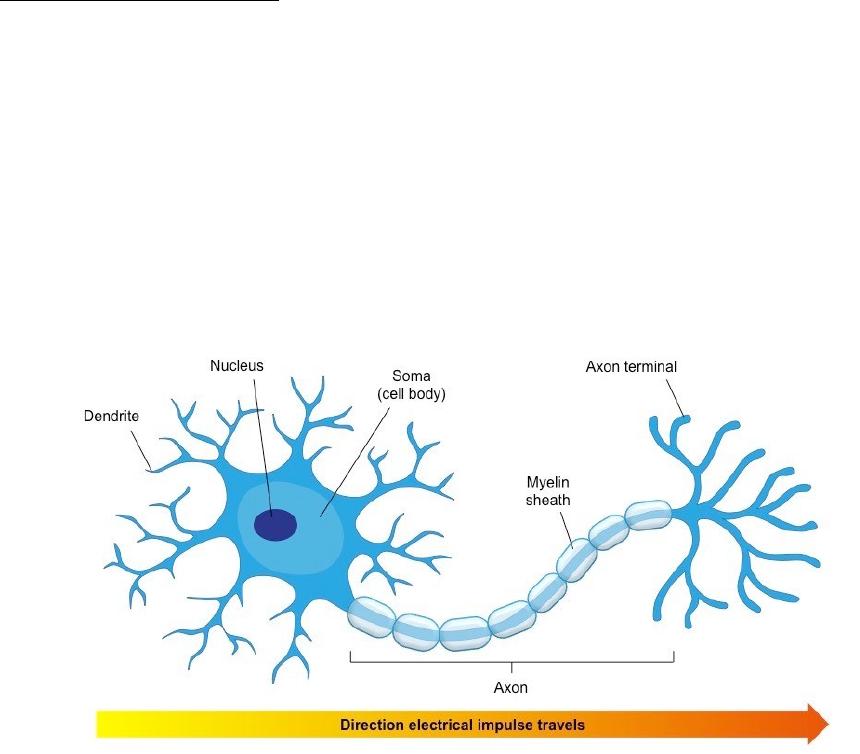
2. List and describe the parts of a neuron, including axon, cell body, and dendrite.
How does an impulse travel from one neuron to another?
Neurons are stimulated by input from the surrounding environment. They
continue to establish synapses, forming increasingly elaborate systems of
communication that support more complex abilities
3. Briefly describe myelinization.
The coating of neural fibers with an insulating fatty sheath, called myelin, that
improves the efficiency of message transfer.
4. What is migration?
New neurons migrate to different parts of the brain to fill voids, when at location they
extend axons and dendrites and communicate via synapses
5. What are sensitive periods?
An optimal/vital time period for certain capacities to emerge and respond to
environment

6. What is experience-expectant brain growth and experience-dependent brain
growth? Give an example of each.
a. Experience-expectant growth
i. Ordinary experiences “expected” by brain to
grow normally
b. Experience-dependent growth
i. Additional growth as a result of specific
learning experiences
7. What are two principles of motor development? Give an example that illustrates
each of these.
Cephalocaudal (head to foot)
Proximodistal (inside out)
oShoulder, arms, then fingers (takes a while)
8. Describe gross motor development and fine motor development. How do they
differ?
Large muscle groups – running
Fine motor movements – writing, drawing, reaching, grasping
9. Describe the dynamic systems theory of motor development.
Many motor skills work together to accomplish larger goals
10. Describe the general progression of locomotion, including average ages.
Newborn- pre-reaching
3-4 months- ulnar grasp (fingers to palm)
4-5 months – transfer object from hand to hand
9 months – pincer grasp (thumb to pointer)
11. What are classical and operant conditioning? Use an example to illustrate infants’
ability to learn using both of these methods.
Classical Conditioning
First described by Ivan Pavlov, a Russian physiologist
Involves placing a neutral signal before a reflex
Focuses on involuntary, automatic behaviors
Operant Conditioning
First described by B. F. Skinner, an American psychologist
Involves applying reinforcement or punishment after a behavior
Focuses on strengthening or weakening voluntary behaviors
12. What is preference for novelty? Why is it important?
-At birth, the human brain is set up to be attracted to novelty. Infants tend to
respond more strongly to a new element that has entered their environment.
-This is important because it focusses our attention on those aspects of the