Determinants of Inflation – A case
study of Turkey
Yashfeen Waheed
Taylor’s Business School
24 June 2020
ECN60604
Applied Ecnometrics
0336195
Content
1. Introduction
1.1 Background…………………………………………………………………………………………………………..
1.2 Problem Statement………………………………………………………………………………………………
1.3 Significance of Research……………………………………………………………………………………….
2. Literature Review
2.1 Inflation and Money Supply Growth……………………………………………………………………..
2.2 Inflation and Exchange Rate………………………………………………………………………………….
2.3 Inflation an Interest Rate………………………………………………………………………………………
3. Research Methodology
3.1 Method – Ordinary Least Squares…………………………………………………………………………
3.2 Data Analysis Techniques……………………………………………………………………………………..
3.2.1 Regression Analysis – OLS…………………………………………………………………………
3.2.2 Multicollinearity Test………………………………………………………………………………..
3.2.3 Serial Correlation Test……………………………………………………………………………….
3.2.4 Heteroskedasticity Test…………………………………………………………………………….
3.3 Research model
4. Results and Discussion
4.1 Regression analysis – OLS Results…………………………………………………………………………
4.2 Multicollinearity……………………………………………………………………………………………………
4.3 Serial Correlation………………………………………………………………………………………………….
4.3.1 Serial Correlation LM Test…………………………………………………………………………
4.3.2 Correlogram – Q – statistics………………………………………………………………………
4.3.3 Durbin-Watson test…………………………………………………………………………………..
4.3.4 Overall conclusion for serial correlation……………………………………………………
4.4 Heteroskedasticity………………………………………………………………………………………………..
4.5 Results interpretation…………………………………………………………………………………………..
5. Conclusion
6. REFERENCE
7. APPENDIX
1. INTRODUCTION
1.1 Background
Inflation rates continuous to remain amongst the main macroeconomic concerns in any
government due to the fact that inflation directly affects the standard living of people.
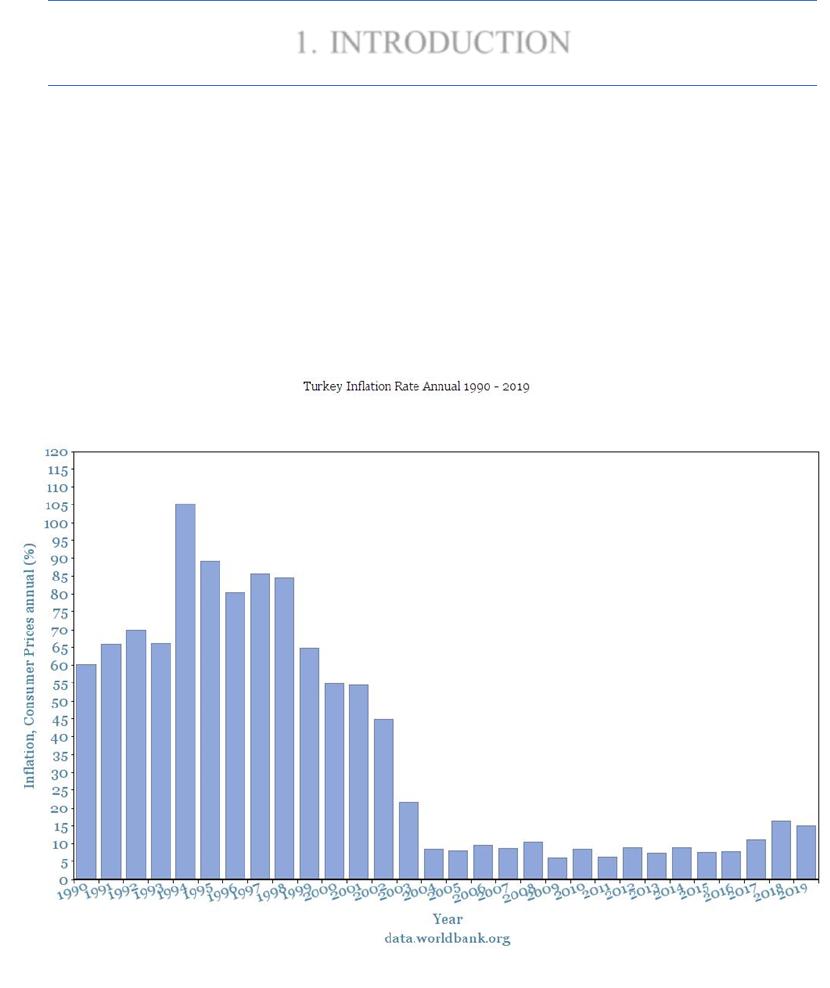
Turkey has been among one of the top countries with high inflation across the globe for a
long period of time. Compared to 1990s the inflation rate of Turkey has dropped significantly
low although it still remains comparatively high.
Past research and theory have proven that inflation can be affected by monetary as well as
non-monetary factors. In the case of Turkey, exchange rates seem to play an integral role in
the country’s high inflation due to the devaluation of Turkish Lira ((Herve, 2019). Moreover,
targeted interest rates and money supply growth which are tools of monetary policy are also
key factors that have been known to affect inflation rates (Khandan and Hosseini, 2016).
Let’s look at each of these factors briefly:
An exchange rate is the price of one of currency in terms of another currency (The Economic
Times, 2020) and these rates can be either fixed or free floating depending on the country’s
policy. According to Central bank Republic of Turkey (2020), Turkey has a floating
exchange rate policy since the economic crisis of 2001. Theory suggest that appreciation of
the domestic currency is deflationary whereas depreciation of domestic currency is
inflationary.
Interest rate is one of the instruments used in monetary policy to control the money supply in
the economy. High targeted interest rates help lower the money supply whereas low interest
rates help increase the money supply. With regards to the quantitative theory of money, if
there is an extra supply of money it would lead to inflation.
1.2 Problem Statement
Inflation continuous to pose a problem in Turkey’s economy even though it has significantly
decreased over the past 10 years. Macroeconomic theories and recent studies predict that
money supply growth, foreign exchange rates and interest rates can be used as tools in
effective policy reforms to control inflation rate. Therefore, this study is designed to examine
how these variables influence inflation rates in Turkey.
1.3 Significance of Research
Inflation continuous to attract a lot of researchers as it is one of the key macroeconomic
concerns of any government. The knowledge about the factors that influence inflation and
their relationship is vital for governments to form policies in order to effectively respond to
them. Previous studies suggest that how inflation responds to its influential factors vary from
country to country (Khandan and Hosseini, 2016; Okafor, 2016; Amassoma et al., 2018).
Thus, it is reasonable for studies to be conducted for all regions to better understand the
movement of inflation and identify the conditions for those movements. Hence, this study
adds to the literature about the factors that influence inflation rates and their relationship in
Turkey. Moreover, the findings in this study in addition to previous studies, can be helpful in
formulating effective policies to better respond to inflation in Turkey.

2. Literature Review
2.1 Inflation and Money supply growth.
There are two macroeconomic theories that explains the relationship between inflation and
money supply growth. One theory is the quantity theory of money. In this theory Fisher, Brown
and Pigue are of the same opinion that there is a movement of price levels in the same direction
as money supply (Su et al., 2016). The other theory, is modern quantity theory of money in
which Friedman (1970) states that inflation would only occur if the money supply growth
exceeds the growth of output. On the basis of theories, we know there is a relationship. However,
let’s look at studies for further clarification.
Sultana, Koli and Firoj (2019) conducted a study in Bangladesh to assess the link between
inflation and money supply. The results of Johansen cointegration test revealed that there is a
long-term positive link between these two variables. The study was limited to the use of only
broad money and narrow money due to unavailability of monthly data for other determinants
Moreover, Sultana, Koli and Firoj (2019) suggested that policymakers of Bangladesh should
consider long-run effects of money supply in formulating their monetary policies.
By adopting the Ordinary Least squares method, a research carried out to find the impact of
money supply on inflation in Ghana showed that there is a long run positive relationship between
these two variables (Ofori, Danquah and Zhang, 2019). This study was limited to the use of only
inflation as dependent variable and money supply. Moreover, the researchers suggested that it is
important for the central bank to be independent so that policy makers can effectively control the
impact of money supply on inflation.
The study by Yousfat (2015) differs to the previously discussed studies on the basis that he
conducted his research on a group of countries. Yousfat (2015), in his inspection of the
relationship between inflation and money supply in CGC countries used annual time series of
1970 – 2013. In contrast to the study by Sultana, Koli and Firoj (2019), Johansen cointegration
test was used in this study which showed that there is a positive affiliation of inflation in relation
to the money supply growth in the long-run.
Hence, this study proposes:
H0: β ≤ 0 There is a negative relationship between inflation rate and money supply growth
HA: β > 0 There is a positive relationship between inflation rate and money supply growth
Expected coefficient sign: Positive
2.2 Inflation and Exchange rate
John Maynard Keynes and his followers predicted the cost push theory of inflation which
provides a relationship between exchange rates and inflation. A devaluation of a country’s
domestic currency raises the import prices which is a factor that decreases the aggregate supply
with regards to the cost push theory. Therefore, a depreciation of the domestic currency is
followed by an increase in inflation in accordance with “Cost push Theory of inflation”.
Nevertheless, we’ll look at what recent researchers have to say about this view.
On the basis of traditional theory which says appreciation of domestic currency reduces
inflationary pressure, Liu and Chen (2017) studied the effects of exchange rate on price levels in
China. This study used monthly data between 2003 – 2012, to check for sensitivity between CPI
and the fluctuations in domestic exchange rates by using vector error correction (VEC) model.
Liu and Chen (2017) found that depreciation (increase) of domestic currency exchange rate will
cause the CPI to increase. This study was limited to the use of only RMB/USD for exchange rate
measure as USD is the key currency in China’s exchange rate “currency basket” (Liu and Chen,
2017).
Similarly, a study was conducted in Switzerland to examine how the Swiss central bank’s
intervention in exchange rates impact the country’s inflation (Žídek and Šuterová, 2017). This
study used the SVAR model to estimate the impact of exchange rate shocks on the prices by
using quarterly data. Based on results Žídek and Šuterová (2017) concluded that there is a
positive relationship between domestic currency depreciation and inflation rate in Switzerland.
In contrast, Mesagan, Alimi and Yusuf (2015) showed similar results in Nigeria by using A R D
L bound testing approach to establish the relationship between exchange rate depreciation and
Inflation rate. The study used annual time series data with a range from 1970 to 2015 which
concluded that there is a significant positive relationship between domestic currency depreciation
and inflation rate (Mesagan, Alimi and Yusuf, 2015). This study is limited to using only
NGN/USD as a measure for foreign currency exchange rate.
Hence, this study proposes:
H0: β ≤ 0 There is a negative relationship between inflation rate and exchange rate
HA: β > 0 There is a positive relationship between inflation rate and exchange rate
Expected coefficient sign: Positive
2.3 Inflation and interest rates.
Interest rate is one of the tools in monetary policy used to control the rate of inflations. The