sustainability
Article
Determinants of Continuous Intention on Food
Delivery Apps: Extending UTAUT2 with
Information Quality
Suk Won Lee 1, Hye Jin Sung 2and Hyeon Mo Jeon 1,*
1Department of Hotel, Tourism, and Foodservice Management, Dongguk University-Gyeonju, 123,
Dongdae-ro, Gyeongju-si, Gyeongsangbuk-do 38066, Korea; leesw113@naver.com
2Department of Foodservice Management, Pai Chai University, 155-40, Baejae-ro, Seo-gu,
Daejeon-si 35345, Korea; jin8083@pcu.ac.kr
*Correspondence: jhm010@dongguk.ac.kr; Tel.: +82-10-6275-4010
Received: 3 May 2019; Accepted: 2 June 2019; Published: 4 June 2019
Abstract:
This study empirically analyzes an extended Unified Theory of Acceptance and Use of
Technology 2 (UTAUT2) model that augments information quality to identify the determinants of
continuous use intention for food delivery software applications. A sample survey of 340 respondents
who had ordered or purchased food through delivery apps was used for the analysis. The results
indicate that habit had the strongest influence on continuous use intention, followed by performance
expectancy and social influence. Furthermore, information quality had an indirect effect on continuous
use intention via performance expectancy. Consequently, this study confirms the importance of
information quality, performance expectancy, habit, and social influence as factors in inducing
users’ continuous use intention for food delivery apps. These findings expand previous research in
online-to-offline business in the field of food services and suggest practical implications. Ultimately,
the model proposed and validated in this study may be employed as a basis for future research on
consumer behavior in the field of food e-commerce services.
Keywords:
O2O; food delivery app; UTAUT2; information quality; continuous intention; food
service consumer
1. Introduction
The rapid growth of e-commerce has spawned new forms of business, such as online to offline
(O2O), and has changed the traditional performance of tasks and jobs [
1
,
2
]. O2O is a marketing method
based on information and communications technology (ICT) in which customers are attracted online
and then induced to complete a transaction in an offline setting [
3
]. In other words, it is a system in
which customers place orders for goods or services online and then receive the goods or services at an
offline outlet. Accessibility and the ability to share information quickly have led to the rapid growth of
mobile commerce connecting suppliers and users via smartphone apps [4,5].
O2O services have emerged in various fields, including food services, hotels, real estate, and
car rentals [
6
]. The real-time connectivity of food delivery apps on mobile devices provides busy
users with speed and convenience [
7
]. The change in how consumers order food has spread globally.
Restaurants in Los Angeles, Calif., have added 200–250 orders per week and have seen revenues grow
by 3–35% after partnering with food delivery apps [
2
]. The apps are expected to become a significant
part of the U.S. restaurant business alongside the fast-food business [
2
]. In China, more than one fifth
of the population has used a food delivery app [
8
]. Food services via mobile apps have become a
convenient way for take-out restaurants in China to boost sales revenue [
2
]. Similarly, the number
of users in Korea’s delivery app market has risen dramatically, from 870,000 in 2013 to 25 million in
Sustainability 2019,11, 3141; doi:10.3390/su11113141 www.mdpi.com/journal/sustainability
Sustainability 2019,11, 3141 2 of 15
2018. The volume of transactions as of 2018 is estimated to be about 3 trillion KRW, accounting for
20% of the food delivery market (15 trillion KRW) [
9
]. Furthermore, according to the findings of the
Factual Survey on Small Business’s Use of Online Delivery Services, 95.5% of 1000 restaurant owners
nationwide using delivery apps reported that net profits either rose (46.2%) or stayed the same (49.3%)
after adopting delivery apps. On the other hand, only 4.5% reported a decrease in net profits [10].
The growing popularity of food delivery apps has intensified competition within the food delivery
market in Korea [
7
]. The food service industry in Korea has more proactively adopted O2O transactions
compared to other industries because the apps offer a low-cost way for businesses to attract customers,
promote their products, and facilitate contact with those customers, features that are especially attractive
to small-scale restaurants [
11
]. Delivery apps offer food service customers the ability to search through
diverse products and compare costs. Small-scale restaurants that have lower advertising and marketing
abilities can use delivery apps as a convenient and highly efficient sales and marketing tool. Therefore,
there is a need for further research on food service consumers’ continuous use intentions for delivery
service apps.
This study aims to identify the determinants of the continuous use intention. In particular,
this study employs the extended UTAUT2 (Unified Theory of Acceptance and Use of Technology 2)
model for empirical analysis. This model is considered to have better explanatory power than the TAM
(Technology Acceptance Model) and UTAUT models that have been used to explain users’ behavioral
intentions toward various information technologies [
12
]. Although the rapid growth of delivery apps
has drawn much discussion, there have been relatively few academic studies [
2
,
7
,
13
] on the subject.
In particular, no previous studies on the subject have applied the UTAUT2 model. Therefore, this study
focuses on the following research questions: What are the factors that might strengthen the continuous
use intention of consumers who have previously used delivery app services? Which factors have the
strongest influence on users’ continuous intention?
DeLone and McLean [
14
] have stated that, in addition to system quality, information quality plays
a vital role in the success of an information system. Information quality, representing the most basic
communication capacity between online buyer and seller, is regarded as the foundational determining
factor for building trust [
15
]. Information quality implies that information itself has inherent qualities
such as accuracy, reliability, and completeness. In particular, the importance of information quality has
been shown through its relevancy, usefulness, and currency [
16
]. Information quality is frequently used
to assess the performance of information systems [
17
] and has been found to significantly influence
usefulness, ease of use, attitude, trust, satisfaction, and use intention in online environments [
16
,
18
–
22
].
Therefore, to expand previous research on food service consumer behavior and include the
acceptance of information technology systems and user studies, this study employs an extended
UTAUT2 model that augments the UTAUT2 model with information quality. This study adds to
previous research by identifying the variables that influence consumers’ continuous intentions to use
delivery app services along multiple perspectives. The study focuses on delivery app services as a
marketing channel for restaurants and analyzes consumer behavior in food e-commerce. The findings
offer useful research material that could contribute to marketing strategies for service providers and
restaurant businesses.
2. Literature Review and Hypotheses
2.1. Information Quality
Information quality refers to the value, validity, and usability of information that is the output of
an information system as well as the quality of that output [
23
]. Furthermore, information quality
refers to the extent to which a system provides the user with useful and significant information in a
speedy and accurate manner [
22
]. Ranganathan and Ganapathy [
24
] considered information quality to
be the key determinant of a website’s quality. Better information quality may elicit enjoyment and
positive behavioral intention [
25
]. Consumers form a positive perception of information quality when
Sustainability 2019,11, 3141 3 of 15
the information meets their expectations during the decision-making process and is provided in an
adequate manner [26].
Information quality represents the most basic communication capacity between an online buyer
and seller and is regarded as the foundational factor in building trust [
15
]. A review of the literature
on technology acceptance shows that trust in information is a key predictive factor for behavioral
intention [
12
,
27
–
29
]. User decisions made while using systems is determined by security and
trust [30,31].
Depending on use and purpose, information quality may be assessed through understandability,
reliability, timeliness, and usefulness. Seddon [
32
] proposed relevance, timeliness, and accuracy as
evaluation items for information quality while Delone and McLean [
14
] argued that individualization,
completeness, relevance, ease of understanding, and security determine success in e-commerce. Nelson,
Todd, and Wixom [
33
] expanded on the factors presented by Delone and McLean [
14
] with sub-factors
such as accuracy, completeness, currency, and format. Hsieh, Kuo, Yang, and Lin [
34
] stated that
the key information quality factors of blogs were understandability, reliability, scope, and usefulness.
As is evident from these studies, various categories of information quality have been presented but
a standardized set of attributes has yet to be established [
21
]. Several studies have also conducted
single-dimension examinations using these factors [22,35–37].
Numerous studies have established the relationship between information quality and performance
expectancy (perceived usefulness), effort expectancy (perceived ease of use), and behavioral intention.
Rai, Lang, and Welker [
38
] and Kulkarni, Ravindran, and Freeze [
39
] found that information quality
had significant influence on perceived usefulness. Based on the TAM model, Shih [
17
] found that
perceived information quality in Internet shopping had a positive effect on perceived ease of use and
usefulness. Lin, Fofanah, and Liang [
35
] found that information quality had a strong influence on
the perceived usefulness and ease of use of e-government systems. Using UTAUT, Alshehri, Drew,
Alhussain, and Alghamdi [
36
] found that the website quality of e-government systems had a stronger
influence on the intention to use than performance expectancy, effort expectancy, social influence,
and facilitating conditions. Escobar-Rodriguez and Carvajal-Trujillo [
40
] found that the quality of
information positively influenced intention to use by reinforcing consumers’ trust in e-commerce. Kang
and Namkung [
21
] stated that, when purchasing food products, the quality of information provided
by O2O commerce positively influenced perceived usefulness and ease of use. Zhao [
22
] found that
the information quality provided by social network-based communities played a significant role in the
intention to participate in communities.
Based on the relevant literature, this study specified the information quality of delivery app
services as the determinant of performance expectancy, effort expectancy, and behavioral intention to
analyze how these variables are related.
H1: The information quality of delivery apps will significantly influence performance expectancy.
H2: The information quality of delivery apps will significantly influence effort expectancy.
H3: The information quality of delivery apps will significantly influence continuous intention.
2.2. Unified Theory of Acceptance and Use of Technology 2 (UTAUT2)
The TAM model, based on the theory of reasoned action (TRA) in the field of social psychology, has
been employed in numerous studies to explain the acceptance of technology [
41
]. In particular, it has
been applied to analyze information systems in mobile commerce [
42
], e-commerce [
43
], and social
networks [
44
]. However, the model’s analysis of relationships between variables in IT environments
is limited because it is unable to adequately account for the influences between various exogenous
variables and the TAM variables [
45
]. Furthermore, it has been criticized for its inability to provide a
general explanation of work-technology environments [46].
Sustainability 2019,11, 3141 4 of 15
In order to address such shortcomings, Venkatesh, Morris, Davis, and Davis [
47
] proposed a
comprehensive model with improved explanatory ability on the intention to use and the behavior of
information system users–UTAUT, which unified various previous theories and models on technology
acceptance, including TAM. UTAUT states that performance expectancy, effort expectancy, social
influence, and facilitation conditions are the direct determinants of behavioral intention and use.
Also, factors such as gender, age, experience, and voluntariness were noted as mediating factors [
47
].
Performance expectancy is a concept in line with perceived usefulness in the TAM model and refers
to the extent of individual beliefs that the use of a system would prove helpful in improving task
or job performance. The stronger the perception that a new technology will improve one’s work
or life, the greater the intention to use that technology [
12
,
47
–
49
]. Performance expectancy is a key
predictive factor for the behavioral intention of users. It has been repeatedly validated in studies on the
factors determining the acceptance and use of new products and technologies [
50
]. Effort expectancy
refers to the ease of use of a system and is in line with perceived ease of use in the TAM model.
A stronger perception of ease of use will lead to a greater intention to use the technology [
12
,
47
,
48
].
Social influence reflects the fact that the use of a system or technology is influenced by the views
of peers. It is analogous to that of subjective norms in TRA [
12
]. Thus, the more strongly peers
perceive the use of a new technology, system, or service to be important, the more likely one is to
follow along [
51
]. Social influence has been validated as positively influencing users’ behavioral
intentions for new technologies, products, and services [
12
,
47
]. Facilitating conditions are defined
as the extent of individual beliefs in the existence of organized technical support for the use of a
system [
50
]. This includes a user’s belief that there will be access to guidance, training, and support
while attempting to acquire a technology [
52
]. Users who deem facilitating conditions to be adequate
are less averse to using a new service, thus strengthening their use intentions [
12
]. UTAUT posits that
when these four exogenous variables influence users’ behavioral intentions or use intentions, factors
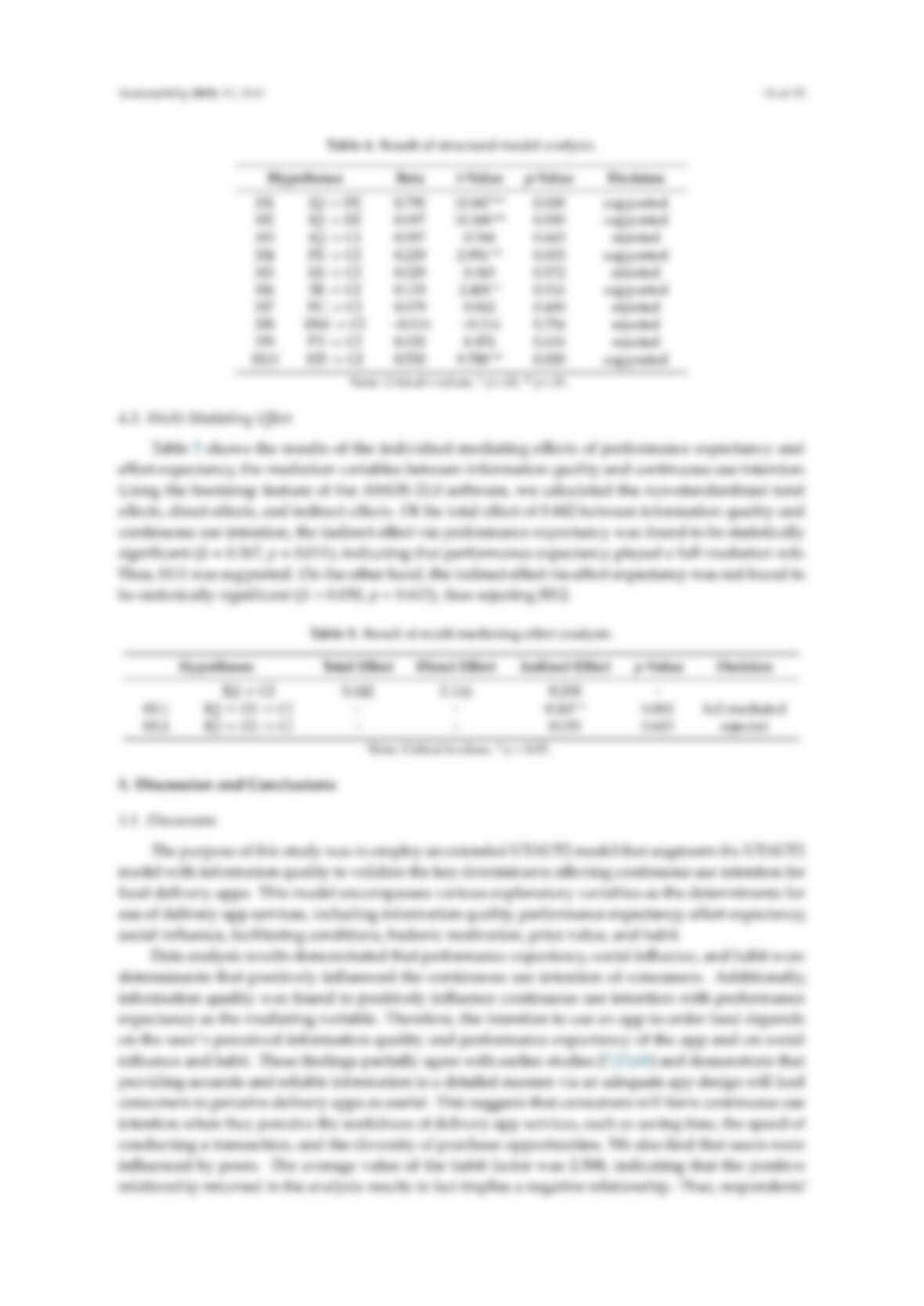
effects, direct effects, and indirect effects. Of the total effect of 0.442 between information quality and
continuous use intention, the indirect effect via performance expectancy was found to be statistically
significant (β = 0.267, p = 0.011), indicating that performance expectancy played a full mediation role.
Thus, H11 was supported. On the other hand, the indirect effect via effort expectancy was not found
to be statistically significant (β = 0.030, p = 0.613), thus rejecting H12.
Table 5. Result of multi mediating effect analysis.
Hypotheses
Total
Effect
Direct
Effect
Indirect
Effect
p-value
Decision
H11
IQ -> CI
IQ -> PE -> CI
0.442
–
0.144
–
0.298
0.267*
–
0.011
full mediated
H11
IQ -> EE –> CI
–
–
0.030
0.613
rejected
Note: Critical t-values. *p<0.05.
5. Discussion and Conclusion
5.1. Discussion