Production, Manufacturing and Logistics
Designing a distribution network in a supply chain
system: Formulation and efficient solution procedure
Ali Amiri
*
Department of MSIS, Oklahoma State University, 210 College of Business, Stillwater, OK 74078, USA
Received 19 November 2001; accepted 6 September 2004
Available online 2 November 2004
Abstract
This paper addresses the distribution network design problem in a supply chain system that involves locating pro-
duction plants and distribution warehouses, and determining the best strategy for distributing the product from the
plants to the warehouses and from the warehouses to the customers. The goal is to select the optimum numbers, loca-
tions and capacities of plants and warehouses to open so that all customer demand is satisfied at minimum total costs of
the distribution network. Unlike most of past research, our study allows for multiple levels of capacities available to the
warehouses and plants. The paper presents a computational study to investigate the value of coordinating production
and distribution planning. We develop a mixed integer programming model and provide an efficient heuristic solution
procedure for this supply chain system problem.
2004 Elsevier B.V. All rights reserved.
Keywords: Distribution; Facility planning and design; Supply chain system; Heuristics
1. Introduction
It is quite common nowadays to see manufacturers and retailers like Proctor & Gamble and Wal-Mart
joining efforts to efficiently handle the flow of products and to closely coordinate the production and supply
chain system. An important strategic issue related to the design and operation of a physical distribution
network in a supply chain system is the determination of the best sites for intermediate stocking points,
or warehouses. The use of warehouses provides a company with flexibility to respond to changes in the mar-
ketplace and can result in significant cost savings due to economies of scale in transportation or shipping
costs. In this paper, we consider the problem of designing a distribution network that involves determining
0377-2217/$ – see front matter 2004 Elsevier B.V. All rights reserved.
doi:10.1016/j.ejor.2004.09.018
*
Tel.: +1 405 744 8649; fax: +1 405 744 5180.
E-mail address: amiri@okstate.edu
European Journal of Operational Research 171 (2006) 567–576
www.elsevier.com/locate/ejor

simultaneously the best sites of both plants and warehouses and the best strategy for distributing the prod-
uct from the plants to the warehouses and from the warehouses to the customers.
A common objective in designing such a distribution network is to determine the least cost system design
such that the demands of all customers are satisfied without exceeding the capacities of the warehouses and
plants. This usually involves making tradeoffs inherent among the cost components of the system that in-
clude: (1) costs of opening and operating the plants and warehouses, and (2) the inbound and outbound
transportation costs.
Many researchers have extensively studied facility and demand allocation problems. Previous research
studies are well surveyed by Francis et al. [5], Aikens [1], Brandeau and Chiu [4], and Avella et al. [2]. More
recently, Jayaraman [8] studied the capacitated warehouse location problem that involves locating a given
number of warehouses to satisfy customer demands for different products. Pirkul and Jayaraman [9] extended
the previous problem by considering locating also a given number of plants. They formulated the problem as
a mixed integer model and developed a Lagrangean based heuristic solution procedure. The procedure was
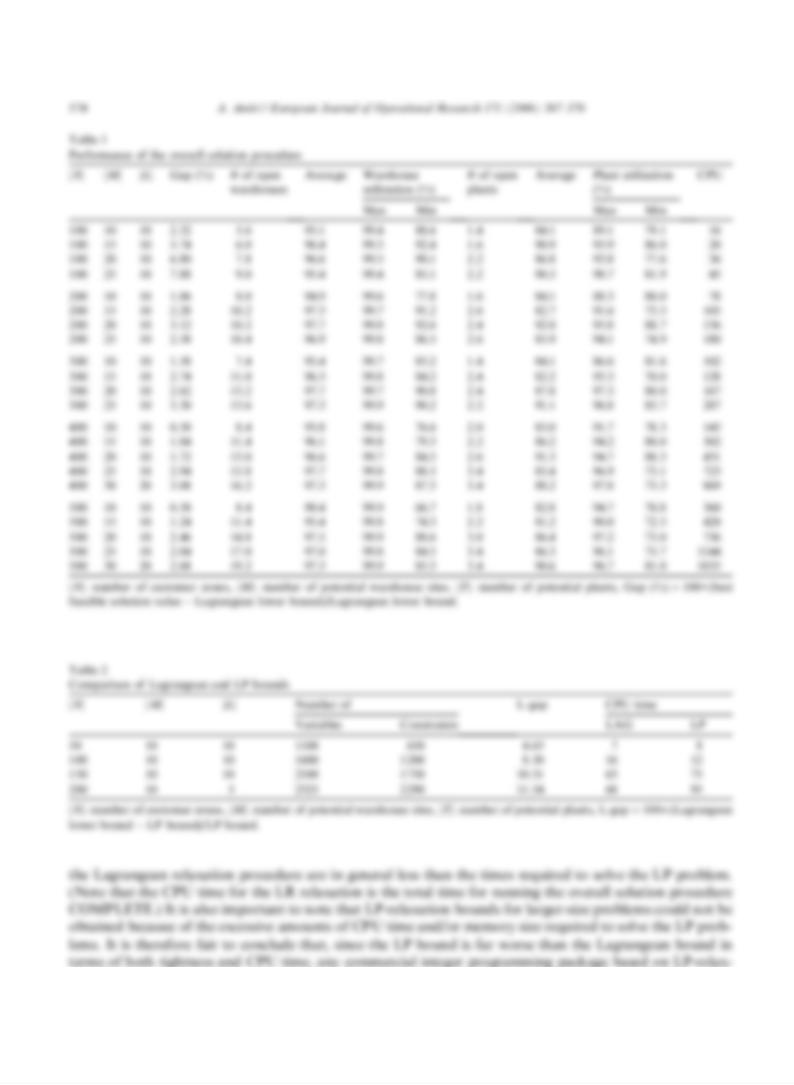
tested using problem instances with up to 100 customers, 20 potential warehouses and 10 potential plants.
Tragantalerngsak et al. [11] considered a two-echelon facility location problem in which the facilities in
the first echelon are uncapacitated and the facilities in the second echelon are capacitated. The goal is to
determine the number and locations of facilities in both echelons in order to satisfy customer demand of
the product. They developed a Lagrangean relaxation based branch and bound algorithm to solve the prob-
lem and reported results of computational tests with up to 100 customers and 15 facilities. Gourdin et al. [7]
studied a particular type of the uncapacitated facility location problem where two customers allocated to
the same facility are matched. They developed several methods to solve the problem after deriving valid
inequalities, and optimality cuts for the problem.
One major drawback in most of past research studies like [7–9,11] is that they limit the number of capac-
ity levels available to each facility to just one. However, as it is the case in practice, there exist usually sev-
eral capacity levels to choose from for each facility. The use of different capacity levels makes the problem
more realistic and, at the same time, more complex to solve. Another major drawback in some previous
studies like [8,9] is that they limit the number of facilities to open to a pre-specified value. Moreover, these
studies fail to describe how this value can be determined in advance.
Our current study represents a significant improvement over past research by presenting a unified model
of the problem that includes the numbers, locations, and capacities of both warehouses and plants as var-
iables to be determined in the model and develops at the same time the best strategy for distributing the
product from the plants to the warehouses and from the warehouses to the customers. An efficient heuristic
solution procedure based on Lagrangean relaxation of the problem is developed and extensive computa-
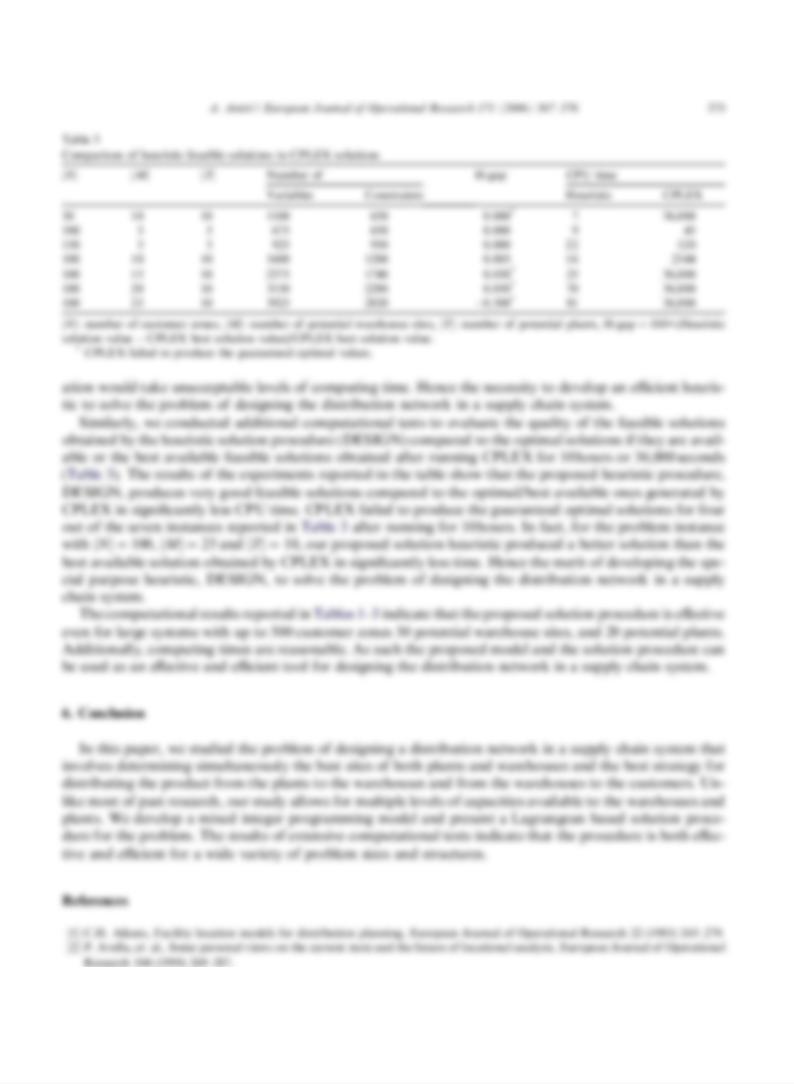
tional tests with up to 500 customers, 30 potential warehouses, and 20 potential plants are reported.
The remainder of this paper is organized as follows. In Section 2, a mathematical formulation of the dis-
tribution design problem is presented. A Lagrangean relaxation of the problem is proposed in Section 3. An
efficient solution algorithm based on this relaxation is developed in Section 4. Computational results are
reported in Section 5. A summary of the work presented in this paper is given in Section 6.
2. Model formulation
The following notation is used in the formulation of the model.
Nindex set of customers/customer zones
Mindex set of potential warehouse sites
Lindex set of potential plant sites
Rindex set of capacity levels available to the potential warehouses
568 A. Amiri / European Journal of Operational Research 171 (2006) 567–576

Hindex set of capacity levels available to the potential plants
C
ij
cost of supplying one unit of demand to customer zone ifrom warehouse at site j
Cjk cost of supplying one unit of demand to warehouse at site jfrom plant at site k
Fr
jfixed cost per unit of time for opening and operating warehouse with capacity level rat site j
Gh
kfixed cost per unit of time for opening and operating plant with capacity level hat site k
a
i
demand per unit of time of customer zone i
br
jcapacity with level rfor the potential warehouse at site j
eh
kcapacity with level hfor the potential plant at site k
The decision variables are:
X
ij
= fraction (regarding a
i
) of demand of customer zone idelivered from warehouse at site j
Yr
jk = fraction (regarding br
j) of shipment from plant at site kto warehouse at site jwith capacity level r
Ur
j=1 if a warehouse with capacity level ris located at site j
0 otherwise
Vh
k=1 if a plant with capacity level his located at site k
0 otherwise
In terms of the above notation, the problem can be formulated as follows.
Problem DistriNet:
Zp ¼Min X
i2NX
j2M
CijaiXij þX
r2RX
j2MX
k2L
Cjk br
jYr
jk
þX
j2MX
r2R
Fr
jUr
jþX
k2LX
h2H
Gh
kVh
kð1Þ
subject to
X
j2M
Xij ¼18i2N;ð2Þ
X
i2N
aiXij 6X
r2R
br
jUr
j8j2M;ð3Þ
X
r2R
Ur
j618j2M;ð4Þ
X
i2N
aiXij 6X
k2LX
r2R
br
jYr
jk 8j2M;ð5Þ
X
j2MX
r2R
br
jYr
jk 6X
h2H
eh
kVh
k8k2L;ð6Þ
X
h2H
Vh
k618k2L;ð7Þ
Xij P08i2Nand j2M;ð8Þ
Ur
j2ð0;1Þ8j2Mand r2R;ð9Þ
Yr
jk P08k2L;j2Mand r2R;ð10Þ
Vh
k2ð0;1Þ8k2Land h2H:ð11Þ
The model minimizes total costs made of: the costs to serve the demands of customers from the ware-
houses, the costs of shipments from the plants to the warehouses, and the costs associated with opening
and operating the warehouses and the plants. Constraint set (2) ensures that the demands of all customers
A. Amiri / European Journal of Operational Research 171 (2006) 567–576 569