Table of Contents
DEMAND AND SUPPLY ………………………………………………………………………………………………. 2
Introduction ………………………………………………………………………………………………………………… 2
Market economy ………………………………………………………………………………………………………. 2
History of the theory of demand and supply ………………………………………………………………… 2
LAW OF DEMAND ……………………………………………………………………………………………………. 3
Factors affecting demand …………………………………………………………………………………………… 4
Interrelationships of Demand …………………………………………………………………………………….. 6
Demand Elasticity…………………………………………………………………………………………………….. 7
LAW OF SUPPLY ………………………………………………………………………………………………………. 7
Exceptions ………………………………………………………………………………………………………………. 8
Factors affecting Supply……………………………………………………………………………………………….. 8
Supply Elasticity …………………………………………………………………………………………………….. 10
Relationship between demand and supply ………………………………………………………………….. 10
Disequilibrium ……………………………………………………………………………………………………….. 11
Conclusion …………………………………………………………………………………………………………….. 11
References ……………………………………………………………………………………………………………………. 13
DEMAND AND SUPPLY
Introduction
Demand and supply is one among the most fundamental concepts of economics. These
forces are the backbone of the market economy. Demand refers to the amount of goods and
services are desired by buyers at a certain time and price. The amount demanded is the amount of
good and services that buyers are willing to pay for the product at a particular time. On the other
hand, supply is the amount of good and services sellers are willing to sell at a particular time
(Surbhi, 2014). Supply is simply a how much good and services the market is willing to offer.
The relationship between the amount of good and services supplied and the price is referred to as
supply relationship. Correlation between price and demand is called demand relationship.
Therefore, price reflect the demand and supply. In economics, the two forces hold it that, holding
all other factors constant, the price of a commodity, service, liquid financial asset and labor will
always vary until the quality that is supplied is the same as the quantity demanded. This point is
referred to as the economic equilibrium.
Whenever supply is up the demand goes down and vice versa. These forces dictate the
amount of goods and service in the market. This is very important because resources will always
be scarce and will always have alternative uses.
Market economy
A market is a place or medium that allows buyers and sellers of specific commodities and
services to interact and facilitate exchange. Using this definition a market place can be either
physical or virtual. The latter has become more common with the increased integration of the
internet and business (Moffatt, 2018). A market is also a place where financial securities are
traded. Market is also referred to people with the ability and desire to buy commodities.
As a physical place, a market could be a bazaar, a store that sell individual items to
shopping centers selling in wholesale. This form of market is the most common especially
traditionally as the internet was not widely known or used. However, over the last decade, we
have seen more and more stores and market opened online (Cohen, 2011). In fact, online
presence has become a necessity. This increases the market reach of a business, which is meant
to bring more profits. For trade to take place there must be a transaction between a buyer and a
seller (Kenton, 2018). The transaction may involve exchange of currency, information, goods or
services. At times, it could be a combination.
The market works by establishing the rates of goods and services that are determined by
the sellers by creating supply and the buyers by creating demand. The market is the central place
for distribution of goods, services and resources in a society. Some emerge organically while
others may be created to facilitated transfer of ownership right of information, goods and
services (Richard, 2018). On regional level markets may be defined as developed or developing
depending on the factors such as region’s openness to trade and level of income of participants.
History of the theory of demand and supply
The laws of demand and supply were discovered long before they were published in
works. These laws are embedded in every aspect of life. Nature dictates that that which is in high
demand is more valuable than that which is in high supply (Smith, 2014). People view
themselves, as unique individual being, and will always demand that which is not common to
everybody else.
In 1776, in his publication ‘The wealth of Nation’ Adam Smith created the basis for
economic works. He is commonly referred to as the father of economics as he explained the
concept of demand and supply, terming the forces as the ‘invincible hands’ that control the
availability of commodities in the market (Investopedia, 2018). The definition of these two
forces has changed and has been refined numerous times after his publication. At first, these
forced seemed uncontrollable. However, it is until 1890 that Alfred Marshall, in his ‘Principles
of Economics’ publication that advanced the study by developing the demand and supply curves
that gave more insight of how the invisible hand work (Investopedia, 2018). He went on to
develop the concept of price elasticity that explains how the price of commodities change affect
demand. It was natural that when a product was highly demanded the high the price of the
product increased. However, he noted that the vice versa was not always true. There are some
instance where the price of a commodity increases without necessarily increasing its demand.
This meant that the price was inelastic. He conclude that price elasticity, cost of production, and
supply and demand of commodity all work together.
LAW OF DEMAND
The law states that, centris peribus that is holding all factors constant the quality or amount of
goods and services demanded by buyers in a market will always be inverse to the price. This
means that when the price of a commodity increased the quantity demanded in the market
reduces. This helps regulate how much the market can offer, as when the quantity demanded
lowers, an increase in price reduces the number of people who can afford it, increasing it
scarcity, thus the price will rise. The vice versa is also true, if the price of a commodity is low,
more people will have the purchasing power of the commodity, therefore many people will buy
it. This definition is center on the factor of price. There are many factors that affect demand but
price dictates the most. Graphically this can be represented as below.
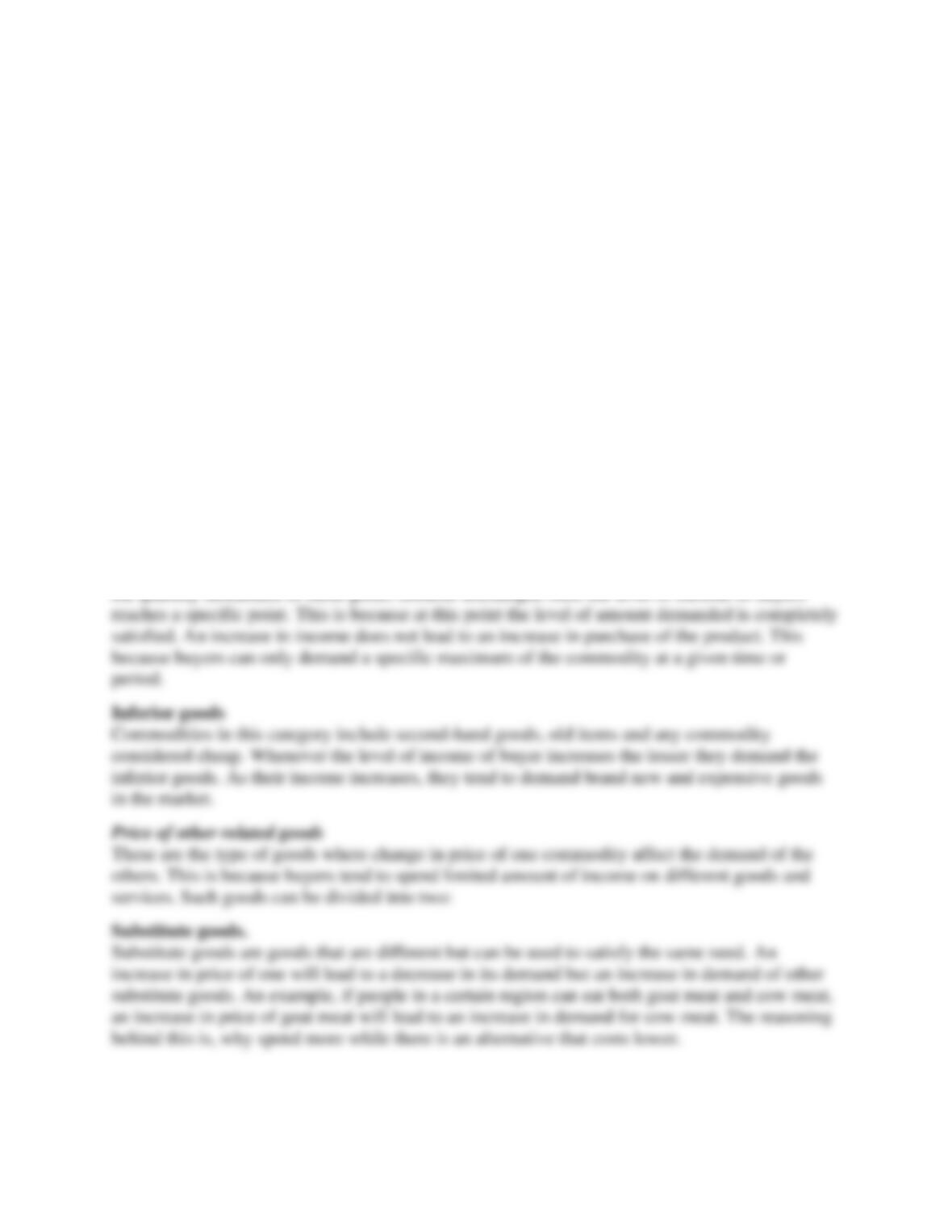
In the diagram, we get to see that when the price of tomatoes is at A, that is 4, 200 units of
tomatoes are demanded. However when the price is at B, that is 2, 600 units of the tomatoes will
be demanded. Price dictates how many people can afford a commodity. The lower the price the
more quantity that people can afford to purchase (Surbhi, 2014). However, as the price reduces it
means that most buyers in the market can buy the product. One of the characteristics of resources
is scarcity. It reaches a point where the price cannot go down any further as the quantity bought
by buyers exceeds that which that can be supplied. This is where supply comes in to equalize the
quantity available and the price offered in the market.
Factors affecting demand
Income
The income level of buyer affects their purchasing power. Whenever the income is high, it mean
that they can afford a higher quantity of a commodity (Agarwal, 2018). This is because the
buyers are willing to spend more for a commodity at a given time. However, the effect of income
depend on the type of product or service considered
Normal goods
Most of the goods that are readily available in the market are classified as normal or superior
goods. The consumer tends to buy more of these goods when the price lowers and less of them
when the price goes high. An increase in income lead to an increase in demand and vice versa.
Goods that are subject to satiation
Goods such as writing ink and salt tend to follow a different kind of demand. It is observed that