OLIGOPOLY: DECISION-MAKING WITH
MUTUAL INDEPENDENCE
INTENDED LEARNING OUTCOMES
1. Solve the maximum profit under cartel agreement.
2. Analyze and state the situation of the different cooperative oligopoly behavior.
3. Describe price leadership.
4. Explain the importance of analyzing oligopolistic behaviour of firms to managerial decision-making.
5. Analyze prisoner’s dilemma and its application to oligopoly.
In the previous two modules, we focused on perfect competition and pure monopoly, the polar
cases of market structure. However, many markets occupy positions between these extremes; that is,
they are dominated by neither a single firm nor a plethora of firms. Oligopoly is the general category
describing markets or industries that consist of a small number of firms. Because of oligopoly’s
importance and because no single model captures the many implications of firm behavior within
oligopoly, we devote the entire chapter to this topic.
A firm within an oligopoly faces the following basic question: How can it determine a profit–
maximizing course of action when it competes against an identifiable number of competitors similar to
itself? This chapter and the succeeding chapter on game theory answer this question by introducing and
analyzing competitive strategies. Thus, we depart from the approach taken previously where the main
focus was on a “single” firm facing rivals whose actions are predictable and unchanging. In crafting a
competitive strategy, a firm’s management must anticipate a range of competitor actions and be
prepared to respond accordingly. Competitive strategy finds its most important applications within
oligopoly settings. By contrast, in a pure monopoly, there are no immediate competitors to worry about.
In pure competition, an individual firm’s competitive options are strictly limited. Industry price and
output are set by supply and demand, and the firm is destined to earn a zero profit in the long run.
OLIGOPOLY
An oligopoly is a market dominated by a small number of firms, whose actions directly affect
one another’s profits. In this sense, the fates of oligopoly firms are interdependent. To begin, it is useful
to size up an oligopolistic industry along a number of important economic dimensions.
Five-Forces Framework
Figure 9.1 provides a summary of the Five–Forces framework. The core of Porter’s analysis
centers on internal industry rivalry: the set of major firms competing in the market and how they
compete. Naturally, the number of close rivals, their relative size, position, and power, are crucial.
9
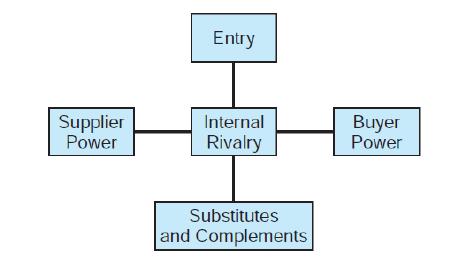
Figure 9.1 The Five-Forces Framework
INDUSTRY CONCENTRATION
Concentration ratios measures the combined market share percentage of the ith leading firms,
𝐂𝐑𝐢=∑𝐗𝐢. The four-firm concentration ratio is the percentage of sales accounted for by the top four
firms in a market or industry. (Eight-firm and twenty-firm ratios are defined analogously.) Concentration
ratios can be computed from publicly available market-share information. The higher the concentration
ratio, the greater is the degree of market dominance by a small number of firms. A common practice is
to distinguish among different market structures by degree of concentration.
• Example:
• Effective Monopoly (CR1 > 90%)
• Effective Competitive (CR4 < 40%)
• Loose Oligopoly or Monopolistic Competition (40% < CR4 < 60%)
• Tight Oligopoly (90% > CR4 > 60%)
• Using a concentration ratio is not the only way to measure market dominance by a small
number of firms.
• An alternative and widely used measure is the Herfindahl-Hirschman Index (HHI), defined as
the sum of the squared market shares of all firms:
𝐇𝐇𝐈 = ∑𝒔𝒏
𝟐=𝒔𝟏
𝟐+𝒔𝟐
𝟐+⋯+𝒔𝒏
𝟐
where sn = market share of nth firm
For instance, if a market is supplied by five firms with market shares of 40, 30, 16, 10, and 4 percent,
respectively.
HHI = 402 + 302 + 162 + 102 + 42 = 2,872
• HHI = 10,000 for pure monopolist
• HHI ≈ 0 for perfectly competitive firms
• If a market is shared equally by n firms, HHI is the n-fold sum of (100/n)2 = 10,000/n.
The Herfindahl-Hirschman Index has a number of noteworthy properties:
1. The index counts the market shares of all firms, not merely the top four or eight.
2. The more unequal the market shares of a collection of firms, the greater is the index because
shares are squared.
3. Other things being equal, the more numerous the firms, the lower is the index.
• Because of these properties, the HHI has advantages over concentration ratios;
Concentration and Prices
• Concentration is an important factor affecting pricing and profitability within markets.
• Increases in concentration can be expected to be associated with increased prices and profits,
other things being equal.
• Low concentration leads to minimum prices and zero profits like pure competition.
• High concentration leads to higher prices and excess profits like pure monopoly.
STACKELBERG OLIGOPOLY
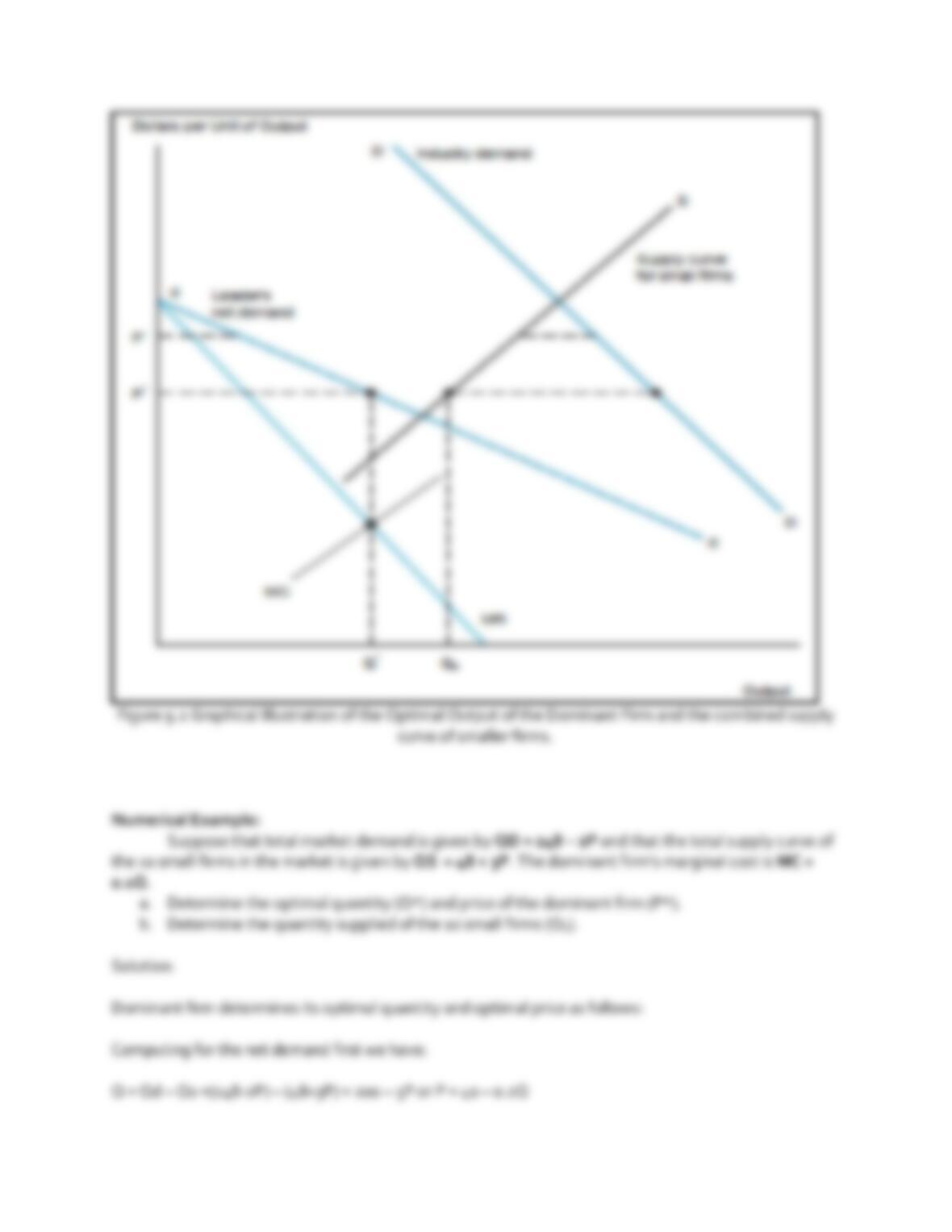
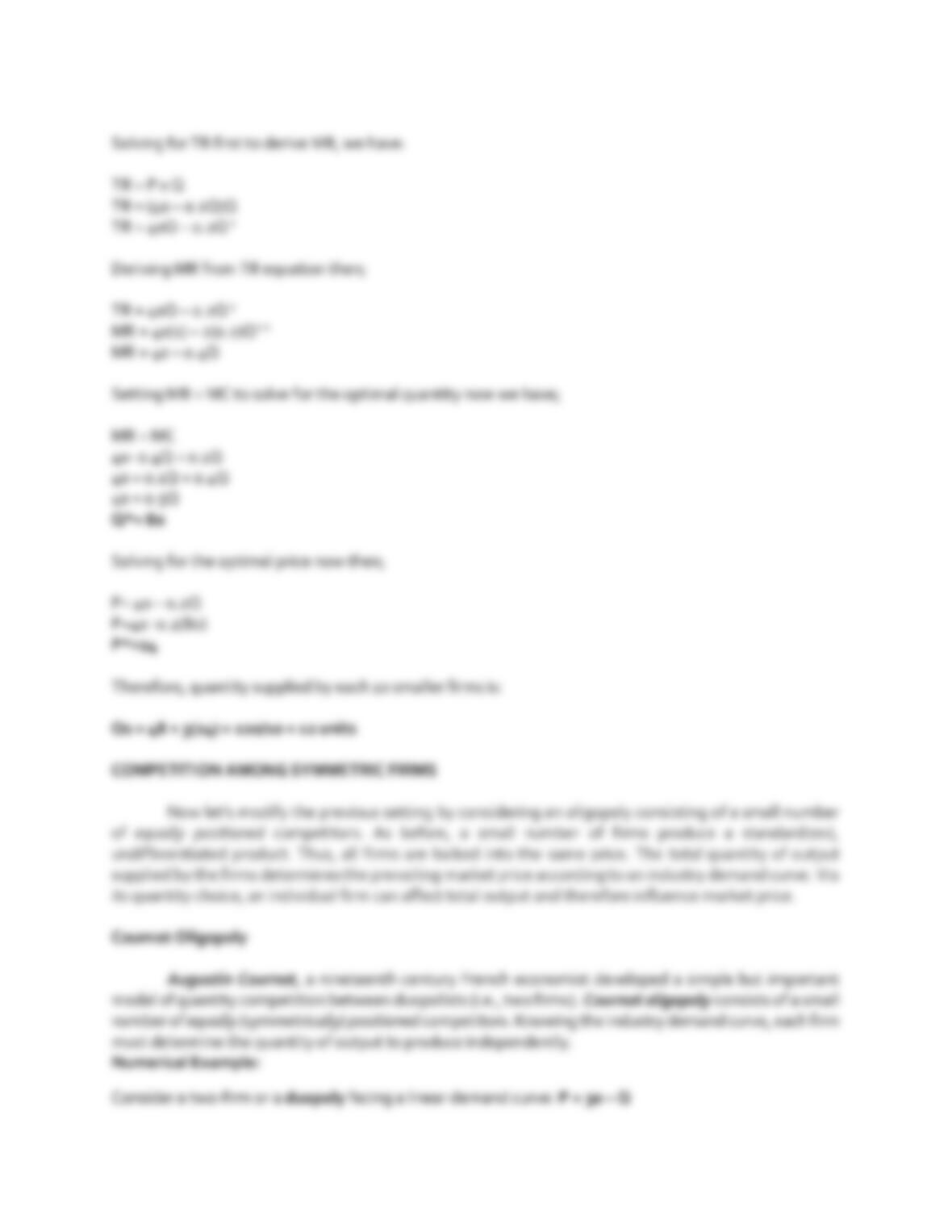
Price leadership means that one firm possesses a dominant market share and acts as a leader by
setting price for the industry.
– Examples: General Motors (automobile), eBay (online auctions), Federal Express
(overnight delivery), Microsoft (PC software), to name just a few.
• This method was formulated by the German economist Prof. Heinrichvon Stackelberg.
• This is also known as leadership solution or followership solution.
Three important cases of price leadership:
1. Price Leadership by a Low-Cost Firm, and
2. Price Leadership by a Dominant Firm.
3. The Barometric Price Leadership Model
• In the low-cost price leadership model, an oligopolistic firm having lower costs than the other
firms sets a lower price which the other firms have to follow. Thus the low-cost firm becomes the
price leader.
• The barometric price leadership, there is no leader firm as such but one firm among the