ISSN 1330-7142
UDK = 631.368
DECISION MAKING UNDER CONDITIONS OF UNCERTAINTY IN
AGRICULTURE: A CASE STUDY OF OIL CROPS
Karmen Pažek, Č. Rozman
Original scientific paper
Izvorni znanstveni članak
SUMMARY
In decision under uncertainty individual decision makers (farmers) have to choose one of a set number of
alternatives with complete information about their outcomes but in the absence of any information or data
about the probabilities of the various state of nature. This paper examines a decision making under
uncertainty in agriculture. The classical approaches of Wald’s, Hurwicz’s, Maximax, Savage’s and Laplace’s
are discussed and compared in case study of oil pumpkin production and selling of pumpkin oil. The
computational complexity and usefulness of the criterion are further presented. The article is concluded with
aggregate the results of all observed criteria and business alternatives in the conditions of uncertainty, where
the business alternative 1 is suggested.
Key-words: uncertainty, Wald’s, Hurwicz’s, Maximax, Savage’s and Laplace’s criterion, decision support
system, agriculture
INTRODUCTION
Typically, personal and professional decisions can be made with some difficulty. Either the best
course of action is clear or the varieties of the decision are not significant enough to require a great
amount of attention. Occasionally, decisions arise where the path is not clear and it is necessary to
take substantial time and effort in devising a systematic method of analyzing the various courses of
action. With decisions under uncertainty, the decision maker should:
1. Take an inventory of all viable options available for gathering information, for experimentation
and for action
2. List all events that may occur
3. Arrange all pertinent information and choices/assumptions made
4. Rank the consequences resulting from the various courses of action
5. Determine the probability of an uncertain event occurring.
Upon systematically describing the problem and recording all necessary data, judgments, and
preferences, the decision maker should synthesize the information set before using the most
appropriate decision rules. Decision rules prescribe how an individual faced with a decision under
uncertainty should go about choosing a course of action consistent with the individual’s basic
judgments and preferences
(http://terpconnect.umd.edu/~sandborn/courses/808S_projects/reynolds.html).
When a decision maker should choose one possible actions, the ultimate consequences of some, if not
all of these actions will generally depend on uncertain events and future actions extending indefinitely
far into the future. The uncertainty is specially expressed in agriculture. Sahin et al. (2008) determine
the cattle fattening breed, which maximizes the net profit for the producers under risk and
uncertainties. The Wald’s, Hurwicz’s, Maximax, Savage’s, Laplace’s and Utility criterions were used.
On the other hand the decision on which crops to include in crop rotation is one of the most important
decisions in field crop farm management. Agronomic, economic
_______________
DSc. Karmen Pažek. Assist. Prof. and DSc. Črtomir Rozman, Assist. Prof. – University of Maribor, Faculty of
Agriculture and Life Sciences, Pivola 10, 2311 Hoče, Slovenia; e-mail: karmen.pazek@uni-mb.si
and market information about each individual crop constitutes an informative basis for decision–
making. There is a significant amount of valuable agronomic and market information already available
on main crop production, including oil crops (Rozman et al., 2006). However, the potential for a wider
range of alternative crops, including oil pumpkin (Bavec and Bavec, 2006), should be evaluated in
order to determine their break-crop characteristics and the benefits and challenges which they bring to
systems (Robson et al., 2002). According to Lampkin and Measures (1999), the economics of oil
pumpkin depends on market price, therefore enquires with potential buyers should be undertaken.
However, recent farm management research has also shown oil pumpkin production can be financially
feasible assuming that the pumpkin oil can be successfully sold. Pažek (2003) and Pažek et al. (2005)
conducted a financial and economical analysis of farm product processing on Slovene farms using a
simulation – modelling approach that included also pumpkin oil production. In agriculture there is a
lack of studies that observe the application of criteria in the situation under uncertainness. From this
reason in the paper five decision rules (criteria) commonly used in decision process under uncertainty
were presented and applied in the case study of production and processing of oil pumpkin:
Wald’s Maximin criterion
Hurwicz’s criterion
Maximax criterion
Savage’s minimax regret criterion
Laplace’s insufficient reason criterion.
The paper is organized as follows; in the first part the methodology and theoretical background of the
decision rules (criteria) is presented. In the second part of the paper the application of observed
decision rules were presented on the example in agriculture; pumpkin oil processing (considering
production area and specific selling presumption by pumpkin oil marketing). The paper is concluded
with results by the observed criteria in the conditions of uncertainty in agriculture.
METHODOLOGY
Decision analysis is a systematic approach by decision making that allows managers to solve problems
with uncertainty figures as a prominent factor. A normative model is developed to represent the
decision making problem, facilitate logical analysis, and produce a recommended course of action.
The technique is most useful in managerial situations where risk is significant. The resulting formal
model is capable of generating optimal strategies for multi-stage decision making problems that
involve a variety of contingencies.
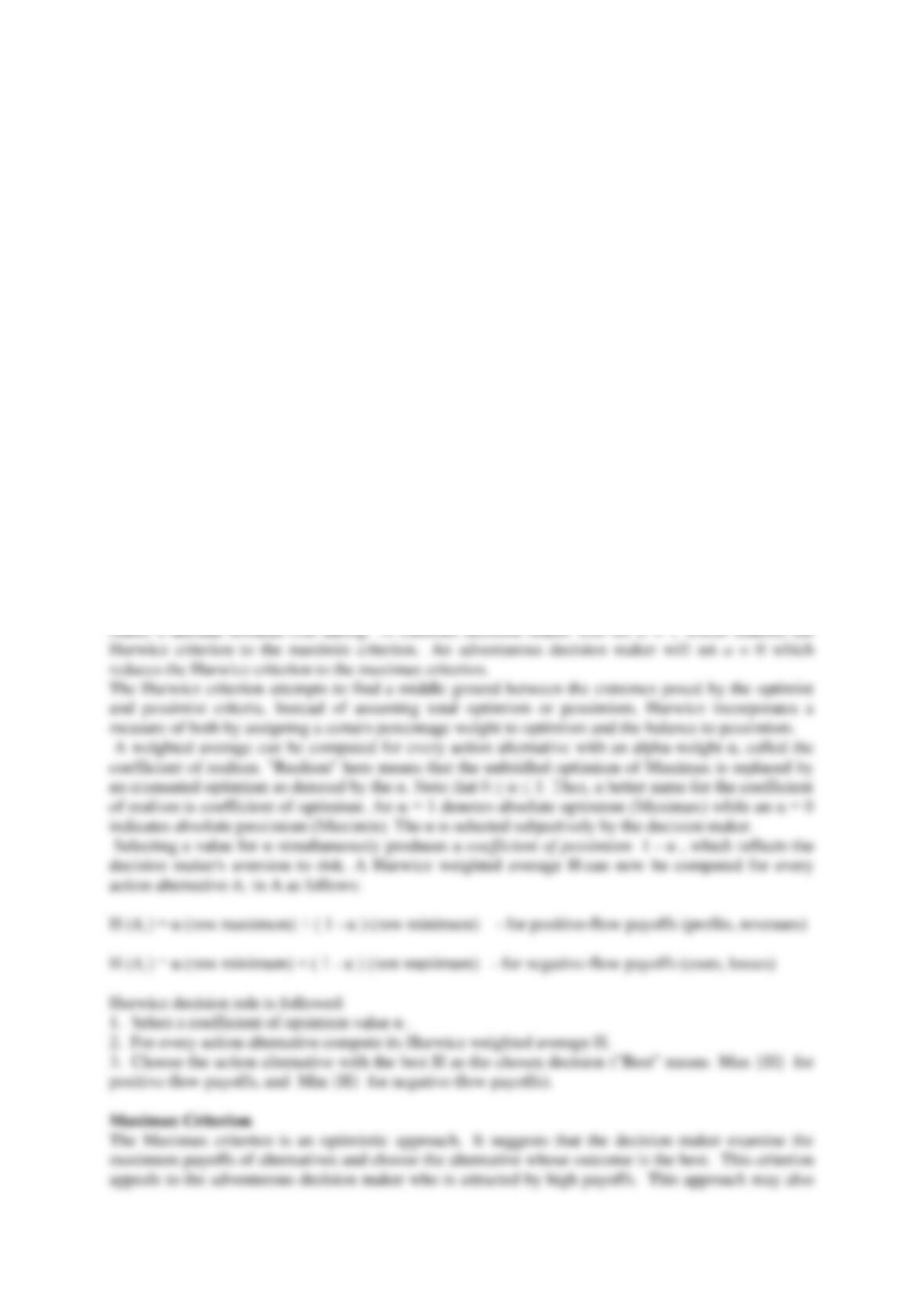
Thus, the payoff (or decision) matrix M = { A , S , R , P } formally defines a decision analysis
problem.
Where:
A – the set of decision alternatives Ai (for i = 1, 2, …, m )
S – the set of events Sj (for j = 1, 2, …, n )
R – the set of payoffs (rewards) Rij obtained by choosing alternative Ai if state Sj occurs
P – the probability distribution applicable to S (the set of probabilities pj describing the
likelihood that state Sj will occur).
However, in the early 1950s, the discussion about criteria for decision making was lively. Several
decision criteria have been proposed to resolve the problem of decision making under strict
uncertainty. Some of the most important ones are furthermore presented.
Wald’s Maximin Criterion
The decision-theoretic view of statistics advanced by Wald had an obvious interpretation in terms of
decision-making under complete ignorance, in which the maximin strategy was shown to be a best
response against natures’ minimax strategy. Wald’s criterion is extremely conservative even in a
context of complete ignorance, though ultra-conservatism may sometimes make good sense (Wen and
Iwamura, 2008). The Maximin criterion is a pessimistic approach. It suggests that the decision maker
examines only the minimum payoffs of alternatives and chooses the alternative whose outcome is the
least bad. This criterion appeals to the cautious decision maker who seeks ensurance that in the event
of an unfavourable outcome, there is at least a known minimum payoff. This approach may be
justified because the minimum payoffs may have a higher probability of occurrence or the lowest
payoff may lead to an extremely unfavourable outcome
(http://terpconnect.umd.edu/~sandborn/courses/808S_projects/reynolds.html).
Hurwicz’s Optimism – Pessimism Criterion
The most well-known criterion is the Hurwicz criterion, suggested by Leonid Hurwicz in 1951, which
selects the minimum and the maximum payoff to each given action x. The Hurwicz criterion attempts
to find a middle ground between the extremes posed by the optimist and pessimist criteria. Instead of
assuming total optimism or pessimism, Hurwicz incorporates a measure of both by assigning a certain
percentage weight to optimism and the balance to pessimism. However, this approach attempts to
strike a balance between the maximax and maximin criteria. It suggests that the minimum and
maximum of each strategy should be averaged using a and 1 – a as weights. a represents the index of
pessimism and the alternative with the highest average selected. The index a reflects the decision