SEM206: Statistics for Business
Lecture 1
Data and Statistics
Khondker Aktaruzzaman
khondker.aktaruzzaman@xmu.edu.my
Chapter 1 – Data and Statistics
Statistics
Applications in Business and Economics
Data
Data Sources
Descriptive Statistics
Statistical Inference
Analytics
Big Data and Data Mining
Computers and Statistical Analysis
Ethical Guidelines for Statistical Practice
What is Statistics?
The term statistics can refer to numerical facts such as
averages, medians, percentages, and maximums that help
us understand a variety of business and economic
situations.
Statistics can also refer to the art and science of collecting,
analyzing, presenting, and interpreting data.
Applications in Business and Economics
Accounting
Public accounting firms use statistical sampling procedures
when conducting audits for their clients.
Economics
Economists use statistical information in making forecasts
about the future of the economy or some aspect of it.
Finance
Financial advisors use price-earnings ratios and dividend yields
to guide their investment advice.
Applications in Business and Economics
Marketing
Electronic point-of-sale scanners at retail checkout counters
are used to collect data for a variety of marketing research
applications.
Production
A variety of statistical quality control charts are used to
monitor the output of a production process.
Information Systems
A variety of statistical information helps administrators assess
the performance of computer networks.
Data and Data Sets
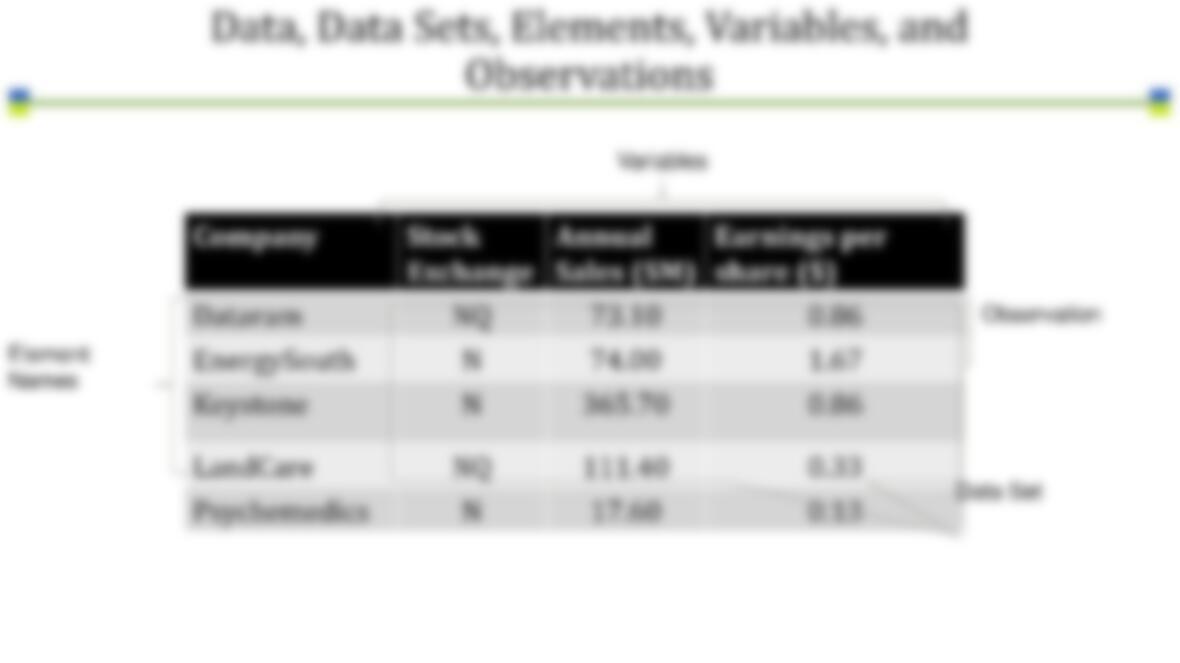
Data are the facts and figures collected, analyzed, and
summarized for presentation and interpretation.
All the data collected in a particular study are referred to as
the data set for the study.
Elements, Variables, and Observations
Elements are the entities on which data are collected.
A variable is a characteristic of interest for the elements.
The set of measurements obtained for a particular element