3-20 (20 min.) CVP exercises.
1a. [Units sold (Selling price – Variable costs)] – Fixed costs = Operating income
[5,000,000 ($0.50 – $0.30)] – $900,000 = $100,000
1b. Fixed costs ÷ Contribution margin per unit = Breakeven units
$900,000 ÷ [($0.50 – $0.30)] = 4,500,000 units
Breakeven units × Selling price = Breakeven revenues
4,500,000 units × $0.50 per unit = $2,250,000
or,
Contribution margin ratio =
price Selling
costs Variable price Selling –
=
$0.50
$0.30 – $0.50
= 0.40
Fixed costs ÷ Contribution margin ratio = Breakeven revenues
$900,000 ÷ 0.40 = $2,250,000
2.
5,000,000 ($0.50 – $0.34) – $900,000
=
$ (100,000)
3.
[5,000,000 (1.1) ($0.50 – $0.30)] – [$900,000 (1.1)]
=
$ 110,000
4.
[5,000,000 (1.4) ($0.40 – $0.27)] – [$900,000 (0.8)]
=
$ 190,000
5.
$900,000 (1.1) ÷ ($0.50 – $0.30)
=
4,950,000 units
6.
($900,000 + $20,000) ÷ ($0.55 – $0.30)
=
3,680,000 units
3-21 (10 min.) CVP analysis, income taxes.
1. Monthly fixed costs = $48,200 + $68,000 + $13,000 = $129,200
Contribution margin per unit = $27,000 – $23,000 – $600 = $ 3,400
Breakeven units per month =
Monthly fixed costs
Contribution margin per unit
=
$129,200
$3,400 per car
= 38 cars
2. Tax rate 40%
Target net income $51,000
Target operating income =
Target net income $51,000 $51,000
1 tax rate (1 0.40) 0.60
= = =
−−
$85,000
Quantity of output units
required to be sold
=
Fixed costs + Target operating income $129,200 $85,000
Contribution margin per unit $3,400
+
==
63 cars

3-22 (20–25 min.) CVP analysis, income taxes.
1. Variable cost percentage is $3.80 $9.50 = 40%
Let R = Revenues needed to obtain target net income
R – 0.40R – $456,000 =
$159,600
1 0.30−
0.60R = $456,000 + $228,000
R = $684,000 0.60
R = $1,140,000
or,
Fixed costs + Target operating income
Target revenues Contribution margin percentage
=
Target net income $159,600
Fixed costs + $456,000
1 Tax rate 1 0.30
Target revenues $1,140,000
Contribution margin percentage 0.60
+
−−
= = =
Proof: Revenues $1,140,000
Variable costs (at 40%) 456,000
Contribution margin 684,000
Fixed costs 456,000
Operating income 228,000
Income taxes (at 30%) 68,400
Net income $ 159,600
2.a. Customers needed to break even:
Contribution margin per customer = $9.50 – $3.80 = $5.70
Breakeven number of customers = Fixed costs Contribution margin per customer
= $456,000 $5.70 per customer
= 80,000 customers
2.b. Customers needed to earn net income of $159,600:
Total revenues Sales check per customer
$1,140,000 $9.50 = 120,000 customers
3. Using the shortcut approach:
Change in net income =
( )
Change in Unit
number of contribution 1 Tax rate
customers margin
−
= (145,000 – 120,000) $5.70 (1 – 0.30)
= $142,500 0.7 = $99,750
New net income = $99,750 + $159,600 = $259,350
Alternatively, with 145,000 customers,
Operating income = Number of customers Selling price per customer
– Number of customers Variable cost per customer – Fixed costs
= 145,000 $9.50 – 145,000 $3.80 – $456,000 = $370,500
Net income = Operating income × (1 – Tax rate) = $370,500 × 0.70 = $259,350
The alternative approach is:
Revenues, 145,000 $9.50 $1,377,500
Variable costs at 40% 551,000
Contribution margin 826,500
Fixed costs 456,000
Operating income 370,500
Income tax at 30% 111,150
Net income $ 259,350
3-23 CVP analysis, sensitivity analysis.
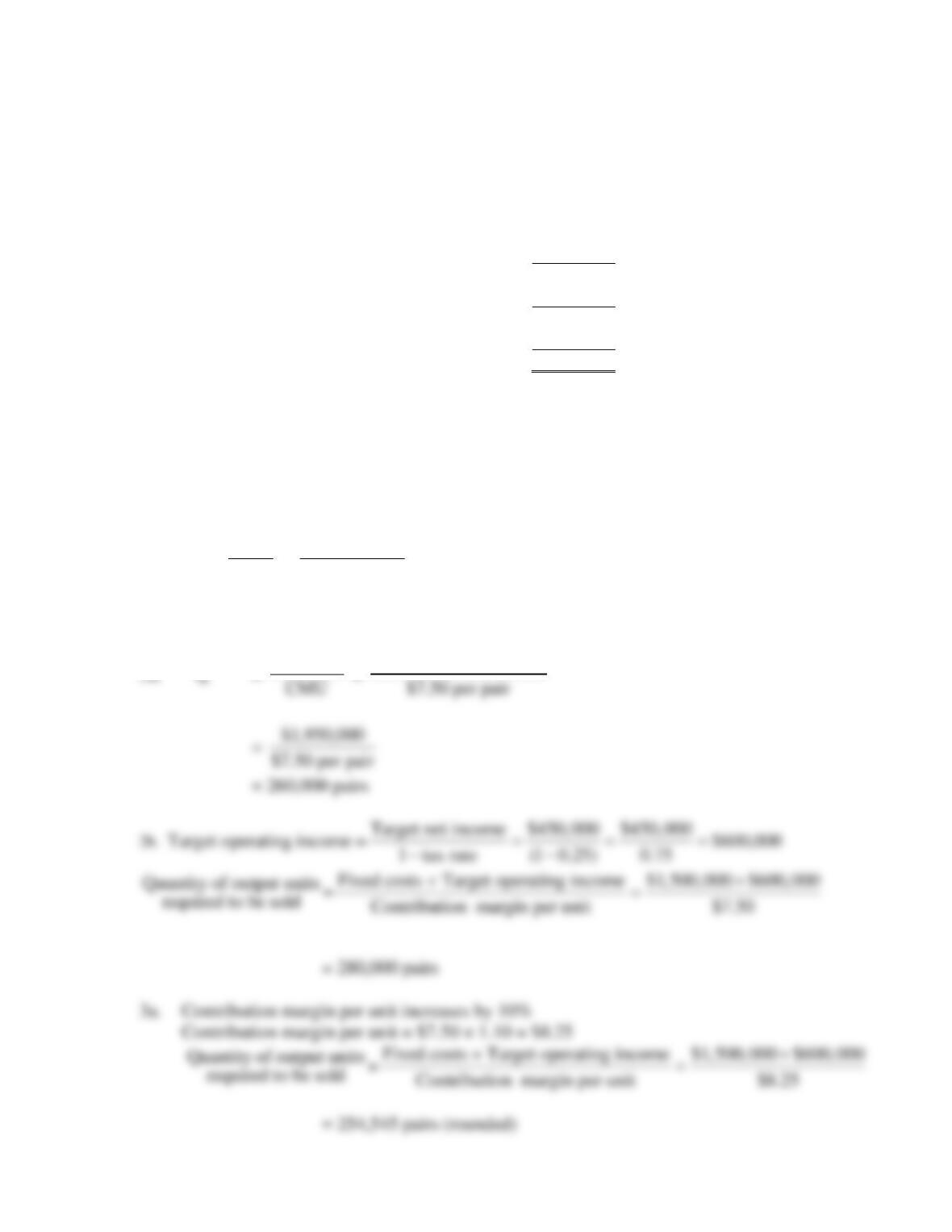
1. CMU = $30−$21−(0.05 × $30) = $7.50
Q =
CMU
FC
=
$1,500,000
$7.50 per pair
= 200,000 pairs
Note: No income taxes are paid at the breakeven point because operating income is $0.
TOI FC +
$1,500,000 $450,000
+
$1,950,000
$7.50 per pair