1
Customer Relationship Management
Starbucks, Neiman Marcus, and Zappos.com
The following document is a research paper I created in my first year at the Fashion Institute of
Design and Merchandising in my Merchandise Strategies course. The assignment I was given
was to choose three retailers that exceptionally use Customer Relationship Management
programs. The three retailers I believe successfully implement CRM programs are Starbucks,
Neiman Marcus, and of course, Zappos.
Alisa Rifredi
Professor Wallace
Merchandising Strategies, Section 17022
30 October 2013

2
Customer Relationship Management
In order for a company specified in retailing and human services to become successful,
they must understand that it is fundamental to manage a relationship with its customers. This
idea is called Customer Relationship Management (CRM). Customer Relationship Management
is properly defined as “a business philosophy and set of strategies, programs, and systems that
focuses on identifying and building loyalty with a retailer’s most valued customers (Levy and
Weitz 275).” More specifically, a company must not just build a relationship with any customer
that has partaken in their service or purchased their product, but to instead focus on building a
strong relationship with its most valuable customers. This idea can be applied when putting into
consideration the 80-20 rule, which indicates that 80% of a retailer’s profits come from 20% of
its customers (Levy and Weitz 285). A company then focuses on building its CRM programs
around the wants and needs of its most profitable and valued customers.
A business can increase its CRM programs through a four-step process that transfers a
customer’s data into customer loyalty called the CRM Process Cycle (Levy and Weitz 277). Step
one involves collecting customer data; this can be done through transactions and surveys that
record demographics, psychographics, customer preferences, and contacts through the consent of
the consumer. Step two is focused on analyzing the data and identifying specific target customers
that correspond to the offerings of the company. A company uses CLV (Customer Lifetime
Value) to determine the value of a customer throughout the lifetime of the relationship with the
company. The customer pyramid is used to then define which customers are the most and least
valuable to the company. The most valuable customers who bring in the most profit are
considered Platinum and Gold level customers. The least profitable customers are considered
Lead and Iron level customers who tend to bring in more deficits for the business (Levy and
Weitz 285). Step three includes developing customer relationship management programs to help

3
compete with retailers who have the same target market. A few programs that can increase a
company’s CRM include frequent-shopper programs, loyalty programs, and private-label credit
cards. The fourth and final step is implementing the customer relationship management
programs. These four steps transfer the learning phase (steps one and two) to the action phase
(steps two and three). In the following pages I will include these four steps in each of my three
chosen retailers and how they choose to include these programs in their businesses.
Starbucks
According to Hoovers.com, Starbucks is the number one coffee retailer in the world,
owning more than 18,000 coffee shops in sixty countries. Starbucks has attained this spot by
finding the importance in customer value and has implemented policies and programs that focus
on growing a relationship with its best customers.
CRM Program
The most popular and effective program Starbucks has used to separate its regular
customers from its most profitable ones is the “My Starbucks Rewards” system. Starbucks has
developed this CRM program that give special perks for its frequent customers and “Starbucks
lovers.”
How it works; Starbucks customers are able to sign up for a Rewards card one of three
different ways:
1. Register a Starbucks card (inc. Teavana cards)
Starbucks cards can be registered online and also acquired from any Starbucks location.
2. Enter a Star Code
Star codes are printed on selected Starbucks products and can be entered in online
3. Download the Starbucks app
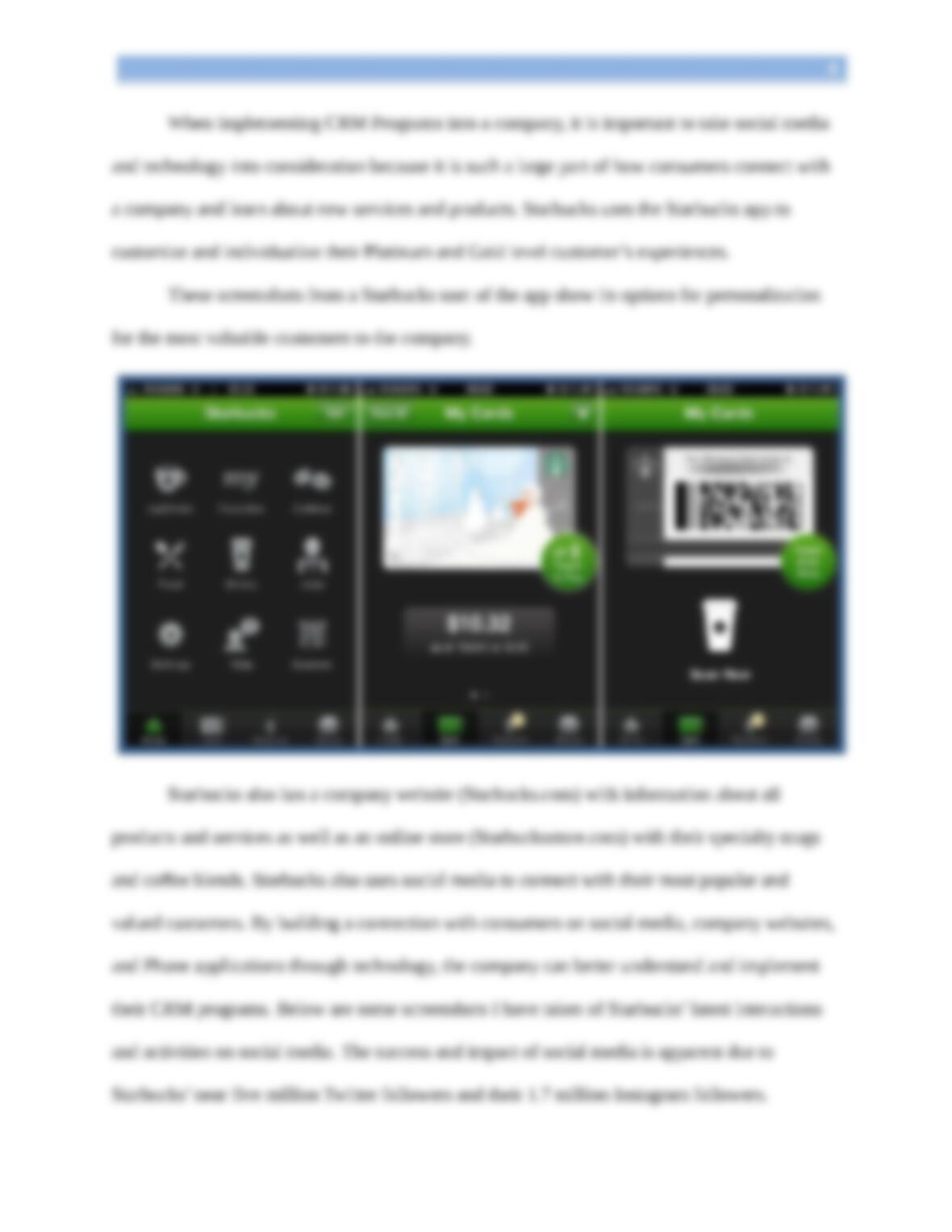
The Starbucks app can be downloaded on the iPhone or Android. The app can be used to
pay with the card, check the balance, reload the card and collect rewards.
Once a customer has a Starbucks “My Rewards” card they can make purchases with the card and
earn many benefits depending on the frequency use and purchase amount. Benefits are earned
through “stars,” which can be received by making purchases with a rewards card at any
4
Starbucks, Teavana, or Evolution Fresh store location. Once a customer earns a certain amount of
stars, they reach a new level with new benefits.
There are three different reward levels:
The Welcome Level – The welcome level is the lowest level of the rewards system.
Zero stars are needed to reach this level; the only requirement for the welcome level is
registration through one of the three steps previously mentioned.
Benefits:
Free complementary drink on one’s birthday
One 15% off coupon from a purchase on StarbucksStore.com
The Green Level – The green level is the second level of the rewards system. Five stars
are required to reach this level.
Benefits:
All benefits of the Welcome level
Free refills on one’s drink at any participating Starbucks and Teavana stores
The Gold Level – The gold level is the last and highest level of the rewards system. An
accumulation of thirty stars within twelve months is required to reach the gold level. In order to
sustain the Gold level membership the following year, customers must accumulate another thirty
stars within those twelve months.
Benefits:
Those of the Welcome and Green Levels
A free drink or food item every 12 stars
A Personalized Gold Card that lets the barista know the customer is a V.I.P.
Specialized coupons and offers via email or text message (opt in requirement)
This rewards system is extremely effective in keeping customers coming and deciding who is a
valuable customer. Starbucks uses this CRM Program to analyze customer frequency and
5
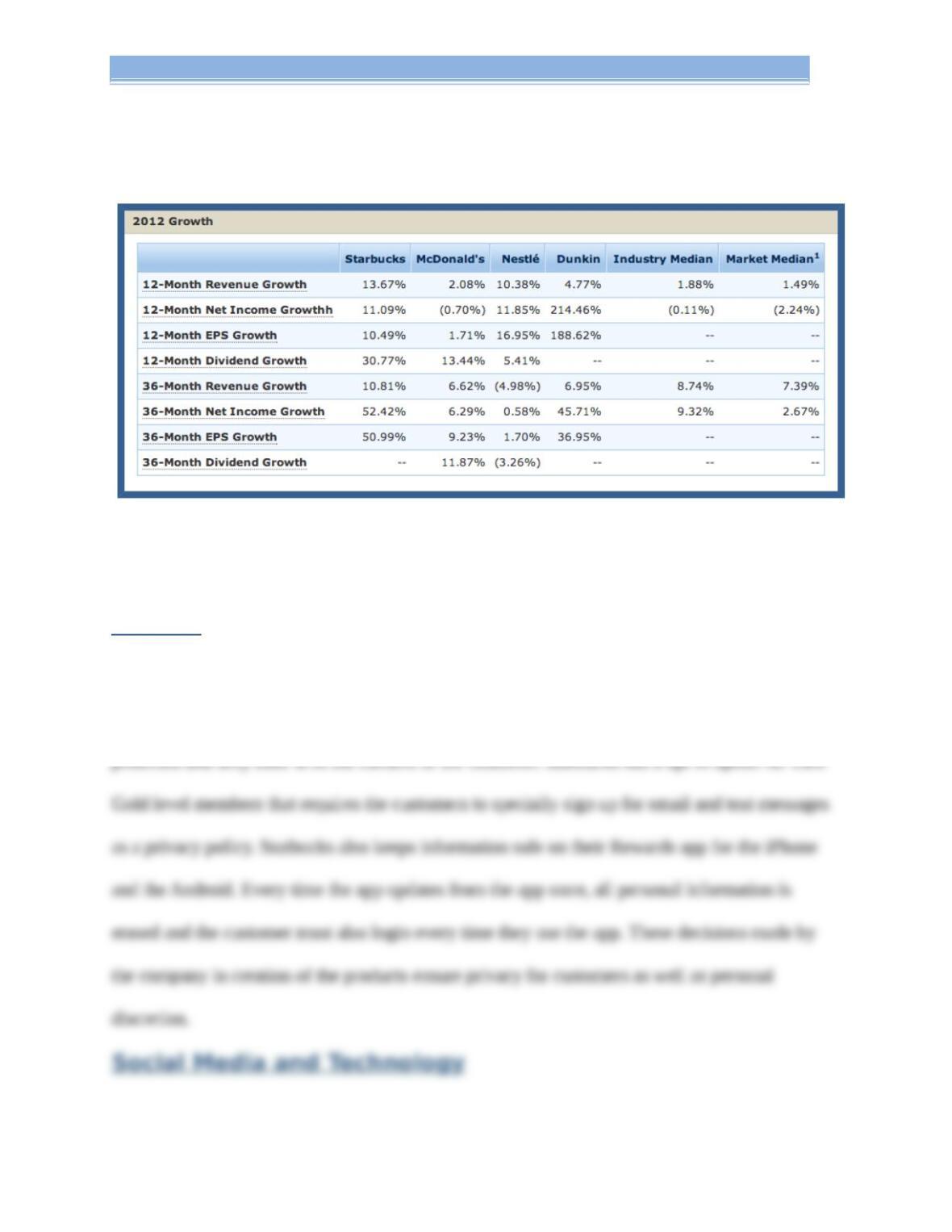
identify which customers have the largest customer lifetime value (CLV). Hoovers.com provides
the success of this program in a table format and comparison to Starbucks’ competitors in 2012.
As shown in the table, from Hoovers.com, Starbucks had the largest growth revenue over any of
its competitors throughout the year of 2012.
Privacy
With the privacy concerns that come with analysis and identification of a consumer’s
personal information, Starbucks takes steps to ensure that their customer’s information is