SUBJECT: Customer Lifetime Value Memo
This memo will discuss the components of customer lifetime value along with why it is
important and how companies can benefit from using it in their marketing strategies. A
consumer will often measure a product’s price vs. (perceived) benefit to decide if it’s worth
buying. The same basic concept applies to an effective profitability metric used in marketing
called customer lifetime value (CLV). This marketing tool refers to the delegation of monetary
value to the lifetime of a customer, i.e., weighted net profit generated throughout a customer’s
lifetime.
Components of Customer Lifetime Value
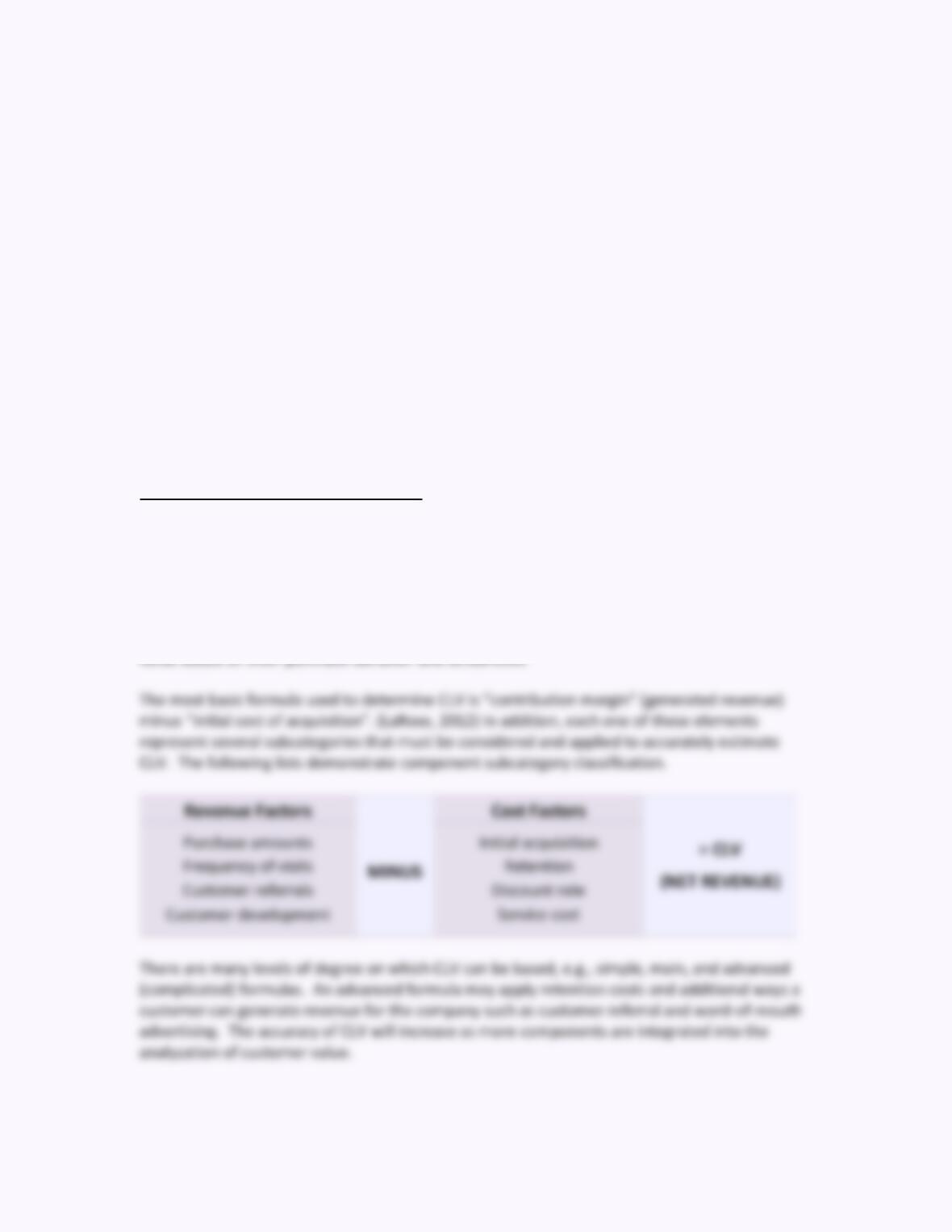
Simply put, the primary objective of CLV is to determine how profitable a consumer will be over
the course of their lifetime with the company. Several factors are considered such as patterns
of behavior based on frequency (recency) of visits and amount spent during each encounter.
Other factors considered in this equation include the length of a customer’s relationship with the
company, likelihood of a continued relationship, and cost(s) of their initial acquisition. Historic
customer data is used to establish current CLV, and more importantly, predict the future lifetime
TO:
Professor Williams
FROM:
Amber Cary
DATE:
November 10, 2017