CURRENCY RISK MANAGEMENT
Currency Risk Management
1. Look at 2 detailed examples of using a Future/Forward contract to
hedged your investment return
2. Discuss the impact of hedge ratios
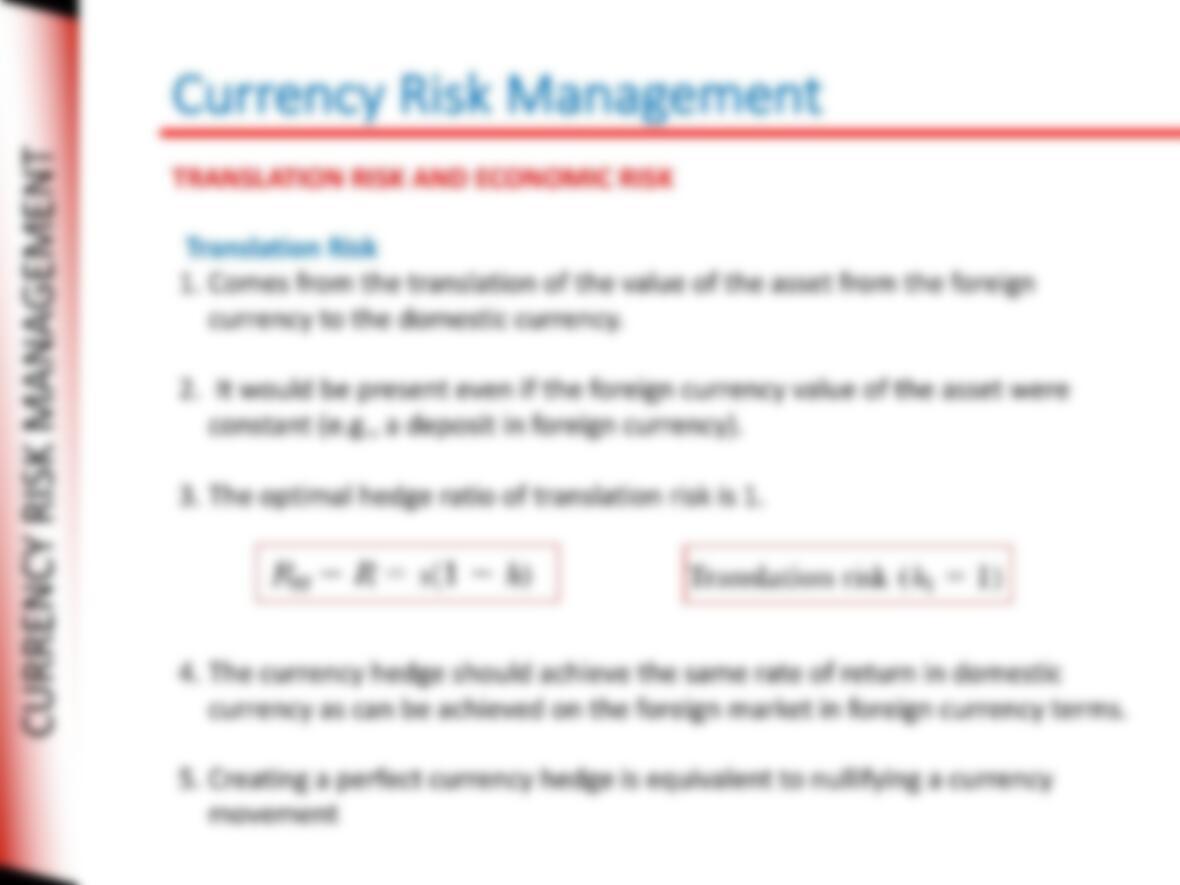
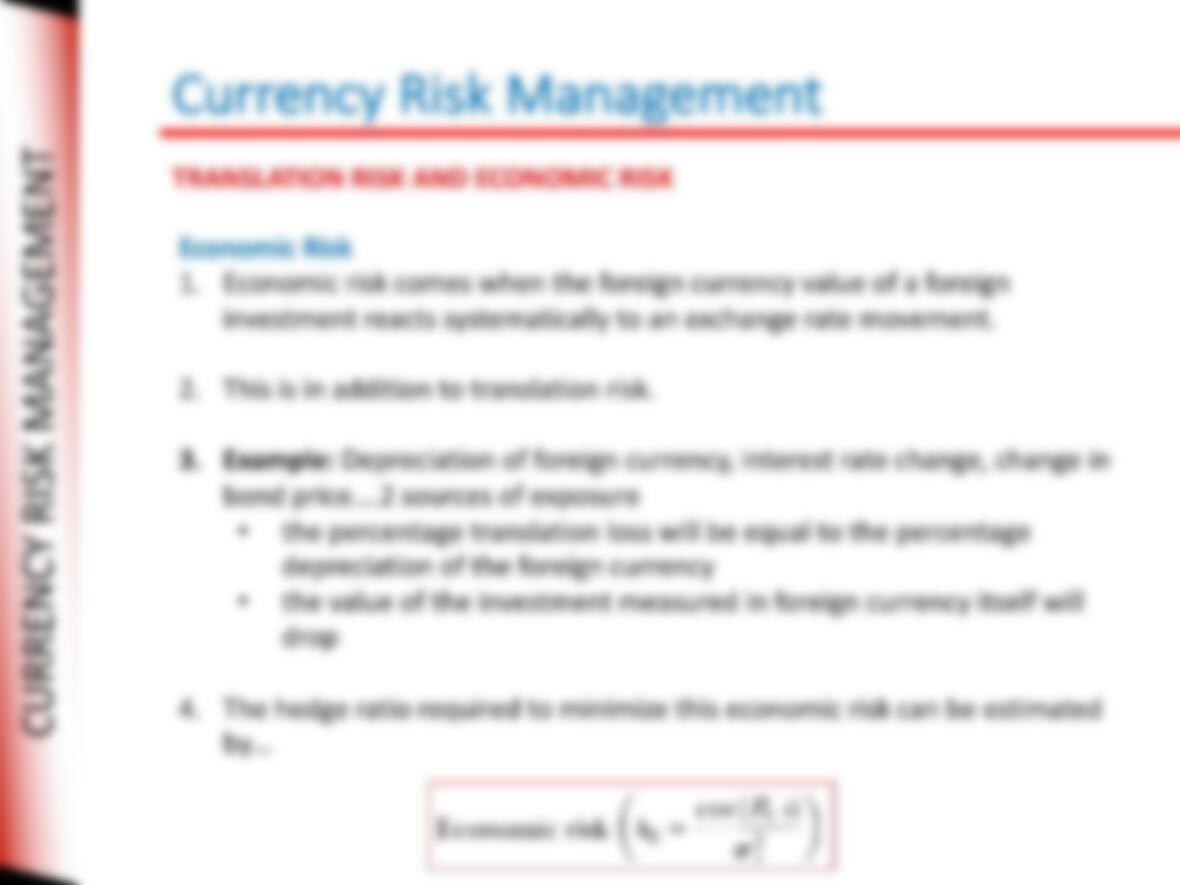
3. Discuss the difference between translation and economic risk
4. Look at 2 detailed examples of using a options contract to hedged
your investment return
5. Currency overlay as an alternative
OBJECTIVES

CURRENCY RISK MANAGEMENT
Currency Risk Management
OBJECTIVES
1. Either futures or forward currency contracts may be used to hedge a
portfolio.
2. Portfolio managers tend to primarily use forward contracts in currency
hedging.
3. Forward and futures contracts allow a manager to take the same economic
position
4. We will refer to futures, but understand that the principles apply equally to
forwards
5. Except for the minor differences highlighted in the previous section, their
impact is more or less the same

CURRENCY RISK MANAGEMENT
Currency Risk Management
HEDGING THE PRINCIPAL
Quite simple!!
1. Suppose you expect a principle sum on Euro3 million in 3 months; let’s
assume it’s the principle of a treasury bond that matures in 3 months.
2. These funds will be exposed to the future spot rate between the ZAR and
the Euro.
3. To remove this uncertainty, you can hedge against potential downside of the
future spot rate by locking in the forward rate.

CURRENCY RISK MANAGEMENT
Currency Risk Management
NOTATION
V
t
The value of the portfolio of foreign assets to hedge, measured in foreign
currency at time
t
V*
t
The value of the portfolio of foreign assets measured in domestic
Currency
S
t
The spot exchange rate: domestic currency value of one unit of foreign currency
quoted at time
t
F
t
The futures exchange rate: domestic currency value of one unit of foreign
currency quoted at time
t
R
The rate of return of the portfolio measured in foreign currency
terms, ( Vt– V0
)
/ V
0
R*
The rate of return of the portfolio measured in domestic currency
terms, ( V*t–
V*
0 )/ V*0
s
The percentage movement in the exchange rate,
(St– S0)/S0

CURRENCY RISK MANAGEMENT
Currency Risk Management
USING FUTURES
Example 1:
1. US investors can buy and sell contracts of GBP62,500 wherein the futures price is
expressed in USD per GBP.
2. The same size contract is also found on the London Futures Exchange.
3. Assume:
•that on September 12, a US investor can buy or sell futures with delivery in
December for 1.95 dollars per pound
•the spot exchange rate is 2.00 dollars per pound.
•In order to hedge her £1 million principal, the investor must sell a total of 16
contracts
4. Now let us assume that a few weeks later,
•the futures rate drop to $1.85
•the spot exchange rate drop to $1.90
•the pound value of the British assets rises to 1,010,000.
If the hedge is undertaken at time 0, and we study the rate of return on the portfolio
from time 0 to a future time t, what is the hedged return on the investment?

CURRENCY RISK MANAGEMENT
Currency Risk Management
USING FUTURES
Example 1 –Solution:
Note:
1. The value of the GBP increases by 1%
2. The GBP exchange rate decreases by 5%
Step 1
You want to find out the absolute value of the your investment in domestic currency given a change
between the current and future spot rate.
V*t–V*0= VtSt– V0S0
V*t–V*0= (£1 010 000 x $1.90/£) –(£1 000 000 x $2.0/£)
V*t–V*0= $1 919 000 –$2 000 000
V*t–V*0= –$81 000
Step 2
Whilst you have lost value on the principal due to the change in the spot rate; you may have gained
based on the change in the futures rate
V*0(-Ft+F0) = Realized Gain
V*0(-Ft+F0) = £1 000 000 x ($1.95/£ –$1.85/£)
V*0(-Ft+F0) = $100 000
Currency Risk Management
USING FUTURES
Example 1 –Solution:
Step 3
You can now calculate the net gain on the futures contract given the change in the spot rate and the
change in the forward rate.
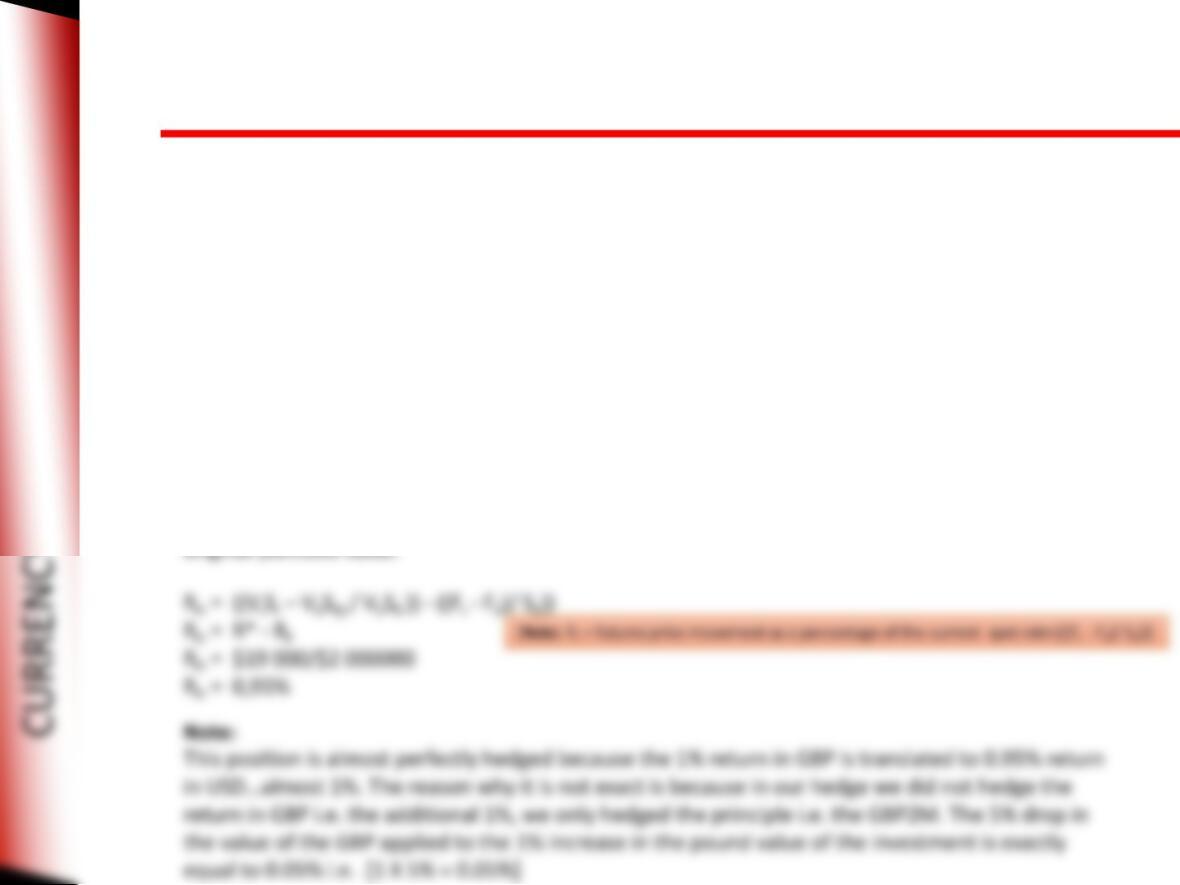
Profit = VtSt– V0S0 –V*0(Ft– F0)
Profit = –$81000 + $100 000
Profit = –$19000
Step 4
The hedged return on the portfolio (RH) can now bet determined by dividing the profit by the