W13530
BONAZZI INDO JOINT VENTURE: CULTURE CLASH OR PURE
ECONOMICS?
Naresh Warrier and Associate Professor Gita Bajaj wrote this case solely to provide material for class discussion. The authors do
not intend to illustrate either effective or ineffective handling of a managerial situation. The authors may have disguised certain
names and other identifying information to protect confidentiality.
This publication may not be transmitted, photocopied, digitized or otherwise reproduced in any form or by any means without the
permission of the copyright holder. Reproduction of this material is not covered under authorization by any reproduction rights
organization. To order copies or request permission to reproduce materials, contact Ivey Publishing, Ivey Business School, Western
University, London, Ontario, Canada, N6G 0N1; (t) 519.661.3208; (e) cases@ivey.ca; www.iveycases.com.
Copyright © 2013, Management Development Institute Gurgaon and Richard Ivey School of Business Foundation Version: 2013-12-13
“We must all hang together or assuredly we will all hang separately.” – Benjamin Franklin
As Nikhil Mehta stared listlessly out of the window of his plush office at Churchgate, Mumbai, he
suddenly appreciated the meaning of the phrase, “To be on the horns of a dilemma.” The irony of the
situation made him smile ever so slightly.
Mehta was the chief executive officer (CEO) and director of Bonazzi Indo Fasteners Limited (BIFL).
BIFL was a joint venture between two leading auto component manufacturers—Bonazzi Group, based out
of Turin, Italy, with a global presence, and the Indo Group (Indo), headquartered in Mumbai, catering to
the Indian and global passenger car market. The two companies had also formed a second joint venture,
Indo Bonazzi Fasteners Limited (IBFL), for servicing the Indian commercial vehicles market. Mehta had
just received the meeting minutes of the recent board meeting of BIFL.
This meeting, held on April 15, 2011, had been a stormy affair. Directors on the board representing both
joint venture partners had blamed each other for the company’s current position. Mehta did not approve
of the aggressive communication between the parties. Later, however, Shankar Menon, chief financial
officer of Indo, offered Mehta a cup of coffee, which Mehta had politely refused. “What is the point in
exchanging pleasantries if in reality Menon doesn’t support me,” Mehta wondered. Menon’s discontent
with Mehta was evident in the meetings and his offer of coffee after the meeting was a farce, Mehta
continued to believe.
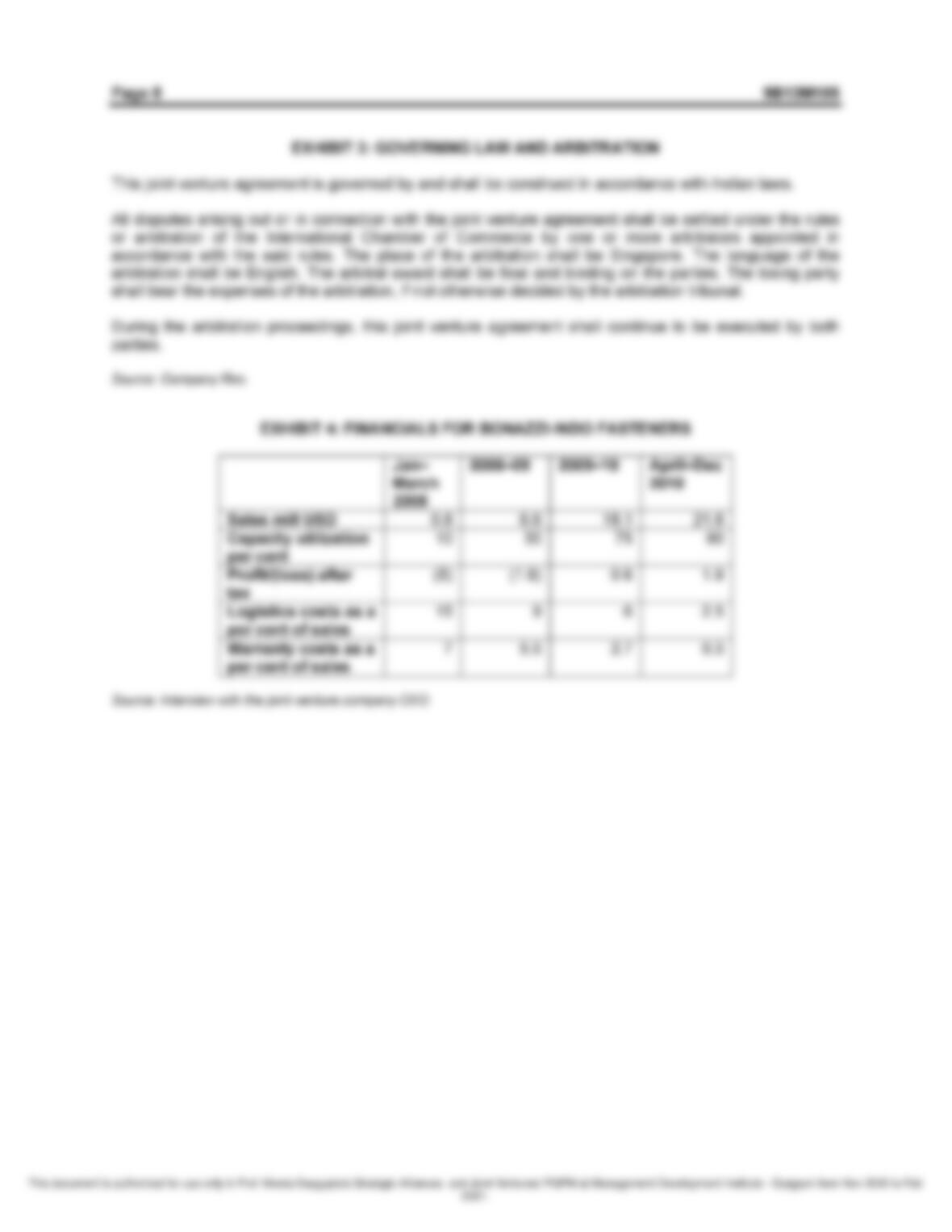
Caught in the crossfire between the two groups, Mehta was finding it difficult to broker peace. Owing to
the large investments made in the plant and machinery, stakes were high. Although BIFL had a strong
presence in the Indian market and excellent customer equity, it had performed much below the projected
turnover of US$35 million.
1
While Indo wanted the projected numbers to be met, Bonazzi wanted to give
Mehta time and independence to deliver results. With such a deteriorating relationship, Mehta wondered
whether it was prudent to continue the joint venture or whether it was time to call it off.
1
All currencies are in US$ unless otherwise stated.
This document is authorized for use only in Prof. Meeta Dasgupta’s Strategic Alliances and Joint Ventures/ PGPM at Management Development Institute – Gurgaon from Nov 2020 to Feb
2021.
Page 2 9B13M105
THE INDIAN AUTOMOTIVE INDUSTRY
According to a recent KPMG report,2 the Indian economy had grown at an average rate of around 9 per
cent over the five years prior to the joint venture and was expected to continue that growth in the medium
term. KPMG had predicted that this would lead to an increase in the percentage of the Indian population
able to afford vehicles. India’s car per capita ratio (expressed in cars per 1,000 population) was among the
lowest in the world’s top 10 auto markets at the time.
The automotive industry was reported to be one of the key drivers of India’s economy, accounting for
around 4 percent of India’s GDPI and over 200,000 jobs. India’s automobile market had grown steadily
over the five to six years preceding the joint venture, with the exception of the two years where the effects
of the global downturn were felt, primarily in the sales of commercial vehicles. However, even during the
downturn, the two-wheeler and three-wheeler segments, which were until then experiencing low growth
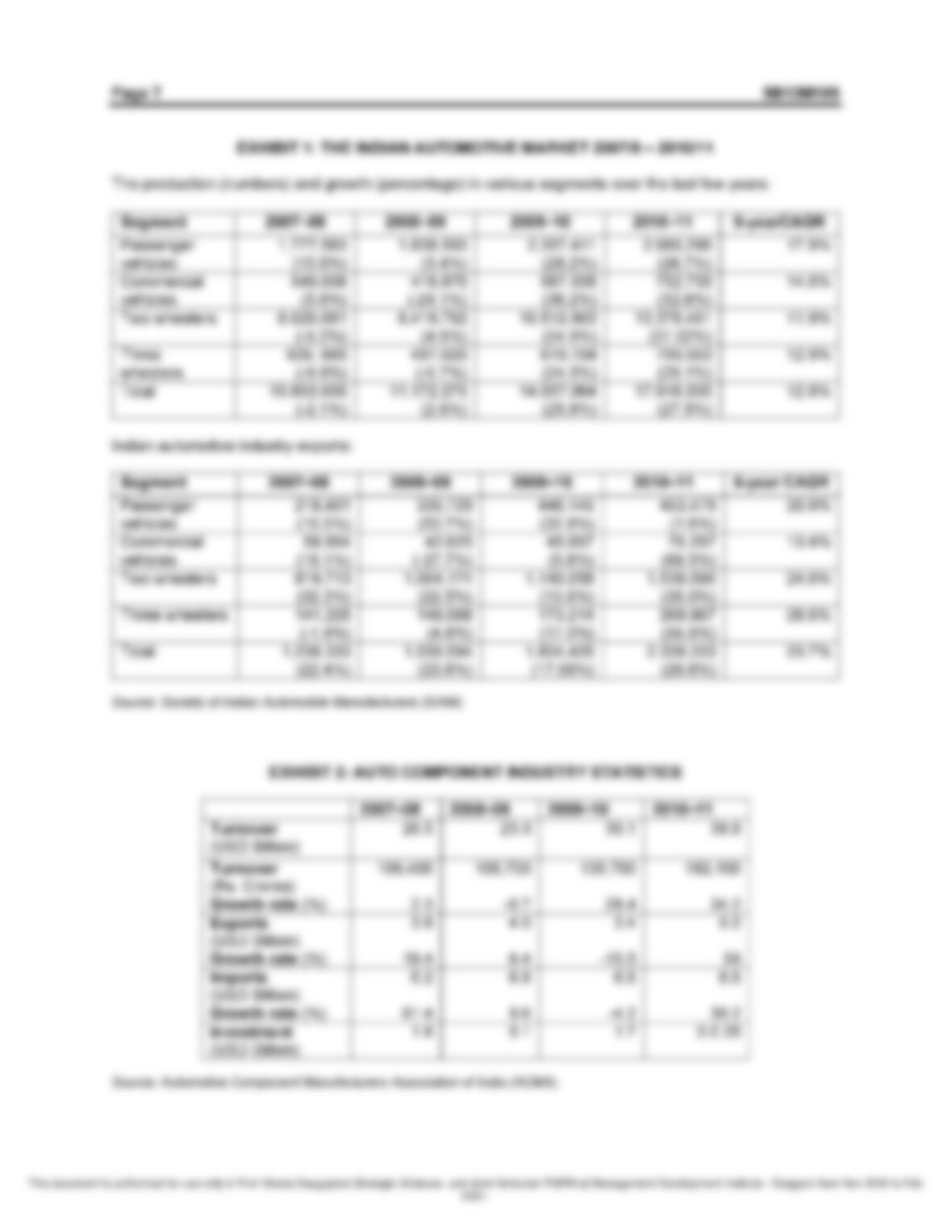
or losing volumes, bucked the trend (see Exhibit 1). Automobile production increased from 10.8 million
units in 2007–2008 to 17.9 million units in 2010–2011 at a compound annual growth rate (CAGR) of 13
per cent.
According to the Automobile Component Manufacturer Association (ACMA), the main body
representing the components of India’s automotive manufacturing industry, the turnover of the
automotive component industry stood at Rs1,821 billion rupees ($39.9 billion) for the period April 2010
to March 2011, registering a growth of 34 percent (in rupees) over the previous year.3 These data
represent the total industry supply of automotive components to vehicle manufacturers and to the
aftermarket in India and abroad.