Solid State Physics
Dr. Sushant Gupta Page | 1
Crystalline, Polycrystalline and Amorphous Structures
Crystalline Structures: Crystalline structures are characterized by the regular arrangement in space of single atoms
or collections of them, leading to long-range order.
Polycrystalline Structures: Polycrystalline structures are composed of an ensemble of crystalline structures
extending over a finite spatial range, with adjacent structures being oriented in different ways.
Amorphous Structures: Amorphous structures are characterized by a spatial ordering limited to the vicinity of the
single atom or molecule.
For most solids the crystalline state is the natural one since the energy of the ordered atomic arrangement is lower
than that of an irregular packing of atoms. However, when the atoms are not given an opportunity to arrange
themselves properly, by inhibiting their mobility, amorphous material may be formed.
In some cases, the solid state may correspond to a super-cooled liquid in which the molecular arrangement of the
liquid state is frozen in; because of rapid cooling and a high viscosity of the liquid, crystals may not have had time to
grow and glassy material results. Upon annealing, such glassy substances may crystallize, as is well known to any
experimentalist who has worked with quartz.
Whether a material solidifies into either a crystalline or polycrystalline, or else amorphous structure, is a
complicated issue strongly affected by conditions of pressure, temperature, impurity content, and so on. While
polycrystalline or amorphous materials are most often the result of spontaneous growing, the growth of a single–
crystal is almost always a very laborious task, requiring efficient and accurate control of the above parameters.
Crystal Structure
Bravais lattice: It is the infinite set of geometrical points, arranged in space according to a regular and periodic
manner. These points are named lattice sites. They share the following property: the geometrical description of the
material, including position, orientation and type of atoms, looks always the same from the perspective of whatever
site one might choose as point of sight.
Basis: It is the basic structure unit, composed of one or more atoms, molecules and/or ions. Its chemical
composition may run from one single atom in crystals of gold and alkaline metals to tens, hundreds or thousands
atoms in inorganic and organic crystals, and up to a hundred-thousand atoms in protein-based crystals such as DNA.
A lattice is a mathematical abstraction; the crystal structure is formed when a basis of atoms is attached identically
to every lattice point. The logical relation is
lattice + basis = crystal structure
The concepts of lattice and crystal structure are no t synonymous: “lattice” is a purely geometrical concept while
“crystal structure” has a physical meaning.
Solid State Physics
Dr. Sushant Gupta Page | 2
Primitive Translation Vectors /Basis vectors / Primitive Vectors
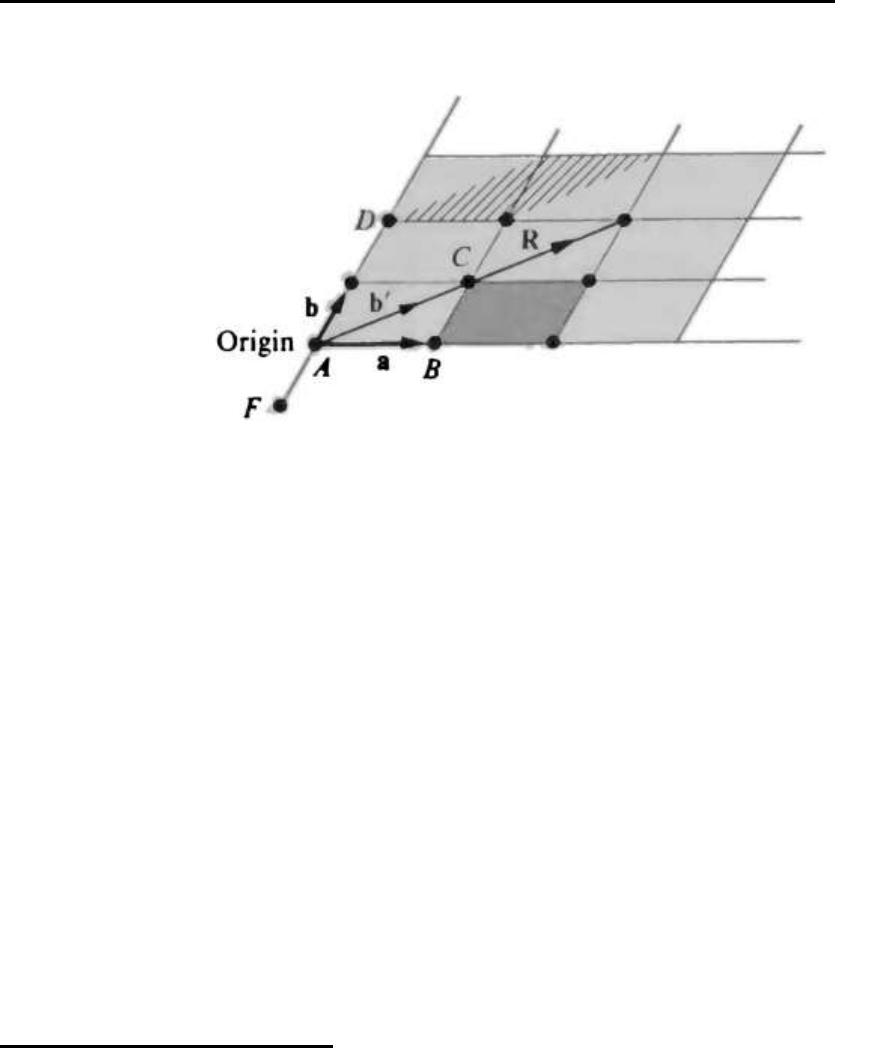
Fig. 1: Vectors a and b are basis vectors of the lattice. Vectors a and b’ form another set of basis vectors. Shaded
and hatched areas are unit cells corresponding to first and second set of basis vectors, respectively.
Consider the lattice shown in Fig. 1. Let us choose the origin of coordinates at a certain lattice point, say A. Now the
position vector of any lattice point can be written as
T = n1a + n2b … (1)
where a, b are the two vectors shown, and (n1, n2) is a pair of integers whose values depend on the lattice point.
Thus for the point D, (n1, n2) : (0,2); for B, (n1, n2) : (1,0); and for F, (n1, n2) : (0, – 1).
The two vectors a and b in terms of which the positions of all lattice points can be conveniently expressed by the
use of Eq. 1 are called Primitive translation vectors or Basis vectors. We may also say that the lattice is invariant
under the group of all the translations expressed by Eq. 1. This is often rephrased by saying that the lattice has a
translational symmetry under all displacements specified by the lattice vectors T.
The choice of basis vectors is not unique. One could equally well take the vectors a and b’ (= a + b) as a basis (Fig. 1).
Other possibilities are also evident. The choice is usually dictated by convenience.
Primitive Cell or Unit Cell
The area of the parallelogram whose sides are the basis vectors a and b is called a unit cell of the lattice (Fig. 1), in
that, if such a cell is translated by all the lattice vectors of T = n1a + n2b, the area of the whole lattice is covered once
and only once. The unit cell is usually the smallest area which produces this coverage. Therefore the lattice may be
viewed as composed of a large number of equivalent unit cells placed side by side, like a mosaic pattern.
The choice of a unit cell for one and the same lattice is not unique, for the same reason that the choice of basis
vectors is not unique. Thus the parallelogram formed by a and b’ in Fig. 1 is also an acceptable unit cell; once again
the choice is dictated by convenience.
The following remarks may be helpful.
Solid State Physics
Dr. Sushant Gupta Page | 3
i) All unit cells have the same area. Thus the cell formed by a, b has the area S = |a x b|, while that formed by a, b’
has the area S’ = |a x b’|= |a x (a + b)| = |a x b| = S, where we used the result a x a = 0. Therefore the area of the
unit cell is unique, even though the particular shape is not.
ii) If you are interested in how many lattice points belong to a unit cell, refer to Fig. 1. The unit cell formed by a x b
has four points at its corners, but each of these points is shared by four adjacent cells. Hence each unit cell has only
one lattice point.
Primitive Versus Non – Primitive Cell
It is sometimes more convenient, however, to deal with a unit cell which is larger, and which exhibits the symmetry
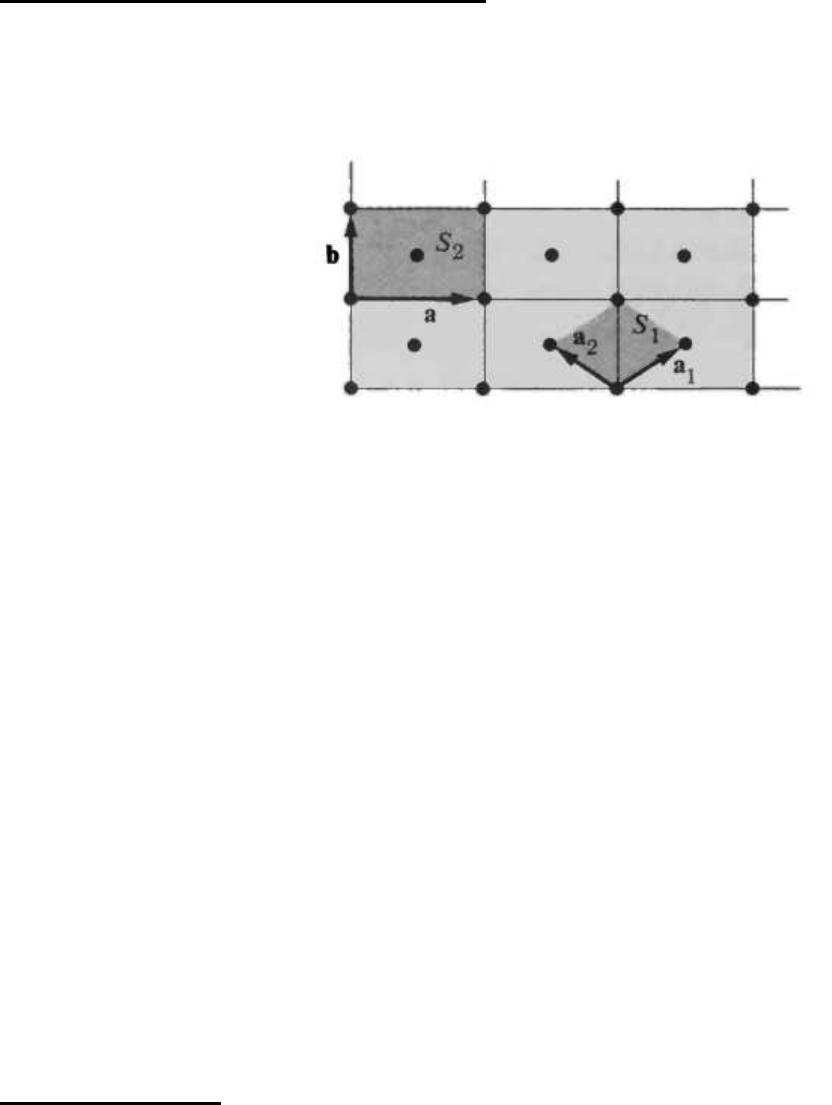
of the lattice more clearly. The idea is illustrated by the Bravais lattice in Fig. 2.
Fig. 2: Area S1, is a primitive unit cell; area S2 is a non-primitive unit cell.
Clearly, the vectors a1, a2 can be chosen as a basis set, in which case the unit cell is the parallelogram S1. However,
the lattice may also be regarded as a set of adjacent rectangles, where we take the vectors a and b as basis vectors.
The unit cell is then the area S2 formed by these vectors. It has one lattice point at its center, in addition to the
points at the corner. This cell is a non-primitive unit cell.
The reason for the choice of the non-primitive cell S2 is that it shows the rectangular symmetry most clearly.
Although this symmetry is also present in the primitive cell S1 (as it must be, since both refer to the same lattice), the
choice of the cell somehow obscures this fact.
Note the following points.
i) The area of the non-primitive cell is an integral multiple of the primitive cell. In Fig. 2, the multiplication factor is
two.
ii) No connection should be drawn between non-primitive cells and non-Bravais lattices. The former refers to the
particular (and somewhat arbitrary) choice of basis vectors in a Bravais lattice, while the latter refers to the physical
fact of nonequivalent sites.
Three dimensions :
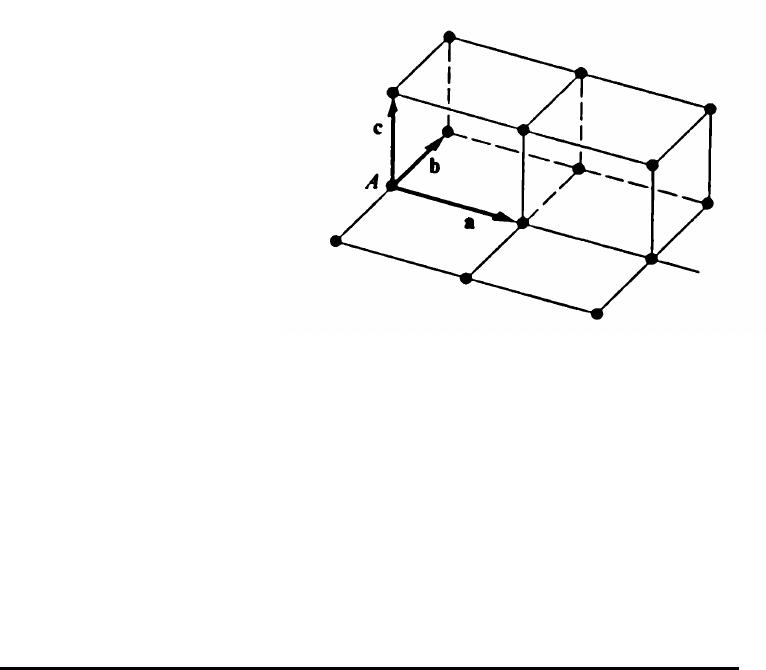
In three dimensions, the position vector of any lattice point can be written as:
Solid State Physics
Dr. Sushant Gupta Page | 4
T = n1a + n2b + n3c
where a, b, and c are three non-coplanar vectors joining the lattice point at the origin to its near neighbors (Fig. 3);
and n1, n2, n3 are a triplet of integers 0, ±1, ±2, etc., whose values depend on the particular lattice point.
Fig. 3: A three-dimensional lattice. Vectors a, b, c are basis vectors.
The vector triplet a, b, and c is the basis vector, and the parallelepiped whose sides are these vectors is a unit cell.
Here again the choice of primitive cell is not unique, although all primitive cells have equal volumes. Also, it is
sometimes convenient to deal with non-primitive cells, ones which have additional points either inside the cell or on
its surface. Finally, non-Bravais lattices in three dimensions are possible, and are made up of two or more
interpenetrating Bravais lattices.
Primitive and Non – Primitive Cell (A Brief Introduction)
A 3D space lattice can be fully defined using just three non – coplanar vectors (a, b, c). The lattice is constructed by
placing a point at every possible combination of the three vectors (T = n1a + n2b + n3c) and any multiples of them
(positive or negative). The vectors used for this operation are known as the primitive vectors for the lattice. A given
lattice can be constructed from the different sets of primitive vectors, so there is no uniquely prescribed set of
primitive vectors associated with a lattice. However, a given set of primitive vectors does uniquely define a Bravais
lattice.
The parallelepiped defined by primitive axes a, b, c is called a primitive cell. A primitive cell is a type of cell or unit
cell. A cell will fill all space by the repetition of suitable crystal translation operations. A primitive cell is a minimum-
volume cell. There are many ways of choosing the primitive axes and primitive cell for a given lattice. There is
always one lattice point per primitive cell. If the primitive cell is a parallelepiped with lattice points at each of the
eight corners, each lattice point is shared among eight cells, so that the total number of lattice points in the cell is
one: 8 X 1/8 = 1.
The simple primitive unit cell formed by the vectors a, b, c does not always display all the symmetries of the given
translation lattice. In many cases these symmetries are clearly recognized only when a larger unit is considered,
namely the so-called multiple primitive unit cell formed by the vectors a’, b’, c’ it contains more than one lattice
point. The lattice points in the multiple primitive unit cell are determined by the basis vectors Q’ i.e.,
Q’ = m1a’+ m2b’ + m3c’
Solid State Physics
Dr. Sushant Gupta Page | 5
where m1, m2, m3 are arbitrary integers.
We often use primitive translation vectors to define the crystal axes. However, non-primitive crystal axes are often
used when they have a simpler relation to the symmetry of the structure. The crystal axes a, b, c form three adjacent
edges of a parallelepiped. If there are lattice points only at the corners, then it is a primitive parallelepiped.
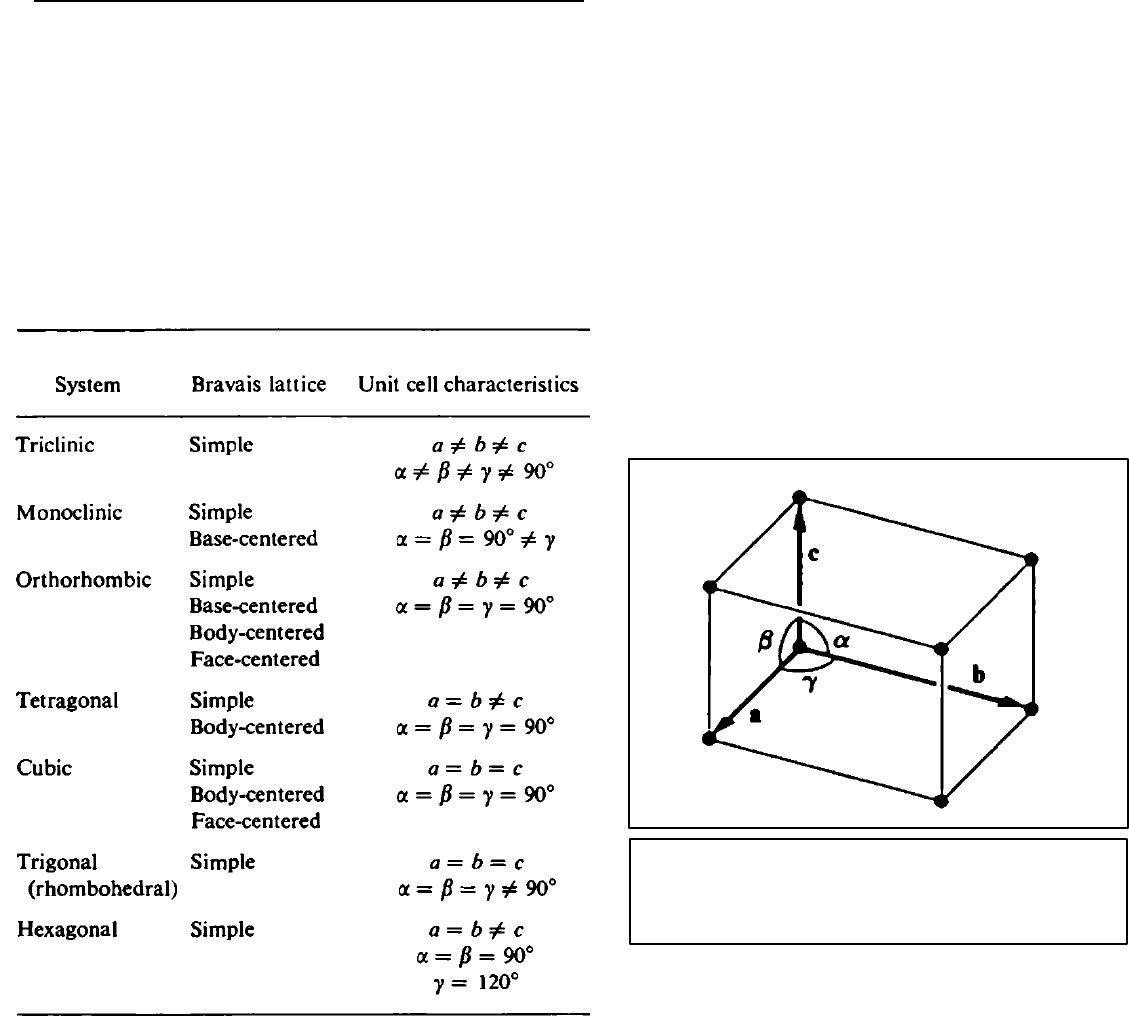
According to Bravais there exist seven simple primitive lattices and seven multiple primitive lattices, i.e. fourteen
different primitive translation lattices, also called Bravais lattices.
The Fourteen Bravais Lattices and the Seven Crystal Systems
There are only 14 different Bravais lattices. This reduction to what is a relatively small number is a consequence of
the translational-symmetry condition demanded of a lattice. To appreciate how this comes about, consider the two-
dimensional case, in which the reader can readily convince himself, for example, that it is not possible to construct a
lattice whose unit cell is a regular pentagon. A regular pentagon can be drawn as an isolated figure, but one cannot
place many such pentagons side by side so that they fit tightly and cover the whole area. In fact, it can be
demonstrated that the requirement of translational symmetry in two dimensions restricts the number of possible
lattices to only five. In three dimensions, the number of Bravais lattices is 14. The number of non-Bravais lattices is
much larger (230), but it also is finite.
The 14 lattices (or crystal classes) are grouped into seven crystal systems, each specified by the shape and symmetry
of the unit cell. These systems are the triclinic, monoclinic, orthorhombic, tetragonal, cubic, hexagonal, and the
Fig. 1: Unit cell specified by the lengths of basis
vectors a, b, and c; also by the angles between the
vectors.
Solid State Physics
Dr. Sushant Gupta Page | 6
trigonal (or rhombohedral). In every case the cell is a parallelepiped whose sides are the bases a, b, c. The opposite
angles are called α, β and γ, as shown in Fig. 1
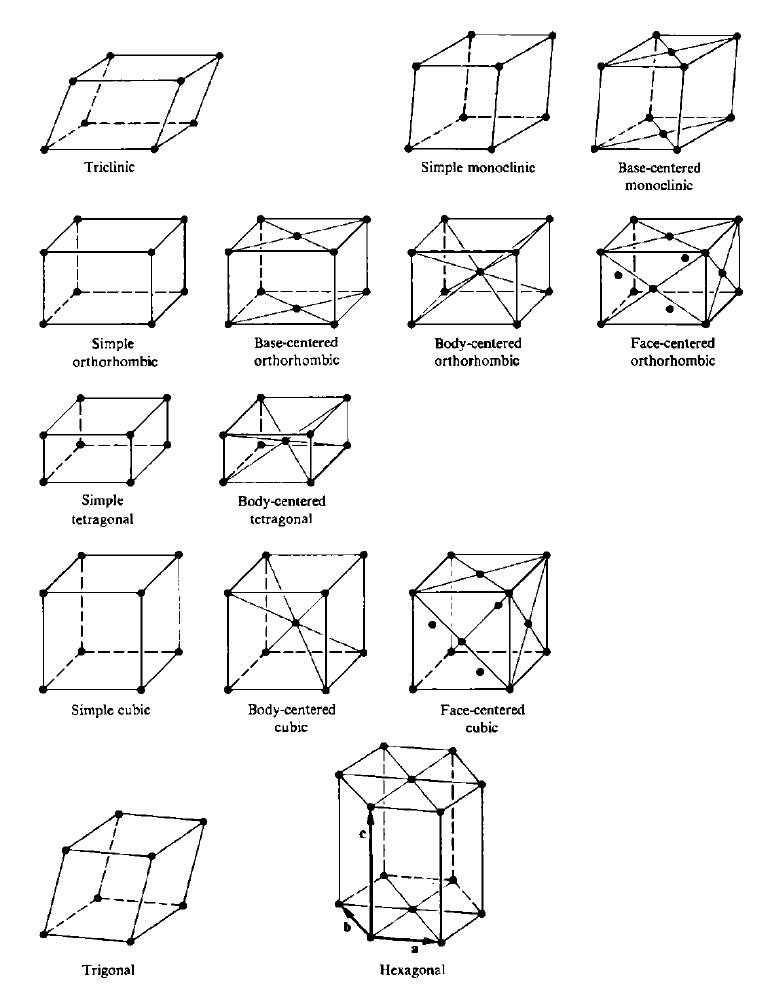
Figure 2 shows the 14 lattices, and Table 1 enumerates the systems, lattices, and the appropriate values for a, b, c,
and α, β, and γ.
Note that a simple lattice has points only at the corners, a body-centered lattice has one additional point at the
center of the cell, and a face-centered lattice has six additional points, one on each face. Let us again point out that
in all the non-simple lattices the unit cells are non-primitive.
Fig. 2: The 14 Bravais lattices grouped into the 7 crystal systems.
Solid State Physics
Bravais Lattices in Two Dimensions
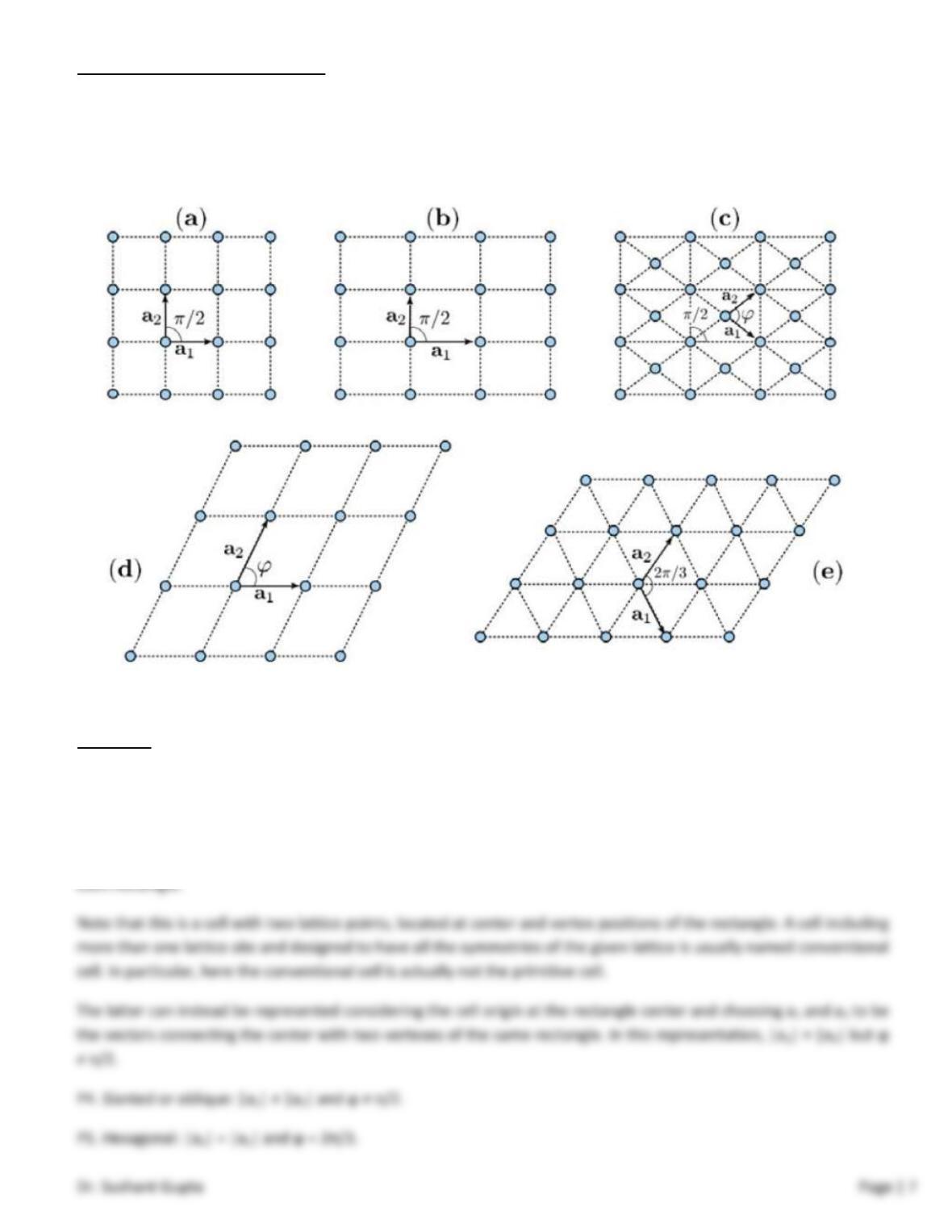
The five Bravais lattices that can be conceived in two dimensions are depicted in Fig. 1 along with the vectors
defining the primitive cell. Here they are described in terms of the elementary translation vectors a1 and a2 and of
the angle ϕ that they form.
Fig. 1: The five conceivable Bravais lattices in 2D.
Properties
P1. Squared: |a1| = |a2| and a1, a2 placed at angle ϕ = π/2.
P2. Rectangular: |a1| ≠ |a2|, and ϕ = π/2.
P3. Body-centered rectangular: As in the rectangular case in P2, but an extra lattice point is located at the center of