Module 1:
Lecture 1.1: What Is Critical Thinking?
What is Critical Thinking?
– Critical thinking is that mode of thinking―about any subject, content, or problem―in
which the thinker improves the quality of her thinking by skillfully analyzing, assessing,
and reconstructing it… It entails effective communication and problem-solving abilities,
as well as a commitment to overcome our native egocentrism and sociocentrism.
Define Critical Thinking
– General: applies to any subject
– Not as specific as biology or chemistry, for example
– Reflective: requires you to think about how you think
– Critical: questions whether the way you think is good or bad
– Aiming at improving your thinking
– Overcoming obstacles: you are often your own worst enemy
– Ego: want to be right, want to know, don’t want to look like we don’t know
– Must overcome own bias
What is Critical Thinking?
– This definition is abstract and general, and thus may not help us fully understand what
critical thinking is.
– Another way of understanding critical thinking: focus on an example of a critical thinker.
– We can then ask what character traits are required for a person to be a critical thinker.
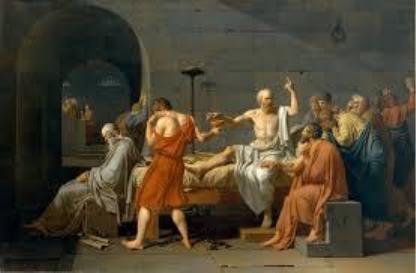
– Socrates (470-399 BCE)
– Father of western philosophy
– Faced death with great courage because he thought what he was doing was right
– Prosecuted for “corrupting the youth,” among other charges
– Sentenced to death by drinking poison hemlock
Socrates: Historical Context
– Greco-Persian Wars (499-449 BCE)
– Persian empire vs. Greek city states
– Persia was by far the larger, stronger force
– Greek city-states prevailed in stunning upset
– “Golden” Age of Athens
– Having repelled the Persian forces, newly opened trade routes made Athens
extremely prosperous
– Became the artistic, cultural, and economic center of the ancient West
– Economic prosperity allowed new discipline to emerge: philosophy
– Philosophers are people who spend time asking questions that don’t need
to be answered right away
– Ask questions that aren’t comfortable

– Need lots of time to think about abstract concepts as opposed to surviving
– Peloponnesian War (431-404 BCE)
– Athens vs. Sparta
– Fought over land, ancient disputes
– Sparta focused on military instead of luxuries
– Sparta destroys entire naval fleet of Athens
– Athens surrenders
– Golden age ended as a result
– Aftermath of loss to Sparta
– Athens was a democracy before the war, while Sparta was an oligarchy
– Sparta imposed the “Thirty Tyrants” to rule over Athens. They killed and
banished many Athenians during their rule.
– Small group of people enacted laws; people could not vote
– Thirty Tyrants were mostly Athenians who required people who did something
wrong to come before them, mostly by family; feared by many
– In 403 BCE, Athens reclaimed its democracy, but never again achieved its former
status.
– File a petition to pass a law with majority vote
– Needed to speak well in order to do this and listened to philosophers to do so
– Not long after democracy was restored to Athens, an Athenian named Meletus brought
Socrates in front of a jury of his peers, accusing him of various crimes
– Socrates defended himself, as was customary, but lost and was sentenced to death
– 500 people voting on the penalty charges
– Plato recounts Socrates’ defense in the “Apology”
Reading Notes for Next Lecture
– Read Plato’s “Apology,” and keep these points in mind:
– Socratic Irony:
– Socrates often says the exact opposite of what he means. If he
compliments someone for his wisdom, he really means to say that the
person is not wise. Watch for this.
– Dramatic Cues:
– If Socrates tells the audience to be calm or to stop yelling, that indicates
that he said something to rile them up. Pay attention to what he says that
gets them so angry.
Lecture 1.2: Plato’s “Apology” Part 1: The “Older” Charges
Plato and Socrates
– Socrates (470-399 BCE) never wrote any philosophical texts
– Philosophy = love (philo) of wisdom (sophia)
– Philosophy as a way of life, not a subject like biology or math
– Anyone can be a philosopher, love of truth, wisdom, having beliefs justified
– Compare to definition of critical thinking
– Philosophy is the attempt to reach truth and to become a better thinker.
– Plato (428-348 BCE), a follower of Socrates, wrote many dialogues in which Socrates is
the protagonist. The “Apology” is one of these.
– Dialogues written as texts for use in Plato’s school, The Academy
– Most are not accounts of actual events, but created as lessons
– The “Apology,” however, is of an actual event; might be accurate
– Deciphering the difference between Plato’s and Socrates’ thoughts is somewhat
difficult because Socrates was a common character in Plato’s texts
Socrates’ Reputation
– Sought knowledge of truth, beauty, justice, virtue, and other “big” questions
– Did not care what the earth was made of, sought truth and what was just
– Questioned powerful people about these topics in the agora (big open area in Athens)
– Talking games like yes or no to contradict oneself
– Socrates would show they did not know
– Gained reputation for tricking people with obtuse arguments meant to confuse
– People followed these techniques to become a better public speaker
– Many of the sons of these powerful Athenians become “followers” of Socrates
– Plato was one of these, wanted to find out about nature instead of politics
Socrates’ Reputation: “Apology” (20C-24B)
– “Apology” comes from apologia, which means defense, not sorry
– Socrates begins his “defense” by addressing the “older” accusations against him before
the formal charges of Meletus
– He does very little defense, almost all offense, example with how much he talked about
politics and how he refused to follow it because everyone who participates is corrupt and
would have killed him years ago, this is an attack!
– He is not defending his life, just accusing people of Athens not being good
– Everybody knew who he was and that he asked people uncomfortable questions, he
would make people contradict themselves, and made him unpopular
– These “older” accusations are just his reputation for deliberately confusing people while
talking about sensitive subjects like what is good, pious, etc., and teaching these things to
the youth who follow him
– He believes he has a god-given reason to carry out this deed
– Socrates tells the story of the Oracle at Delphi to explain how he gained this reputation
The Oracle at Delphi
– The oracle was a religious figure who claimed to be able to predict the future
– Had a reputation for giving misleading predictions
– General before a battle: Will the battle be victorious?
– Oracle: Yes, it will be a resounding victory
– Yet the general and his entire army are killed
– Oracle: You never asked who will be victorious
– Oracle doesn’t like people who assume they are better
– The oracle proclaimed that “none are wiser” than Socrates
– Socrates is confused; he believes he knows nothing about the most important things in
life. How can he be the wisest? (Remember reputation of oracle)
– Most important things in life = Nature of justice, beauty, virtue, etc.