TOPIC: CRITICAL ANALYSIS ESSAY ON OF MICE AND MEN (BY
PROFESSOR THOMAS SCARSETH)
Discipline
Language Arts, History, Research/Analysis Skills
Grade Level
8-12
Type of Activity
Small Group, Entire Class, Individual, Cumulative, Critical Analysis, Research
Source
Scarseth, Thomas. “A Teachable Good Book: Of Mice and Men.” Censored Books:
Critical Viewpoints. Eds. Nicholas J. Karolides, Lee Burress, and John M. Kean.
Lanham, Maryland: Scarecrow Press, 1993, pp. 388 – 94.
The article by Dr. Scarseth, in full, is included below.
Objectives
• Students will be able to analyze/interpret an article of criticism about Of Mice and
Men.
• Students will provide their own opinions about both the article and Of Mice and
Men with supporting quotations from both the article and the novel.
• Students will learn to judge the validity of a critic’s opinion and agree/disagree
with the critic.
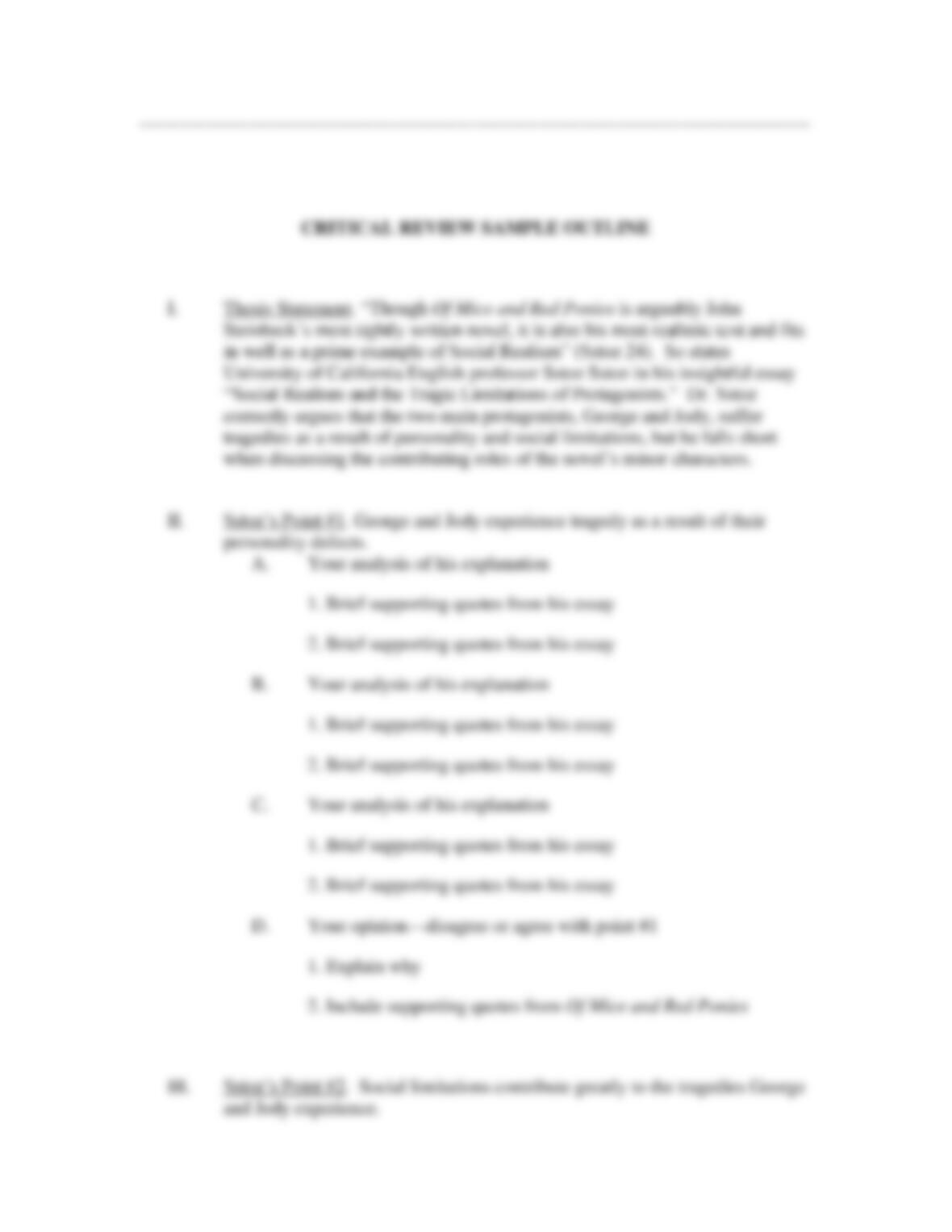
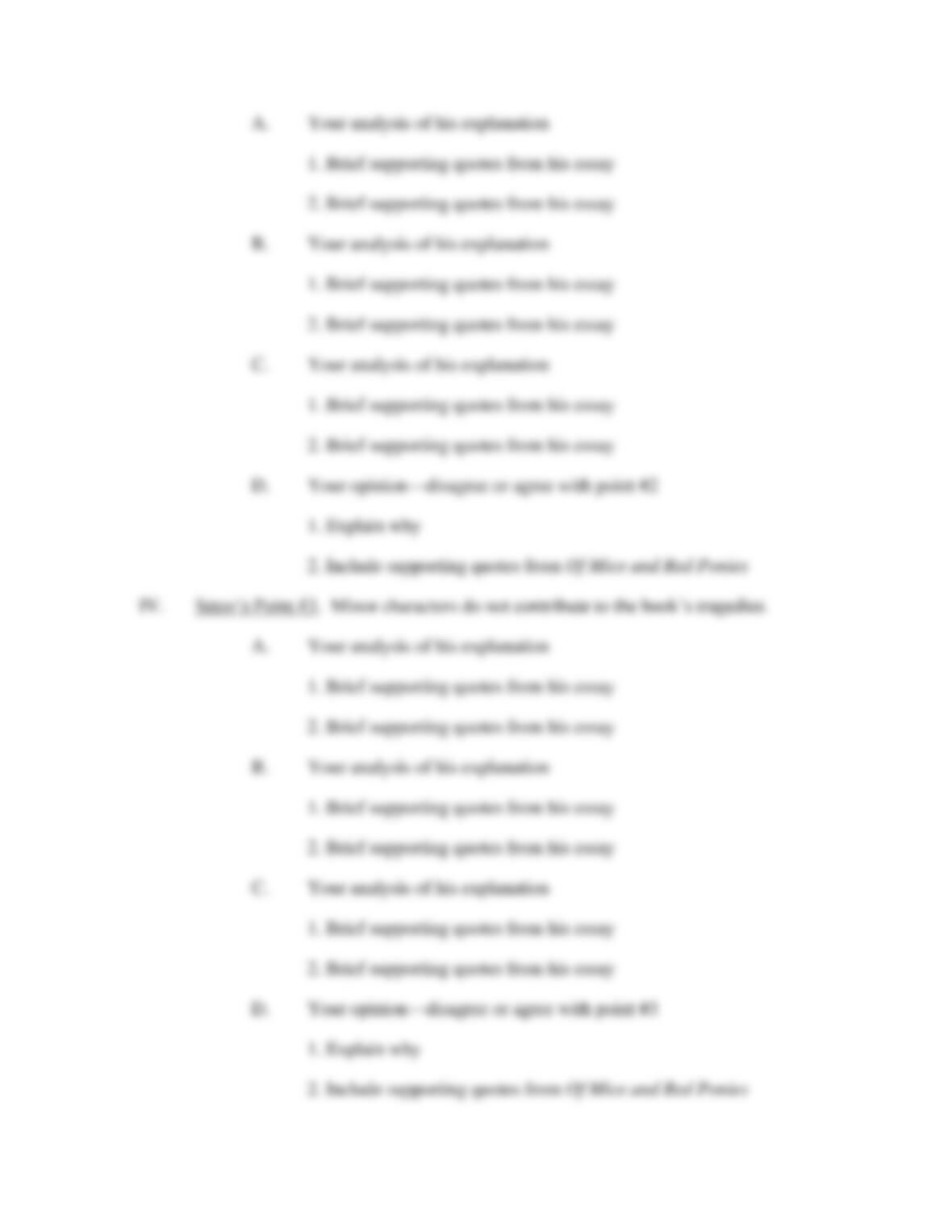
• Students will provide an outline (refer to the sample following the critical article).
• Students will publish their papers on edmodo.com, a shared website for teachers
and students: http://www.edmodo.com/.
Overview
This essay assignment is a major step in developing the students’ critical analysis
abilities. Dr. Scarseth’s paper, unlike other scholars’ works, is very readable and easy to
understand. This article, which can be modified per grade level/ability, is a perfect
introduction to scholarly papers.
Materials Needed/Preparation
• Critical review by Professor Scarseth (included below)
• Of Mice and Men text

Estimated Time
With the students’ preparation (see below), development of an outline, a first draft, and a
final version, teachers may use their own discretion, though a two-three week completion
period is ideal.
Procedures
• If students have access to a computer lab, take about two periods so students (in
pairs) can read through Scarseth’s article, access the Internet, mark up the paper,
define any words they do not know, and understand any literary or historical
allusions with which they might not be familiar.
• Of course, closely monitor students, answer any questions, and ensure they stay
on task.
If students do not have access to a computer lab, teachers should spend about the
same two periods, have students read aloud through the critical essay, and
discuss/define terms/allusions as a class.
• After a group analysis of the critical review, have students write an outline for the
critical examination of Professor Scarseth’s paper (refer to the example outline
after the text of the Scarseth’s paper).
• In the outline (and later, first draft) have students explain, point by point (at least
three points), what the critic is saying about Of Mice and Men. In the first draft,
students should quote the critic to support their analysis.
• Then students should provide their own analysis. Ask: Do you agree or disagree
with the critic’s points? Point by point, have students provide their own opinions.
• If students agree with a point, state why and also provide examples/quotes from
Of Mice and Men that further support why they agree with the critic.
• If students disagree with a point, state why and also provide examples/quotes
from Of Mice and Men that further support why they disagree with the critic.

Standards Met
• Reading Standards for Literature 6-12
o Key Ideas and Details: 1,2
o Craft and Structure: 4,5,6
o Integration of Knowledge and Ideas: 9
o Range of Reading and Level of Text Complexity: 10
• Reading Standards for Informational Text 6-12
o Key Ideas and Details: 1,2,3
o Craft and Structure: 4,5,6
o Integration of Knowledge and Ideas: 7,8
o Range of Reading and Level of Text Complexity: 10
• Writing Standards 6-12
o Text Types and Purposes: 1,2,3
o Production and Distribution of Writing: 4,5.6
o Research to Build and Present Knowledge: 7,8,9
o Range of Writing: 10
• Speaking and Listening Standards 6-12
o Comprehension and Collaboration: 1,2
• Language Standards 6-12
o Conventions of Standard English: 1,2
o Knowledge of Language: 3
o Vocabulary Acquisition and Use: 4,5,6
• Reading Standards for Literacy in History/Social Studies 6-12
o Key Ideas and Details: 1,2
o Craft and Structure: 4,5
o Integration of Knowledge and Ideas: 8, 9
o Range of Reading and Level of Text Complexity: 10
• Writing Standards for Literacy in History/Social Studies, Science, and Technical
Subjects 6-12
o Text Types and Purposes: 1,2
o Production and Distribution of Writing: 4,5,6
o Research to Build and Present Knowledge: 7,8,9
o Range of Writing: 10
Post Activity/Takeaways/Follow-up
• Takeaways
o Students should understand how to create “mini” critical reviews of other
short works.
o Teacher’s comments on the outline, draft, and final version.
• Follow-up
o Continue to use this exercise for students’ subsequent work.
Assessment

• Teacher’s comments on the:
o Outline