CREDIT APPRAISAL REPORT
SAIGON ALCOHOL BEER AND
BEVERAGE JOINT STOCK
CORPORATION
Subject: Credit Analysis and Lending Management
Tutor: Nguyen Thi Minh Hang
Tutorial: 3
Group: 9
Group members: Hoang Tram Anh – 1704040004
Vuong Minh Ngoc – 1704040087
Nguyen Thi Hang – 1704040030
Do Thi Ngan – 1704040082
Ha Noi, 7th Dec 2020
HANOI UNIVERSITY
FACULTY OF MANAGEMENT AND TOURISM
Table of Contents
I. INTRODUCTION 2
II. CREDIT ANALYSIS 3
1. 5Cs approach 3
2. PARSER 5
3. Risk premium 6
III. RECOMMENDATION 6
1. Legal documents 6
2. Other conditions imposed 6
IV. CONCLUSION 7
APPENDIX 8
APPENDIX A: FINANCIAL STATEMENTS 8
Appendix A-I: Income Statement 8
Appendix A-II: Balance Sheet 9
Appendix A-III: Statement of cash flow 12
APPENDIX B: INDUSTRY AVERAGE GROSS PROFIT MARGIN 14
APPENDIX C: LEGAL REPRESENTATIVES 14
REFERENCE 15

I. INTRODUCTION
Saigon Alcohol Beer and Beverage Joint Stock Corporation, also called SABECO is Vietnam’s leading
beer brewer. It was under the authority of Vietnam’s Ministry of Trade and Industry but in December 2017
the company was acquired by ThaiBev- one of Southeast Asia’s largest beverage companies. Recently,
according to Refinitiv data, SABECO has a market capitalization of $4.5 billion.
Our following credit appraisal report assume SABECO would increase its sales by at least 20% and
approach the bank for the working capital of approximately 10% of its actual total assets. This research
presents five C’s of credit evaluation and financial performance in the period of 3 years for SABECO.
Furthermore, the paper indicated in the view of the relationship manager by determining whether SABECO
can be approved as a working capital 10% of its actual total assets, deciding required loan or legal document
should have to make the loan decision and lastly other conditions that the relationship manager would
impose.
II. CREDIT ANALYSIS
1. 5Cs approach
There are several methods of evaluating the extension of corporate facilities. Each of lending institutions
have different choices and require critical standards that demonstrate the corporate culture of the institution.
Above all the standards is the five C’s– a method of applying the five elements of loan appraisal, and PASER
(another standard that reflects minor different methods for approval and analysis of corporate loans). To
sum up, it is best to realize that the aim for every method is to uphold the safety, suitability, and profitability
of the applicant and how the proposal links to the risk profile of the institution.
Later on, this report will discuss the five C’s approach, which look around for the key aspect of the loan
proposal. Even though this method has a weakness of not formally pointing the analyst to the reason for the
loan, it is still a chief among lending methods. Therefore, we will continue by the five C’s approach for
SABECO’s loan proposal.
Character:
Saigon Beer-Alcohol-Beverage Corporation has been over 142-year of its history with 40-year in brand
building and development.
Capacity:
Current and quick ratio represent the ability to meet firm’s short-term obligations, these ratios of SABECO
show the excess liquidity in recent 2 years (beyond 2). Moreover, the firm improved its gross profit margin
from 22.53%% 2018A to 25.2% 2019A, this range is higher than industry average at 23.69% in 2019A
(Appendix B). In three years, SABECO reduced its D/E ratio gradually from 52.66% to around one-third.
In addition, the firm’s efficiency experienced a positive outlook: As its days receivables held and days
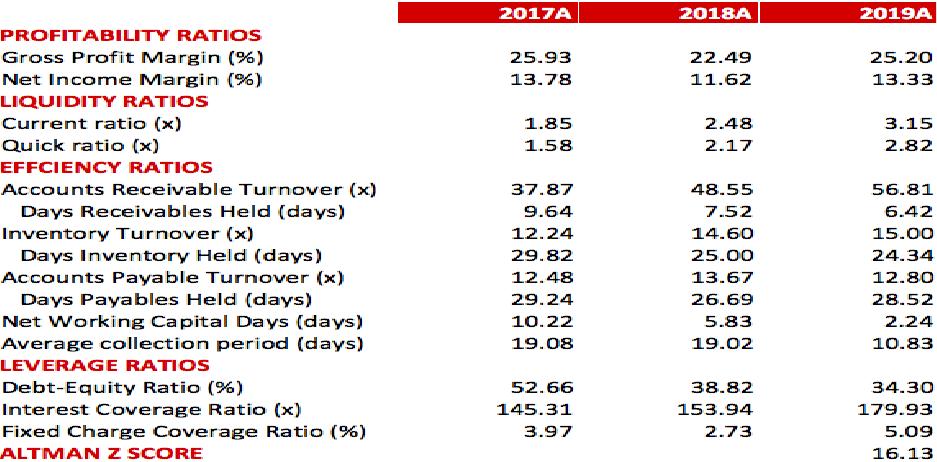
inventory held decreased year on year. This leads to the significant drop in net working capital days from
10.22 days 2017A to only 2.24 days 2019A. Specially, SABECO’s Altman Z score is 16.13, it indicates the
healthy status of the company during 2019A.
Table 1: SABECO’S KEY RATIOS
Sources: Group calculation
Collateral:
SABECO includes 26 breweries and 10 trading subsidiaries and holds a distribution network consisting of
100,000 retailers nationwide.
Conditions:
It is undeniable the Vietnamese beer market has shown an optimistic trend recently. According to a recent
study by market research firm Statista, the annual growth rate of Vietnam beer market will increase by 5.6%
from the year 2019 to 2023. In other words, Vietnamese will pay USD 9.6 billion to drink beer in 2023.
Although there are numerous beer brands on Vietnamese market today, more than 90% of the Vietnamese
market share belongs to big beer brands like SABECO, Habeco, Carlberg and Heineken. Specifically,
SABECO and Heineken are the two big brands in the market with more than 60% of the market share.
However, SABECO, which is the leader in the beer market, also has pressure from the second-ranked
competitor, Heineken. As claimed by SABECO’s management said that even though they have seen an
increasing market share in rural areas, there is also a strong competition pressure in urban areas.
Capital:
In the year 2017, a unit of Thai Beverage (ThaiBev) invested nearly VND110 trillion ($4.8 billion) on
acquiring nearly 54% of Vietnam’s largest beer brand, the Saigon Beer Alcohol and Beverage Corporation
(SABECO). More than 343.66 million SABECO shares were sold to the unit, Vietnam beverage, at the
starting price of VND320,000 ($14.05) at the December 18 auction. SABECO’s foreign ownership is
capped at 49 percent. Along with 10 percent already in foreign investors’ hands, 39 percent left for overseas
buyers at the December 18 auction. The sales is made to attract significant attention from both domestic
and foreign investors, which give the company’s leading position in the industry. Additionally, SABECO
holds about 41 percent of the nation’s $6.5 billion beer market
2. PARSER
One common credit scoring system referred to lenders is known as PARSERS. This is an acronym for the
different areas regarded as important by commercial lenders.
The P stands for personality of the company, which refers to the person and how much the lender knows
about them, whether they have a clarified track record in the business, and how well the business plan has
been researched. Last year, Vietnam Beverage bought over 343.6 million SAB shares (equivalent to 53.6%
of capital) at the price of VND 320,000 per share, equal to the starting price from state shareholders.
According to experts, after taking control of the target companies, investors will use a variety of methods
to repay or transfer debt. Experts also said that the fact that debts are difficult to assign directly to
SABECO’s balance sheet, but there are many ways to restructure borrowed debts.
The A stands for the amount that is being requested and affordability. Based on the company’s financial
statements in 4 recent years, it can be seen that the company has a high ability to repay loans. The company’s
average profit increased sharply from 2017 to 2019. For the whole year, SABECO achieved revenue of