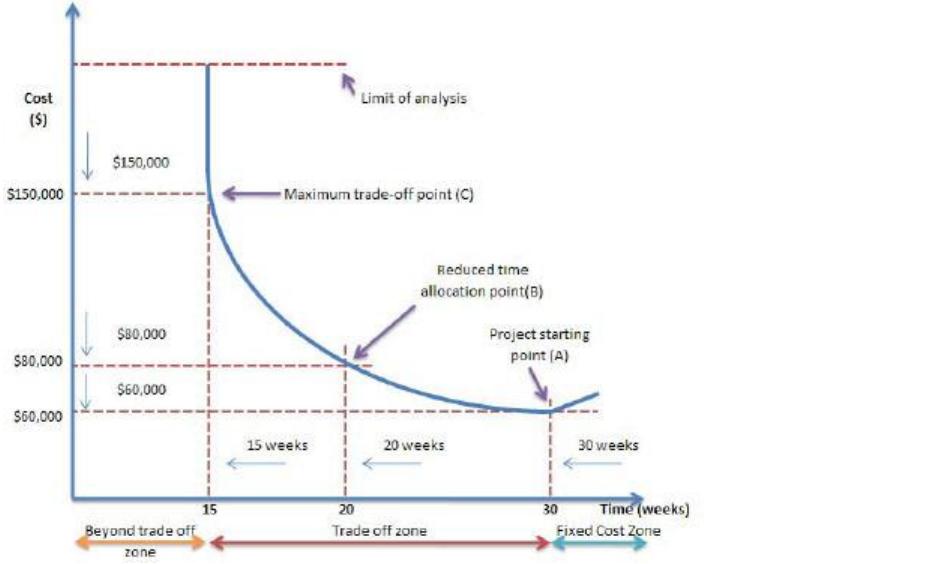
In crash analysis, the project manager offers re-planning advice based on the
relationships between time and cost. This of course assumes that performance
or quality criteria are fixed, as is the case in most projects. In most cases the
specified outcome is fixed.
A Guide to the Project Management Body of Knowledge (PMBOK® Guide) –
Fourth Edition defines crashing as, “A schedule compression technique in which
costs and schedule tradeoffs are analyzed to determine how to obtain the
greatest amount of compression for the least incremental cost.”
As a compression technique, crashing concentrates on the project schedule in an
effort to accelerate the project’s completion date. Plausible examples of crashing
include the following:
• Over-time
• Allocating additional resources to specific activities
• Hiring additional resources
• Incentive payments for early completion
• Subsequently outsourcing portions of the project to be completed within a
shorter time period than would have been possible if the same work was to be
completed by internal resources.