Country Paper Assignment / China
Introduction
The objective of this paper is to inform the reader about the tax structure of China as well as the
Tax Treaty the country has with The United States (U.S.). By the end of the reading, you should know
more about the facts of China, how its tax structure has evolved over the years and the major differences
between the tax treaty in force with The U.S. and the U.S. Model Tax Treaty. We hope that this paper
helps the reader develop more knowledge about China, and it helps them understand how business is done
in the country.
Pertinent Facts about China
The People’s Republic of China, established on October 1, 1949, is one of the oldest civilizations
in the world. Its history began around 1.7 million years ago, where one of the first dynasties, Xia Dynasty,
dominated around 2070 BC through 1600 BC. Located in the Middle and East Asia, China is the third
largest country on earth with 9,600,000 square kilometers or 3,706,580 square miles. The Republic is
bordered by 14 countries like Korea, Russia, Pakistan, Afghanistan, Mongolia, Nepal, India, among
others. Its capital, Beijing, is one of the largest and most populated capitals in the globe. (China Facts)
As of 2014, China has a population of 1.37 billion with 55 ethnic minorities which make the
country the most populated one in the World. The Chinese people are proud to be the largest nationality
on earth, living around on almost every single nation on the planet. (China Facts) New York is considered
the city with the largest Chinese population outside Asia with more than 680,000 individuals living in
nine different Chinatowns. San Francisco, Los Angeles, and San Jose are other cities with a strong
presence of the Asian community in The United States. Canada also has two cities, Vancouver and
Toronto, with huge Chinese population. Vancouver has approximately 400,000 individuals living in the
largest Chinatown in Canada. (By Dot Chinese)
The official language of China is the Mandarin which was recognized by the United Nations as
one of the official’s languages in the world. The Mandarin is spoken by about one-fifth of the population
on earth. The country also has around ten different dialects of which four of them are recognized as
official by the government. The official dialects are North China, Northwest China, Southwest China, and
Yangtze-HuaiRiver. The non-official dialects are Wu, Gan, Xiang, Yue, Min, and Hakka. English is a
COUNTRY PAPER / CHINA
required course in the education of the Republic to facilitate interaction with foreigners in hotels,
restaurants, and airlines, but the language is only spoken in large cities like Beijing, Shanghai, and Hong
Kong which are the places with more tourism in China. (China Facts)
China is well-known for the extensive history, splendid culture, and unique customs. Among the
greatest inventions belonging to the Chinese Civilization are the papermaking, gunpowder, printing, and
the compass. China has made great contributions to architecture with the construction of The Great Wall
and The Terracotta Warriors. The Great Wall is one of the Greatest Wonders of the World, and The
Terracotta Warriors is considered one of the most significant archeological excavations of the 21st
century. The UNESCO listed them as a World Heritage in 1987. China is known officially as an atheist
country, but with such a huge population this is very difficult to determine. Some of the main religions
and beliefs practice there are Confucianism, Buddhism, Taoism, Islam, Catholicism, and Protestantism.
The country is governed by a system of National People’s Congress that has divided China into
Administrative Demarcations including 23 provinces, 5 autonomous regions, 4 municipalities, and 2
Special Administrative Regions. (China Facts)
The official currency of China is the Renminbi or people’s currency issued by the People’s Bank
of China. The short official name of the currency is China Yuan and it is known by the symbol ¥. (China
Facts) The current exchange rate for one U.S. Dollard into one China Yuan is 6.91842. (Historical
Currency) As an interesting fact, the currency used in Hong Kong is the Hong Kong Dollar and its symbol
is HKD$. (China Facts) The current exchange rate for one U.S. Dollard into one Hong Kong Dollard is
7.75611 (Historical Currency) The form of Government is a system of National People’s Congress. China
is one of the most interesting countries of the planet, and it is going to be a privilege and a challenge to
write about its Tax Structure and the Tax Treaty in place with the United States. (China Facts)
China’s Current Tax Structure
The tax system in China is comparatively new. Mainly formed by domestic companies until
around the 1980s that its system was reformed, with a specific end goal to control foreign enterprises and
foreign invested enterprises. Taxes provide the most important revenue source for the Government of the
People’s Republic of China. As the most important source of fiscal revenue, tax is a key component of
macroeconomic policy, and greatly affects China’s monetary and social evolution. In 1994 the tax system
2
COUNTRY PAPER / CHINA
suffered some changes, China has preliminarily set up a streamlined tax system geared to the socialist
market economy. The public entity overseeing of tax policy is the Ministry of Finance. For tax
collection, State Administration of Taxation. China’s tax revenue came to 11.05 trillion yuan (1.8 trillion
U.S. dollars) in 2013, up 9.8 percent on 2012. (Chinese Tax)
In China, the taxes are not just in one law. There is a fundamental law giving the wide standards
of every tax. Points of interest are given by implementing regulations and specific rules in the form of
circulars issued by the State Administration of Taxation (SAT) or the Ministry of Finance (MOF). The
language of the law is Chinese and if laws have been translated, Chinese version is the most authoritative
one. China’s tax administration is characterized by the important discretionary power given to the local
authorities. The regulation-making is not strictly centralized. (Chinese Tax)
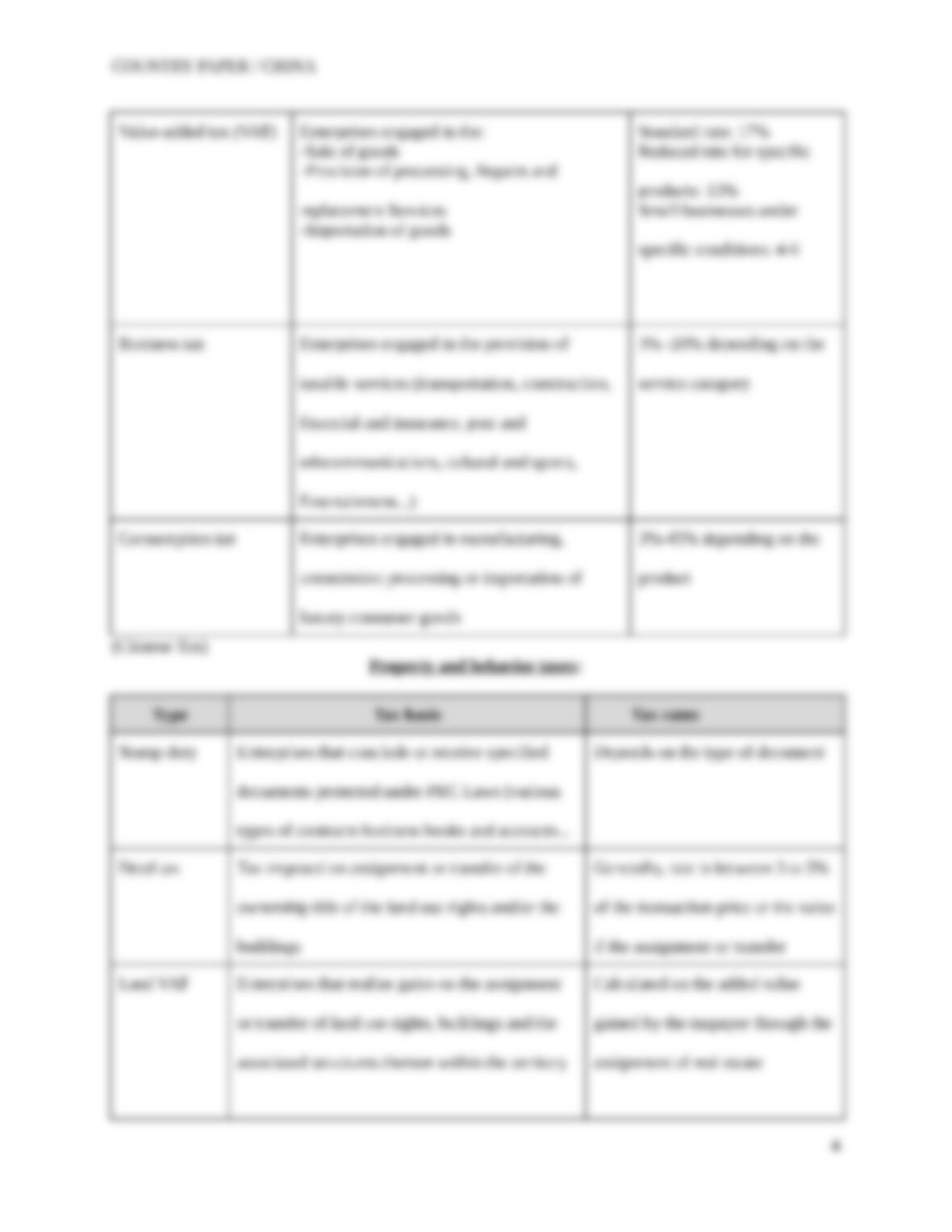
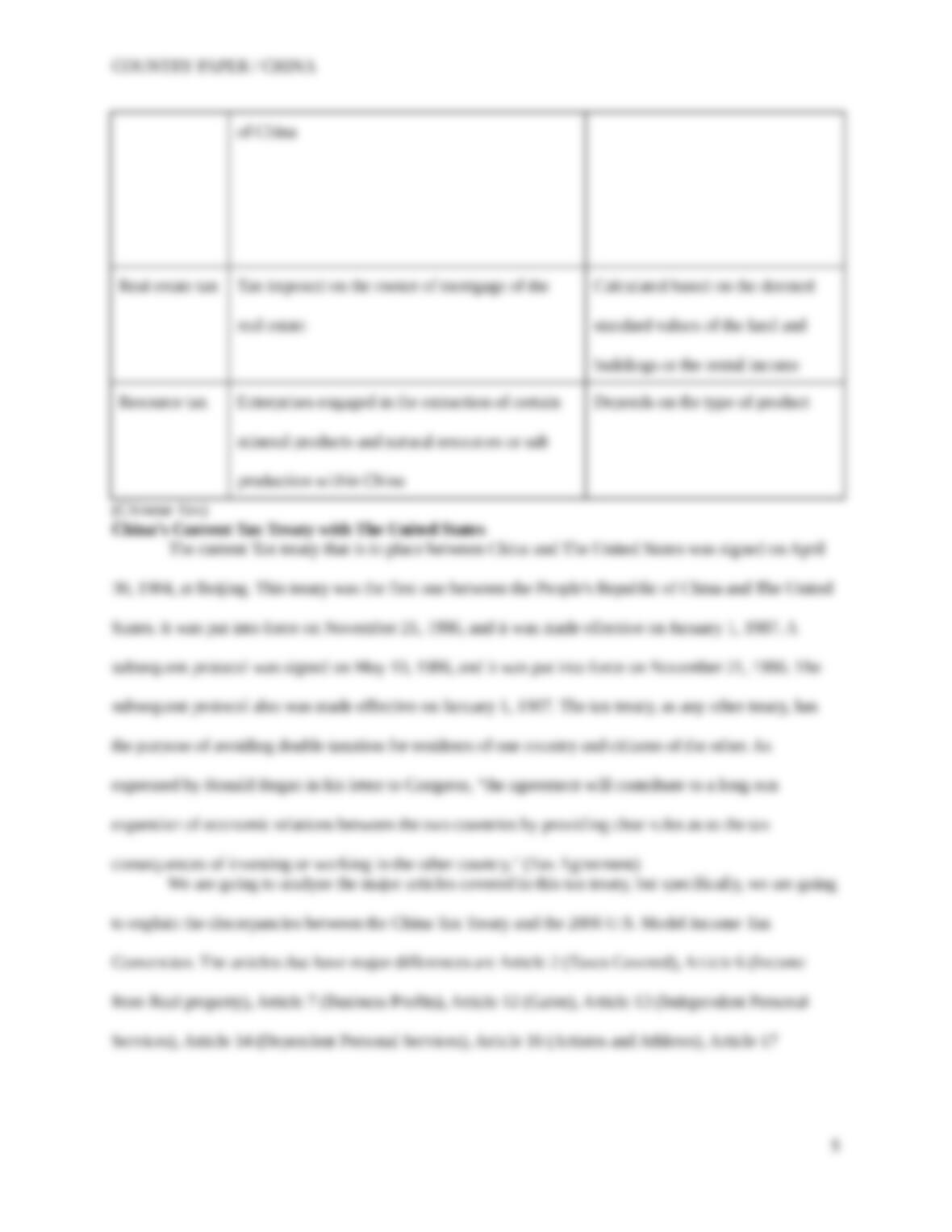
There are 7 categories which are composed of 24 taxes in China: turnover, income, resource,
property and behavior, prescribed items, agriculture and customs taxes. The most important are described
as follows: (Chinese Tax)
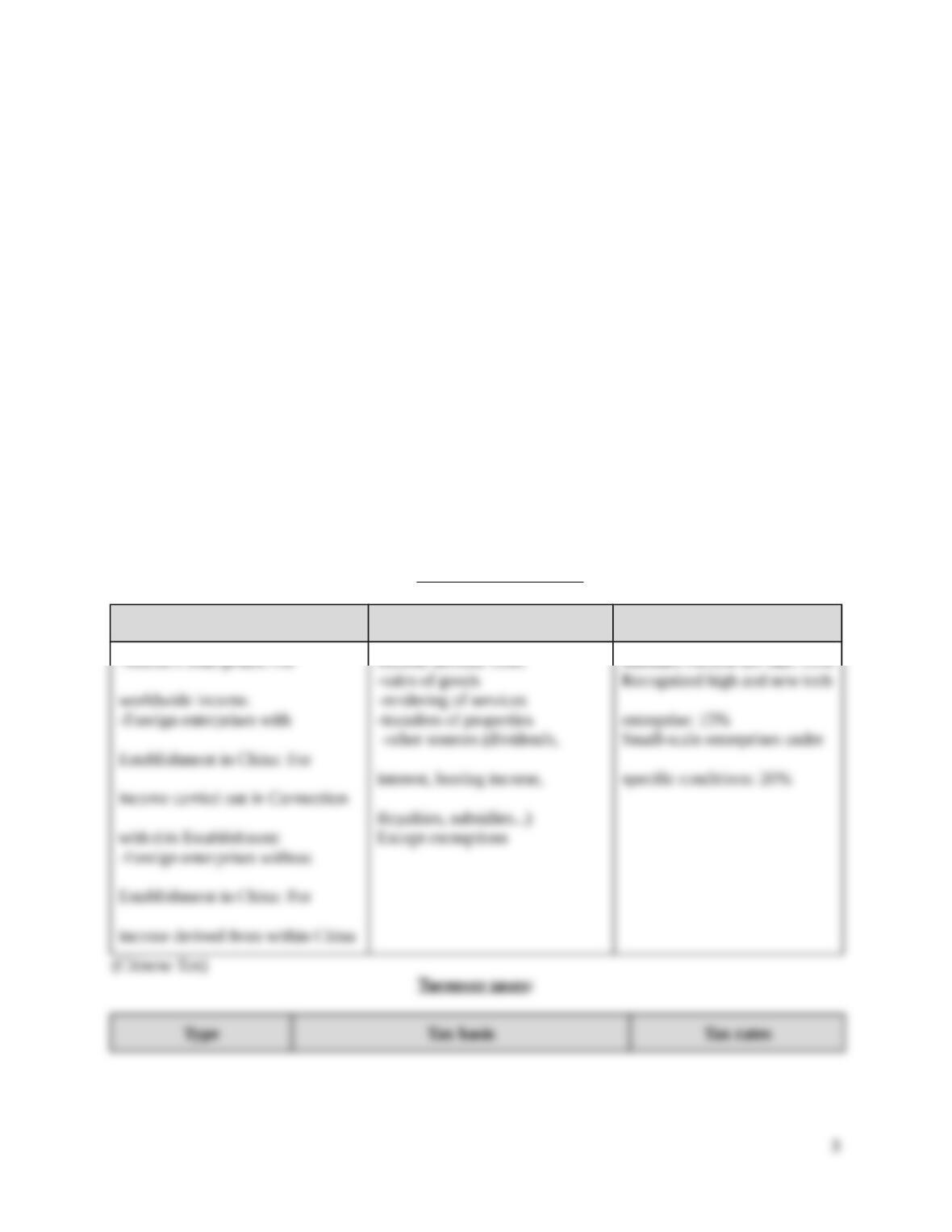
Enterprise Income Tax:
Liability to tax Taxable basis Tax rates