Counterfeiting 1
Counterfeiting
History of Counterfeiting
One of the oldest crimes in United States history
Counterfeiting is known as one of the oldest crimes in United States history, dating back
as far as the American Revolution. During that time the British counterfeited U.S. currency in
such large amounts that it became worthless (Know Your Money, 2008, History of Counterfeiting
section, ¶ 2). Even though counterfeiting was considered treasonous and punishable by death, it
still continued to grow without regard for the law. By the start of the Civil War, the United States
government estimated that one-third to one-half of the money in circulation was fake. Because
every bank created its own currency, each bank had a different design. This made it impossible to
make the distinction between real and counterfeit (Know Your Money, 2008, History of
Counterfeiting section, ¶ 3). Finally, in 1862 the United States government started to produce its
own currency, to put a stop to the counterfeiting problem. This attempt to stop the counterfeiting
did very little; once criminals were able to reproduce the newly formed government currency, it
soon circulated in the economy. The United States finally sought to stop this problem
permanently. Thus the Secret Service was established on July 5, 1865 to stop the spread of the
counterfeited currency (Know Your Money, 2008, History of Counterfeiting section, ¶ 4). Even
though the Secret Service has greatly reduced the counterfeiting problem, it still poses a threat to
the United States economy (Know Your Money, 2008, History of Counterfeiting section, ¶ 5).
Definition of Counterfeiting
Money is considered one of the most important things to a human being; it enables
humans to purchase the basic essentials and to satisfy their wants and needs. Counterfeiting
Counterfeiting 2
enables a criminal to do this with ease. Counterfeiting is defined as the illegal reproduction of
national currency without the proper approval or consent of the United States government.
Counterfeiting is becoming once again a growing problem, because of how easy it is to produce
counterfeit bills with basic computer operation. Someone could produce massive amounts of
counterfeit bills with a computer and printer (Know Your Money, 2008, History of Counterfeiting
section, ¶ 6). No real way exists to fully stop the production and distribution of counterfeit
money; technology is growing faster than the security features on the currency, making it
impossible to stop. However, with the proper detection tools and education, the passing of
counterfeit money will be greatly reduced.
Production
Basic computer skills
Counterfeiting is a crime that evolves as time goes on and technology advances. The
traditional method to produce counterfeit money is known as “off-set printing,” which requires
its own set of skill to do. However, due to increased technology, criminals are moving to
scanners, computers and the use of ink-jet printers to rapidly produced counterfeit bills in
substantial amounts. Even someone with basic computer knowledge could produce a counterfeit
bill with ease. Due to the advances of technology, the amount of counterfeit bills in circulation is
likely to increase because of the availability and capabilities of these machines (Know Your
Money, 2008, Advanced Technologies in Counterfeiting section, ¶ 5). Since this technology is
used by the general population, even operators with limited skills are able to produce high-
resolution color copies with everyday office machines (Know Your Money, 2008, Office Machine
Copiers/Printers section, ¶ 1). With the right machines, even young kids can produce counterfeit
Counterfeiting 3
bills; for example: “In Milford, Mich., detectives this month were investigating the case of a 15-
year-old boy who allegedly photographed currency on a scanner copier and passed it off at his
high school cafeteria” (Leinwand, 2008).
If someone this young was able to do this with his computer at home, anyone could do it
at any given time. Just to think in a few years technology will be even further advanced that
anyone “with even the cheapest printer, you’ll be able to counterfeit money. The pizza delivery
comes, you’re short $10. No problem. Scan the $10 bill you do have into a computer, hit print,
and you’ve got a perfect fidelity bill. In short, the United States will not be able to stop
counterfeiting by making paper currency more and more intricate. Printers will reproduce any
image” (Davidson, 2007). Methods of production will continue to advance as long as the
technology that supports it advances.
Raised notes
Raising the value of a genuine paper note is also considered counterfeiting. This is when
an actual legit bill is taken and the denomination is raised higher by taking the numbers off a
higher denomination bill and gluing them over top of the smaller one in an attempt to increase
the bill’s face value (Know Your Money, 2008, Raised Notes section, ¶ 1). This is easily noticed
because the general public has the common knowledge of who appears of what bill. Also in the
area that the higher denomination was glued the paper color doesn’t match; it is usually darker or
lighter compared to whole bill, and the numerals don’t equal the actual value written on the
bottom of the bill (Know Your Money, 2008, Advanced Technologies in Counterfeiting section, 
2).
Counterfeiting 4
These raised bills might not appear legitimate at a glance. However, to a skilled
counterfeiter raised notes is more than just cutting and pasting a higher denomination on a
smaller bill. Counterfeiters take a legitimate bill and “wash” it with bleach; then by making a few
alterations to the smaller bill it appears as if it were actually a $100 bill (Monson, 2009). If
someone took the time out to examine the bills they would notice that the face of Abraham
Lincoln appears in the right-hand corner when held up to the light rather than the ghost image of
Benjamin Franklin. However, this form of counterfeit money seems to slip through the cracks
quite often because of how fast pace society is today. For example, there is a line forming at the
market and there’s a rush to get everyone through the line. The cashier is handed a $100 bill and
at a glance it seems real; the cashier is not going to take the time out and fully examine the bill.
So they accept it, and that bill is put into circulation if not found at a later time (Monson, 2009).
Distribution
Exchanging marked bills for real currency
The most common form of distribution of a counterfeit bill is going to a store and buying
a relatively cheap item, and in return the cashier hands back real currency as change. This is
where most of the counterfeit bills get into circulation, because no one is expecting someone who
buys a cheap item such as ice tea to be passing off counterfeit money so in exchange that person
who passed off the phony bill is handed legitimate currency as their change (Monson, 2009).
This happens often because the counterfeiter is trying to “clean” their money, in other words get
rid of fake bills in exchange for the real ones. For example, a restaurant known as “The Jukebox”
located in Indian Trail, North Carolina no longer accepts anything larger than a $50 bill after a
teen paid for an $11order with a counterfeit $100 bill and walked away with $89 in real currency.
Counterfeiting 5
Counterfeiters put the fake money into circulation by buying everyday things without cashier
knowing a thing (Johnson, 2009).
Laundering
The primary use of counterfeit bills in today’s world is to fund terrorism. The amount
recovered by federal agents reach well into the millions of dollars, and continues to increase. The
seized counterfeit money is coming from all over the world, so counterfeiters are producing
massive amounts of phony bills in foreign countries and trying to smuggle them into the United
States. Various banks estimated that about $7.8 million dollars in fake bills were discovered in
banks across the United States. From the evidence gathered by the Secret Service, these notes
were created in Peru (Counterfeit U.S. Money from Peru “A Form of Economic Terrorism, 2009).
In some cases, the counterfeiters that produce massive amounts use small banks to help launder
the money. For example, a tiny bank in the Chinese enclave of Macau allowed North Korea to
pass their “supernotes” through, so the bills would be put into circulation (Hall, 2008). North
Korea is a key player in the laundering of counterfeit currency; in an undercover investigation by
the United States Secret Service revealed that a Chinese nationalist working for the North
Korean government was in charge of selling weapons as well as counterfeit bills (Counterfeiting:
Notes on a Scandal, 2009). Eventually the phony bills would make their way out into the world
and into circulation (Hall, 2008). Sean Garland, a leader of Irish Republican Army was also
brought up on charges of laundering over one million dollars in fake bills into Europe; the
“supernotes” origins were traced back to North Korea (Counterfeiting: Notes on a Scandal,
2009). With the laundering of counterfeit bills increasing, the confidence in United States
currency is decreasing, which starts to take an effect on the United States as well as its economy.
Counterfeiting 6
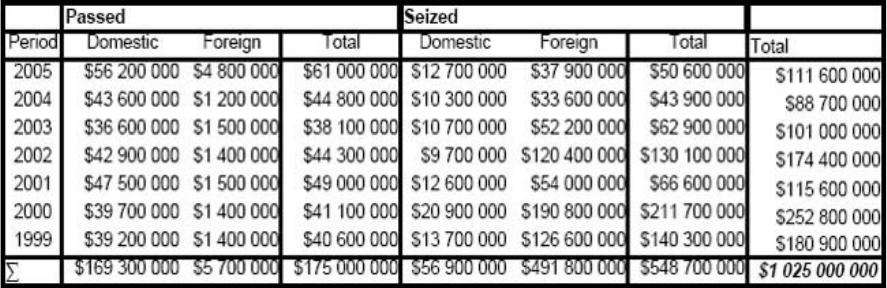
In figure one, the amount of counterfeit bill passed and seized by United States agencies are
shown.
Figure 1: United States Dollars Counterfeiting Statistics
Adapted from: Counterfeiting statistics – EURO; US Dollars; Russian Rubles, Indian Rupees. (2009).
Effects
Millions of dollars in counterfeit money is being passed off each year; this is costing
United States citizens millions of dollars in losses. Since United States currency is also accepted
as a form of payment in some countries around the world, the citizens of that country are also
being affected (Counterfeit U.S. Money from Peru “A Form of Economic Terrorism, 2009). Since
nearly $70 million of fake currency gets used daily, it is likely that some way or another
everyone has felt the affect. As long as counterfeit bills continue to be produced, the consumers
as well as the economy will continue to be affected, with loses reaching ridiculous amounts
(Chemists and Security Scientists Add New Technology to Redesigned Five Dollar Bill, 2008).
Like consumers, businesses are also affected by counterfeiting. Businesses do what they
can to help fight the counterfeit money, but sometimes they are not successful. Some counterfeit
bills slip through the cracks, and when that happens money is lost. When that happens “the
Counterfeiting 7
retailer’s usually the one that will end up eating the cost of the counterfeit bill,” since there is no
way to find out whom they received the bill from. Federal law does nothing to return the lost
money to the victim; therefore they take the hit for what is lost (Chemists and Security Scientists
Add New Technology to Redesigned Five Dollar Bill, 2008). Businesses try to prevent counterfeit
passing; “they become more vigilant, working with police on the latest counterfeiting techniques
and improving their own detection systems” (Monson, 2009). However, if a bill gets through, it
becomes part of the billions of dollars in circulation and it finds its way through the economy.
Counterfeit money is a devastating blow to the United States economy; counterfeiting
rings have produced so much counterfeit bills that it’s actually causing people and foreign
governments to second guess the value of United States currency (Counterfeit U.S. Money from
Peru “A Form of Economic Terrorism, 2009). Even when the United States government tries to