1
– 1 –
TEACHING NOTE
CASE 4
Costco Wholesale Corp. in 2016:
Mission, Business Model, and Strategy
Overview
Four years after being appointed as Costco Wholesale’s president and chief executive officer, Craig Jelinek
was proving fully capable of cementing the company’s standing as one of the world’s biggest and best
consumer goods merchandisers. His predecessor, Jim Sinegal, cofounder and CEO of Costco Wholesale
from 1983 until year-end 2011, had been the driving force behind Costco’s 28-year evolution from a startup
entrepreneurial venture into the third largest retailer in the United States, the seventh largest retailer in the world,
and the undisputed leader of the discount warehouse and wholesale club segment of the North American retailing
industry. Jelinek was handpicked by Sinegal to be his successor. Since January 2012, Jelinek had presided over
Costco’s growth from annual revenues of $89 billion and 598 membership warehouses at year-end fiscal 2011
to annual revenues of $116 billion and 686 membership warehouses at year-end fiscal 2015. Going into 2016,
Costco ranked as the second largest retailer in both the United States and the world (behind Walmart).
In early 2016, there were about 1,440 warehouse locations across the United States and Canada; most every major
metropolitan area had one, if not several, warehouse clubs. Costco had about a 59 percent share of warehouse
club sales across the United States and Canada, with Sam’s Club (a division of Walmart) having roughly a 34
percent share and BJ’s Wholesale Club and several small warehouse club competitors close to a 7 percent share.
Competition among the warehouse clubs was based on such factors as price, merchandise quality and selection,
location, and member service. However, warehouse clubs also competed with a wide range of other types of
retailers, including retail discounters like Walmart and Dollar General, supermarkets, general merchandise
chains, specialty chains, gasoline stations, and Internet retailers. Not only did Walmart, the world’s largest
retailer, compete directly with Costco via its Sam’s Club subsidiary, but its Walmart Supercenters sold many of
the same types of merchandise at attractively low prices as well. Target, Kohl’s, and Amazon.com had emerged
as significant retail competitors in certain general merchandise categories. Low-cost operators selling a single
category or narrow range of merchandise—such as Trader Joe’s, Lowe’s, Home Depot, Office Depot, Staples,
Best Buy, Circuit City, PetSmart, and Barnes & Noble—had significant market share in their respective product
categories. Notwithstanding the competition from other retailers and discounters, the low prices and merchandise
selection found at Costco, Sam’s Club, and BJ’s Wholesale were attractive to small business owners, individual
households (particularly bargain-hunters and those with large families), churches and non-profit organizations,
caterers, and small restaurants.
As of January 2016, Costco was operating 698 membership warehouses, including 488 in the United States
and Puerto Rico, 90 in Canada, 36 in Mexico, 27 in the United Kingdom, 24 in Japan, 12 in South Korea, 11 in
Taiwan, 8 in Australia, and 2 in Spain. Costco also sold merchandise to members at websites in the United States,
Canada, the United Kingdom, Mexico, and South Korea. Over 81 million cardholders were entitled to shop at
Costco, generating over $2.5 billion in membership fees for the company. Annual sales per store averaged about
Case 4 Teaching Note Costco Wholesale Corp. in 2016: Mission, Business Model, and Strategy
2
$166 million ($3.2 million per week), some 86 percent higher than the $89 million per year and $3.4 million per
week averages for Sam’s Club, Costco’s chief competitor. In 2014, 165 of Costco’s warehouses generated sales
exceeding $200 million annually, up from 56 in 2010; and 60 warehouses had sales exceeding $250 million,
including 2 that had more than $400 million in sales.4 Costco was the only national retailer in the history of the
United States that could boast of average annual revenue in excess of $160 million per location.
The case spotlights Costco’s mission, business model, and strategy, but it also contains good coverage of
the company’s warehouse operations, compensation practices, business philosophy, core values, and ethical
standards. The company is interesting in several important respects:
nCostco’s mission in the membership warehouse business was “To continually provide our members with
quality goods and services at the lowest possible prices.”
nThe centerpiece of Costco’s business model entailed generating high sales volumes and rapid inventory
turnover by offering fee-paying members attractively low prices on a limited selection of nationally
branded and selected private-label products in a wide range of merchandise categories. Membership
fees were a critical element of Costco’s business model because they provided sufficient supplemental
revenues to boost the company’s overall profitability to acceptable levels.
nThe cornerstones of Costco’s strategy were low prices, a limited product line and limited selection, and
a “treasure hunt” shopping environment. Costco’s philosophy was to keep customers coming in to shop
by wowing them with low prices and thereby generating big sales volumes.
nCostco attracted the most auent customers in discount retailing—the average income of individual
members was about $75,000, with over 30 percent having incomes of $100,000 or more annually. Many
members were auent urbanites, living in nice neighborhoods not far from where Costco warehouses
were located.
nWhereas typical supermarkets stocked about 40,000 items and a Wal-Mart Supercenter or SuperTarget
might have as many as 150,000 items for shoppers to choose from, Costco’s merchandising strategy was
to provide members with a selection of only about 3,700 items. Of these, about 85 percent were quality
brand-name products and 15 percent carried the company’s private-label Kirkland Signature brand,
which were a growing percentage (over 20 percent) of merchandise sales.
nEmployee compensation at Costco was higher than at Sam’s Club. Jim Sinegal was convinced that
having a well-compensated workforce was very important to executing Costco’s strategy successfully.
He said, “It has to be a significant advantage for you….. paying good wages and keeping your people
working with you is very good business.” Moreover, executives at Costco did not earn the outlandish
salaries that had become customary over the past decade at most large corporations.
Suggestions for Using the Case
This case was written to (1) illustrate the CEO’s role as chief strategist and organization leader, (2) demonstrate
how a company’s business principles and core values can link tightly to and drive a company’s strategy and
operating practices, and (3) give students practice in evaluating a company’s direction and strategy in the highly
competitive retail marketplace. The case requires that students draw upon most all of the concepts discussed in
Chapters 1 and 2 in preparing the case for class discussion.
We think Costco Wholesale is an excellent leadoff case for the course (other good choices are Mystic Monk
Coffee, Airbnb, and Amazon.com—all of which require that students draw upon the material covered in Chapters
1 and 2). Student familiarity with “big box” discount retailing, the very interesting character of Costco Wholesale
and its co-founder/former CEO Jim Sinegal, and the very close connection between the case and the material
in Chapters 1 and 2 make this an especially good leadoff case. You may want to consider covering Chapter 1 in
your first day’s lecture, Chapter 2 on your second day’s lecture, and then assigning Costco Wholesale for class
discussion on Day 3.

Case 4 Teaching Note Costco Wholesale Corp. in 2016: Mission, Business Model, and Strategy
3
However, if you opt for another lead-off case, we think you will find that the Costco Wholesale case works
exceptionally well (1) as part of your business strategy module (where you want students to draw from Chapters
1-7 in doing their analysis and making action recommendations), (2) as a comprehensive written case or oral
team presentation case, or (3) as an end-of-the-course or final exam case (because the case contains issues that
cut across topics covered in many of the 12 chapters). If you want to cover Chapters 1-7 before assigning a case
for class discussion, you’ll find that the Costco case contains ample information on industry and competitive
conditions and the businesses of Costco’s two chief competitors in North America—Sam’s Club and BJ’s
Wholesale. Thus, Costco Wholesale is one of those multi-faceted cases that will work nicely in any of several
places in your lineup of case assignments—although our preference is to use it as an early case assignment or a
leadoff case.
You’ll find ample opportunity here to explore Jim Sinegal’s style of managing, his values and business
principles, the company’s clever and innovative business model, the chief elements of its business strategy, and
the company’s financial performance. If you wait to assign the case until students have read Chapters 3, 4, and
5, then you can expect students to probe a bit deeper in evaluating Costco’s competitive strengths/weaknesses,
its potential for continued growth, and how well it is positioned to compete against Sam’s Club, BJ’s Wholesale,
and other big-box discounters like Walmart and Target. But students will really have no trouble wrestling with
the competitive issues and generating opinions without the benefit of having first covered Chapters 3, 4, and 5—
this is because they not only are likely to have shopped at one or more membership warehouses but also because
the strategic issues and analysis turn out to be fairly clear-cut, which is why Costco Wholesale makes such a
good early assignment or leadoff case.
We suggest use of a teaching plan that focuses on Jim Sinegal’s business principles and management philosophy,
how well Craig Jelinek is performing as Sinegal’s successor, the various aspects of Costco’s business model,
the company’s strategy and growth initiatives, its compensation and benefits practices, why shopping at Costco
appeals to upscale consumers, and whether the strategy is delivering good financial performance. If class
members have read Chapter 3, then you can also make a point of press class members for their five-forces
analysis of competitive conditions in the North American wholesale club industry.
The assignment questions and teaching outline presented below reflect our thinking about how to conduct
the class discussion.
Videos for Use with the Costco Case. As a way to set the stage for class discussion, we suggest showing
either or both of the following videos
nA 2:26-minute video shot in 2015 entitled “Jim Cramer Discusses Why Costco Is King.” It can be
accessed at https://www.youtube.com/watch?v=mCU1hLF7jE0.
nA 2:46-minute video shot in 2015 and broadcast on the TV news program “Nightly Business Report” titled
“Costco Strikes a New Deal;” it can be accessed at https://www.youtube.com/watch?v=mCU1hLF7jE0.
Links to the two videos are also posted in the instructor resources section of the Connect Library. Either or both
of the videos will be particularly helpful to students who have never been in a Costco or other wholesale club
store, and they also embellish some of the themes in the case.
The Connect-based Exercise for the Costco Case. We developed an exercise for the Costco Wholesale
case for inclusion in the publisher’s Connect™ Management web-based assignment and assessment platform
because
nThe case is very appropriate for use early in the course (following coverage of Chapters 1, 2, and 3).
nOne of the purposes of the Connect-based case exercises is to drill students in applying the concepts
and analytical tools discussed in the chapters to the circumstances posed in the cases.
Case 4 Teaching Note Costco Wholesale Corp. in 2016: Mission, Business Model, and Strategy
4
The Connect-based case preparation exercise for Costco Wholesale is framed around the following questions:
1. What are the chief components of Costco’s business model?
2. What are the chief elements of Costco’s strategy?
3. Draw a representative five-forces diagram for the North American wholesale club industry.
4. What is your assessment of the strength of competitive pressures stemming from rivalry among
Costco, Sam’s Club, and BJ’s Wholesale?
5. What is your assessment of the strength of competitive pressures stemming from the threat of entry of
new competitors into the North American wholesale club market?
6. What is your assessment of the strength of competitive pressures stemming from substitutes for
shopping at wholesale clubs?
7. What is your assessment of the strength of competitive pressures stemming from suppliers to the three
North America-based wholesale club competitors?
8. What is your assessment of the strength of competitive pressures stemming from the customers/
members of the three North America-based wholesale club competitors?
9. What is the collective strength of the five competitive forces facing the three North America-based
wholesale clubs?
Note that this exercise entails conducting a full-fledged five-forces analysis of competition in the wholesale
club industry (five-forces analysis is introduced in Chapter 3 and should be covered before asking the class
to complete the Connect-based exercise). It should take class members roughly 30-40 minutes to complete
the Costco Connect-based exercise, assuming they have read Chapters 1-3 and done a conscientious job of
reading and absorbing the information the Costco case contains. All aspects of the 9 questions in this exercise
are automatically graded and entered in your electronic grade book that is part of the Connect platform, which
makes it easy for you to evaluate each class member’s understanding of what five-forces analysis is all about and
the extent to which they can accurately gauge the strength of the various competitive forces that prevail in the
wholesale club industry.
Unless you want to use a particular case exercise for testing purposes, the best approach to using the Connect
case exercises is to require all class members to complete this exercise for the Costco case before coming to
class on the day the case has been assigned. Students definitely need practice in doing a five-forces analysis—it
is not as simple as it might look to do an insightful analysis of competitive pressures. Certainly, students that do
a conscientious job of completing the exercise will be better prepared to make meaningful contributions to the
discussion of what competition is like in the wholesale club industry, as opposed to merely giving off-the-cuff
opinions.
What to Tell Students in Preparing the Costco Case for Class. To give students guidance in what to do
and think about in preparing the Costco case for class discussion, we strongly recommend two things:
1. Have class members complete the Connect-based exercise for the Costco case (in the event you have
opted to make the Connect supplement for the 21st Edition a part of the materials required for your
course).
2. Provide class members with assignment questions (in addition to what is covered in the Connect
exercise) and insist that they prepare good notes/answers to these questions before coming to class.
Our recommended assignment questions for the Costco case are presented in the next section of this
TN. Since there are 12 assignment questions, you may want to have students focus on a subset of the
questions (depending on how you want to conduct the class discussion).
Case 4 Teaching Note Costco Wholesale Corp. in 2016: Mission, Business Model, and Strategy
5
To facilitate your use of assignment questions and making them available to students, we have posted
a file of the Assignment Questions contained in this teaching note in the Instructor Resources section
of the Connect Library). (You should be aware that there is a set of assignment questions posted in the
student OLC for each of the 31 cases included in the 21st edition.)
In our experience, it is quite difficult to have an insightful and constructive class discussion of an assigned
case unless students have conscientiously have made use of pertinent core concepts and analytical tools in
preparing substantive answers to a set of well-conceived study questions before they come to class. In our
classes, we expect students to bring their notes to the study questions to use/refer to in responding to the
questions that we pose. Moreover, students often find that a set of study questions is useful in helping them
prepare oral team presentations and written case assignments—in addition to whatever directive question(s)
you supply for these assignments. Hence, we urge that you provide students with assignment questions—
either those we have provided or a set of your own questions—for all those aspects of an assigned case that
you believe are worthy of student analysis or that you plan to cover during your class discussion of the case.
Utilizing the Guide to Case Analysis. If this is your first assigned case, you may find it beneficial to have
class members read the Guide to Case Analysis that is available when you adopt the 21st edition. The content of
this Guide is particularly helpful to students if your course is their first experience with cases and they are unsure
about the mechanics of how to prepare a case for class discussion, oral presentation, or written analysis.
Suggested Assignment Questions for an Oral Team Presentation or Written Case Analysis. The
Costco case is quite suitable for both oral team presentations and a written case assignment. Our suggested
assignments for either an oral presentation or a written case assignment are as follows:
1. What is your assessment of Costco’s business model and strategy? How well is Costco’s strategy
working? What recommendations would you make to Costco management to sustain the company’s
growth and improve the company’s financial performance?
2. What is competition like in the North American wholesale club industry? Which of the five competitive
forces is strongest and why? Which of the three rivals—Costco, Sam’s, or BJ’s Wholesale—has the best
strategy? Why? Which of the three rivals has been the best performer? Five years from now, is Costco’s
standing as the industry leader likely to be stronger or weaker? Are the other two rivals likely to gain
or lose ground on Costco? Why? What recommendations would you make to Costco management to
sustain Costco’s growth and improve the company’s financial performance?
(Should time permit, you could ask for action recommendations pertaining to Sam’s Club and/or BJ’s
Wholesale. If you are using the case for oral presentations by two or more teams, then different teams could
be assigned different companies when it comes to proposing action recommendations.)
Assignment Questions
1. What is Costco’s business model? Is the company’s business model appealing? Why or why not?
2. What are the chief elements of Costco’s strategy? How good is the strategy?
3. Do you think Jim Sinegal was an effective CEO? What grades would you give him in leading the process of
crafting and executing Costco’s strategy? What support can you offer for these grades? How well is Craig
Jelinek performing as Sinegal’s successor? Refer to Figure 2.1 in Chapter 2 in developing your answers.
4. What core values or business principles did Jim Sinegal stress at Costco?
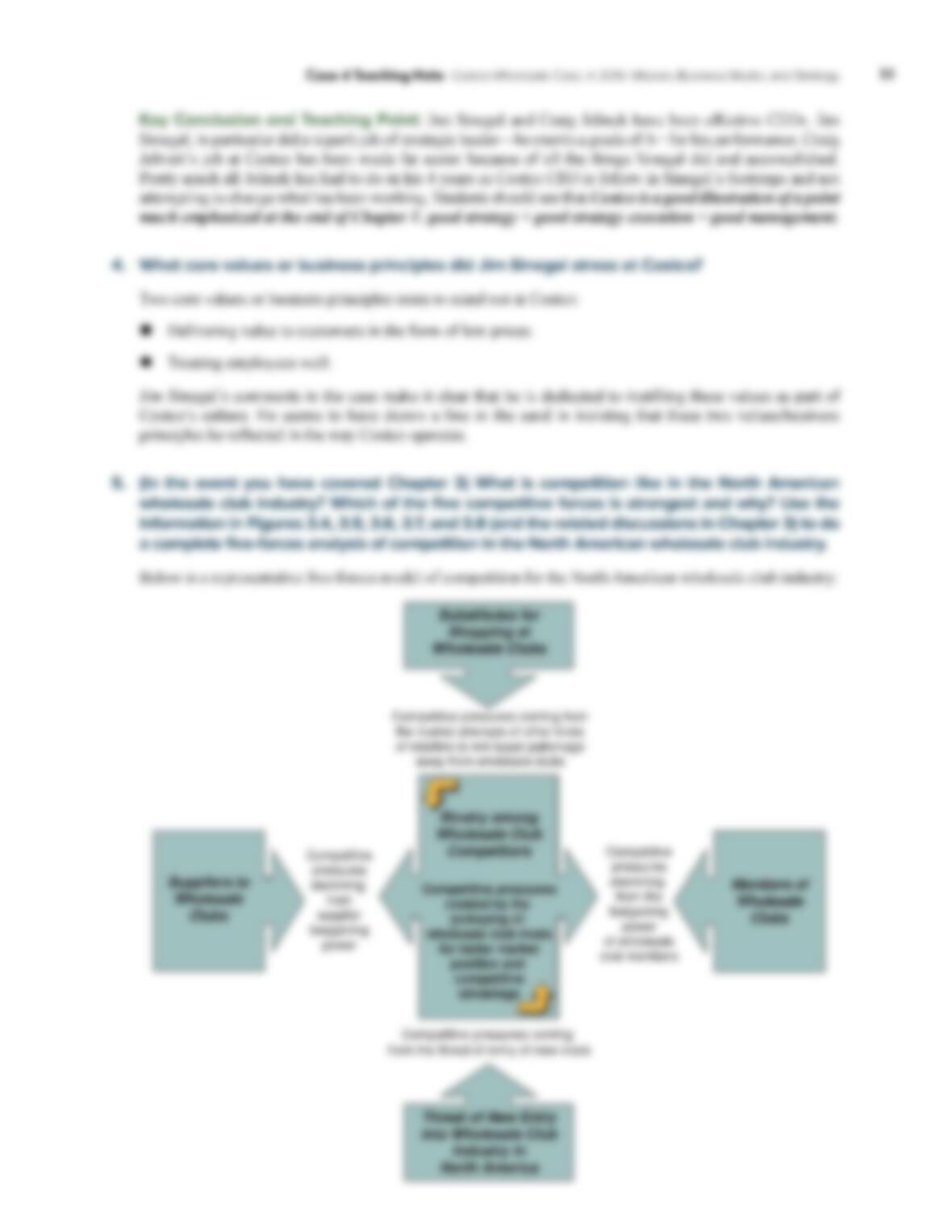
5. (In the event you have covered Chapter 3) What is competition like in the North American wholesale club
industry? Which of the five competitive forces is strongest and why? Use the information in Figures 3.4,
3.5, 3.6, 3.7, and 3.8 (and the related discussions in Chapter 3) to do a complete five-forces analysis of
competition in the North American wholesale club industry.
Case 4 Teaching Note Costco Wholesale Corp. in 2016: Mission, Business Model, and Strategy
6
6. How well is Costco performing from a financial perspective? Do some number-crunching using the data in
case Exhibit 1 to support your answer. Use the financial ratios presented in Table 4.1 of Chapter 4 (pages
85-87) to help you diagnose Costco’s financial performance.
7. Based on the data in case Exhibits 1 and 4, is Costco’s financial performance superior to that at Sam’s Club
and BJ’s Wholesale?
8. Does the data in case Exhibit 2 indicate that Costco’s expansion outside the U.S. is financially successful?
Why or why not?
9. How well is Costco performing from a strategic perspective? Does Costco enjoy a competitive advantage
over Sam’s Club? Over BJ’s Wholesale? If so, what is the nature of its competitive advantage? Does Costco
have a winning strategy? Why or why not?
10. Are Costco’s prices too low? Why or why not?
11. What do you think of Costco’s compensation practices? Does it surprise you that Costco employees
apparently are rather well-compensated?
12. What recommendations would you make to Costco top management regarding how best to sustain the
company’s growth and improve its financial performance?
Teaching Outline and Analysis
1. What is Costco’s business model? Is the company’s business model appealing? Why or why
not?
As discussed in Chapter 1, a company’s business model explains the rationale for why its business approach
and strategy will be a moneymaker. This rationale sets forth the key components of the company’s business
approach, indicates how revenues will be generated, and makes a case for why the strategy can deliver value
to customers and at the same time be profitable.
The information in the case lays out the chief components of Costco’s business model in a straightforward
manner:
nRequire the payment of membership fees to shop at Costco (Costco employs a “subscription” membership
business model)
nGenerate high sales volumes and rapid inventory turnover by offering members very low prices on a
limited selection of nationally branded and selected private label products in a wide range of merchandise
categories.
n The broad appeal of the company’s low prices created high levels of store traffic and produced big sales
volumes on many items.
n Management believed that rapid inventory turnover, when combined with the operating efficiencies
achieved by volume purchasing, efficient distribution and reduced handling of merchandise in no-
frills, self-service warehouse facilities, enabled Costco to operate profitably at significantly lower gross
margins than traditional wholesalers, mass merchandisers, supermarkets, and supercenters.
n Furthermore, Costco’s high sales volume and rapid inventory turnover generally allowed it to sell and
receive cash for inventory before it had to pay many of its merchandise vendors, even when vendor
payments were made in time to take advantage of early payment discounts. Thus Costco was able to
finance a big percentage of its merchandise inventory through the payment terms provided by vendors
rather than by having to maintain sizable working capital (defined as current assets minus current
liabilities) to facilitate timely payment of suppliers.
Case 4 Teaching Note Costco Wholesale Corp. in 2016: Mission, Business Model, and Strategy
7
2. What are the chief elements of Costco’s strategy? How good is the strategy?
The cornerstones of Costco’s strategy were low prices, a limited product line and limited selection, and a
“treasure hunt” shopping environment. The company was, moreover, a low-cost operator.
n Costco is pursuing a low-cost leader strategy (as students should quickly recognize from the discussions
in both Chapter 1 and Chapter 5). Costco’s CEO Jim Sinegal left no doubt about the company’s efforts
to be a low-cost operator when he stated:
n Costco is able to offer lower prices and better values by eliminating virtually all the frills and costs
historically associated with conventional wholesalers and retailers, including salespeople, fancy
buildings, delivery, billing, and accounts receivable. We run a tight operation with extremely low
overhead which enables us to pass on dramatic savings to our members.
n Costco’s strategic approach to pricing was to keep customers coming in to shop by wowing them with
low prices. Costco was known for selling top quality national and regional brands at prices consistently
below traditional wholesale or retail outlets. The company only stocked items which could be priced
at bargain levels and provide members with significant cost savings; this was true even if an item was
oft-requested by customers.
• A key element of Costco’s strategy to keep prices low to members was to cap the margins on brand
name merchandise at 14 percent (compared to 20 to 50 percent margins at other discounters and
many supermarkets).
• The margins on Costco’s private-label Kirkland Signature items were a maximum of 15 percent,
but the fractionally higher markups on Costco’s private label items still resulted in its private-label
prices being about 20 percent below comparable name brand items. The company’s private label
Kirkland Signature products—which included juice, cookies, coffee, tires, housewares, luggage,