Central to the decision to develop and implement a new or improved HRIS will be the costs and
benefits of the investment. Like most consumers, HR professionals and managers are frequently
awed by the new computer-based HR applications or the entire HRIS and make a purchase
decision on this basis. Without a comprehensive cost-benefit analysis, this purchase could be
disastrous.
Cost Justifying HRIS Investments
In most organizations today an HRIS system provides the primary infrastructure used to deliver
HR programs, ensure HR regulatory compliance, and produce the metrics that are used to
evaluate not only the HR function but also the contribution of the organization’s human
resources to the accomplishment of the firm-level strategic objectives.
HRIS functionality continues to evolve and to expand – no longer simply shifting paper-and-
pencil processes to their electronic equivalents but seeing new capabilities that leverage the
advantage of integrated information systems that are faster and more capable computing
technologies.
HRIS functionality refers to the number of programs or functions – such as recruiting,
compensation, job analysis – that are operational using the specific HRIS configuration as well as
features of these programs that enhance their usability and capacity to affect outcomes. Some
might be a fully integrated program or simply a number of more important programs for example
compensation and benefits.
HRIS functionality typically varies with organizational size, with larger companies having a
greater number of programs or functions in their HRIS configurations that smaller companies
HR Metric Tool Kit
Metrics provide a number of factors that can be measured to show how HR contributes to the
business. Measures such as absence rate, health cost per employee, and HR expense factors show
that HR has a sense of the importance of human capital measurement in supporting business
objectives. The following calculators are basic HR and business metrics to help measure your
company’s absence rate, cost per hire, the value of your human capital and human capital return
on investment.
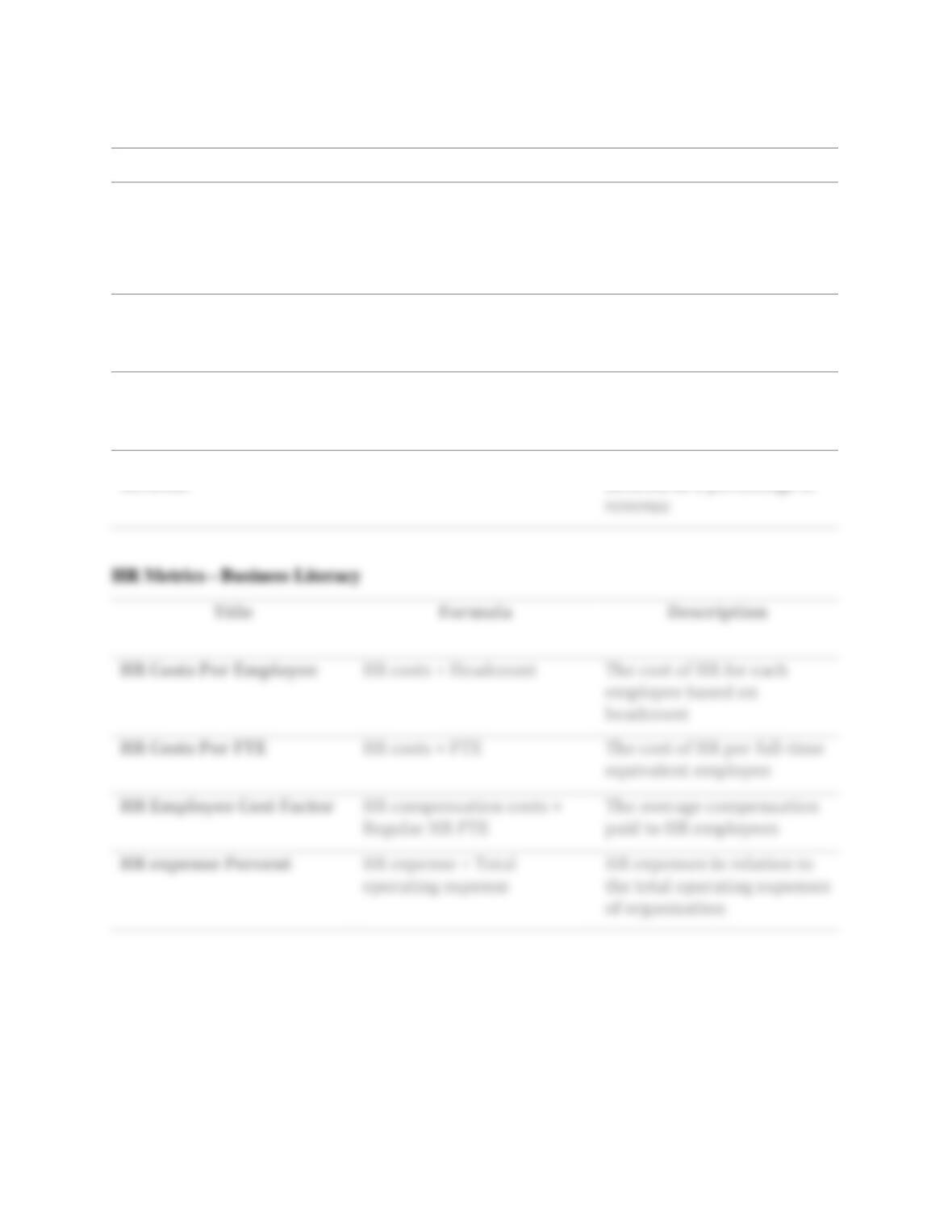
HR Metrics – Benefits Table
Title
Formula
Description
Benefits Cost
Benefit costs ÷ Total
number of
employees on payroll
headcount
Factor The average cost for
all benefits per
employee
Benefits as Percentage of
Total Compensation
Benefits ÷ Labor costs
The total cost of benefits as
a percentage of the total
cost of compensation
Benefits as a Percentage of
Operating Expenses
Benefit costs ÷ Operating
expenses
Employee benefit costs as a
percentage of operating
expenses
Benefits As a Percentage of
Benefit costs ÷ Revenue
The cost of employee
Revenue
benefits as a percentage of
revenue
HR costs ÷ Headcount
The cost of HR for each
employee based on
of organization