Running head: HOW SMALL BUSINESS OWNERS AND EMPLOYEES BENEFIT
FROM THE NEW CORPORATE TAX LAW
How Small Business Owners and Employees Benefit From The New Corporate Tax Law
HOW SMALL BUSINESS OWNERS AND EMPLOYEES BENEFIT FROM THE NEW
CORPORATE TAX LAW
2
It has been almost four months since Donald Trump, the 45th President of the United
States, signed the new tax cut bill, and some changes have already had substantial effects on the
economy of the United States. The recent tax reform includes so many significant changes that it
is no exaggeration to say that it will bring the biggest impact to the United States and even other
competitive countries. Out of all the changes of this tax reform, the change in the corporate tax,
especially, is considered as the most remarkable change as the corporate tax rate has been
reduced from 35% to 21%. President Trump claims that the low tax rate will tremendously
improve the economy of the United States as the low tax rate will attract foreign investors to start
businesses in the United States, and many U.S companies that have moved overseas because of
the high tax rate will be back to the states. Furthermore, the low corporate tax rate will create
more jobs in the United States as more companies will either stay inside the United States or
locate their headquarters in the states. However, there are always pros and cons, which means
that not all people are in favor of this sweet talk. There also have been cons for this huge change
in corporate tax. The cons argue that the low corporate tax rate is expected to cause a tax cut war
against companies all over the world as many competitive countries around the world will
decrease their corporate tax rate in response to the growing possibility of corporations getting
into the US with low tax advantages. Furthermore, the New York Times has raised the criticism
that this new tax law will increase the tax burden on the middle class, rather than minimize it.
The cons further argue that the tax reform is a plan that does not care about people who fall in
the low-income bracket. Neither pros nor cons can be exactly on point because they hold
different perspectives. However, corporations, especially small corporations including
employees as cons mentioned, will have more much more to gain than to lose when comparing
HOW SMALL BUSINESS OWNERS AND EMPLOYEES BENEFIT FROM THE NEW
CORPORATE TAX LAW
3
benefits and drawbacks that the new tax law entails. The new corporate tax provisions will
provide corporations with valuable opportunities to thrive and prosper.
The flat 21% tax rate means that all corporations in the United States will be taxed at the
same rate regardless of the amount of revenue at the corporate level, but it does not necessarily
mean that two different corporations will have the same tax liability even though they have the
same amount of revenue. In other words, the tax liability for corporations can vary slightly
depending on where the corporations are located within the states. With the presence of the flat
tax rate, there should be some minor factors such as state income tax and other taxes that need to
be considered when finding the best place to start a business in the United States. The State of
Delaware is known as one of the most flexible states for business start-ups with various tax
benefits; the State of Nevada follows the next. It is interesting to notice that half of Fortune 500
Companies are based in Delaware. According to Leslie Wayne, a former business writer for The
New York Times, “It is also a great place to reduce a tax bill. Delaware today regularly tops lists
of domestic and foreign tax havens because it allows companies to lower their taxes in another
state — for instance, the state in which they actually do business or have their headquarters — by
shifting royalties and similar revenues to holding companies in Delaware, where they are not
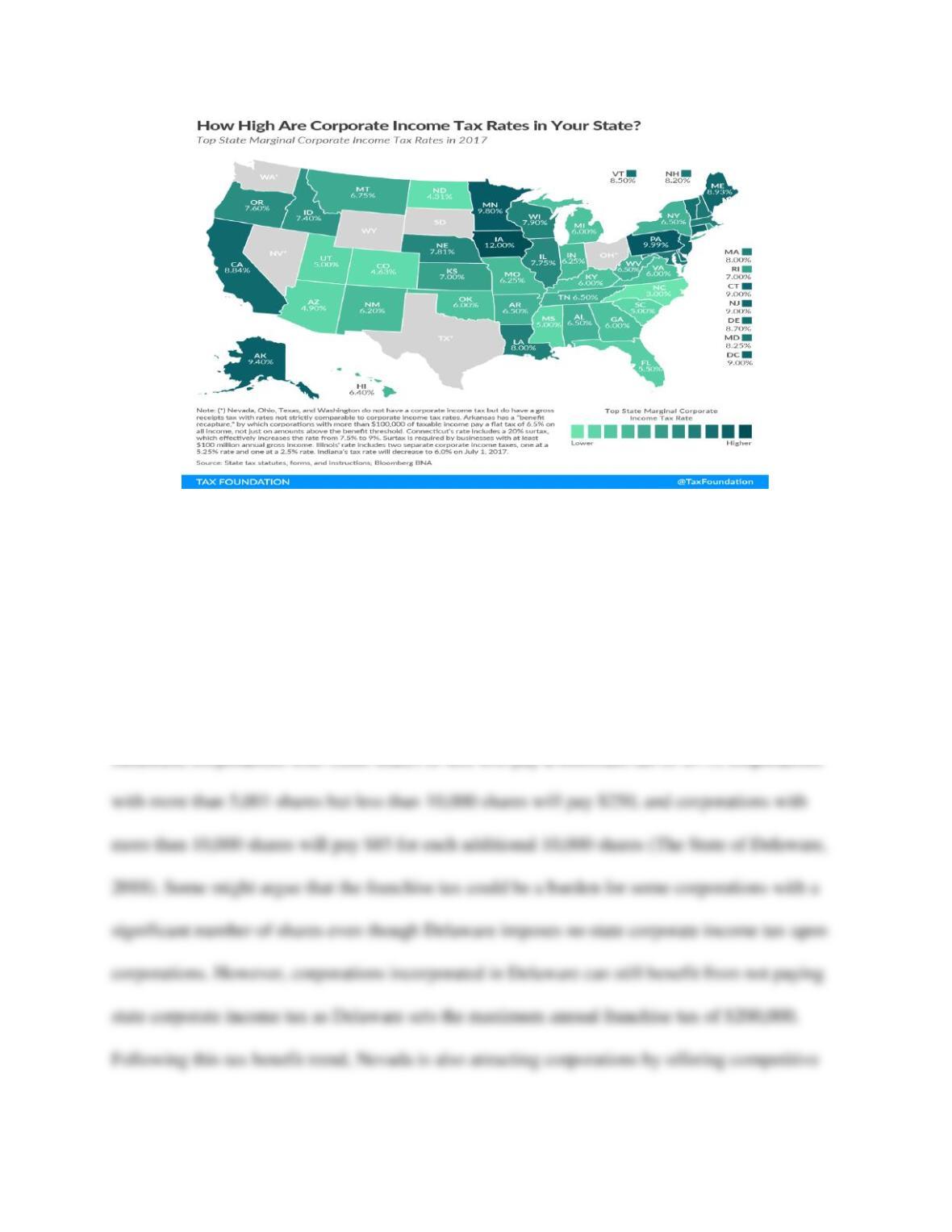
taxed (Wayne, 2012).” The following reference shows corporate income tax rates for each state
in the United States.
HOW SMALL BUSINESS OWNERS AND EMPLOYEES BENEFIT FROM THE NEW
CORPORATE TAX LAW
4
Figure 1. How High Are Corporate Income Tax Rates In Your States? (Tax Foundation, 2017)
It shows that Delaware has corporate income tax rate of 8.70%. However, if a corporation has its
headquarter in Delaware but operates in other states, the corporation does not pay state corporate
income tax. Instead, corporations incorporated in Delaware need to pay a franchise tax in the
state but is not based on the amount of revenue that corporation earned. According to the State of