1
Finance 660 Fall 2014
Corporate Social
Responsibility:
Impact on Financial Performance
Heather Goble, Kaci Huynh, Cristy Jones, & Curtis Koons
11/17/2014
Introduction
In recent years, corporate social responsibility or CSR has become a topic of increased
debate and discussion. CSR is becoming more and more mainstream and most companies are
taking part in corporate social initiatives. Because of this increased focus on CSR, “recent
conversation about CSR has shifted from whether to be socially responsible to how to be socially
responsible” (Maltz, Thompson, Ringold, 2011). This shift in discussion leads into the discussion
of, what are the financial impacts of corporate social responsibility? The financial impact of
CSR is difficult to determine, but evidence shows that there may be a positive relationship
between CSR practices and stock price performance. This paper will examine the relationship
between CSR and financial performance by looking at several sample companies, their current
financial impact, and the CSR policies. After reviewing several companies who have active CSR
policies, findings suggest that CSR practices increase the publics’ perception of a company. This
increased perception creates a positive “brand image” which may in turn have a positive effect
on stock price performance.
Literature Review
Corporate social responsibility has been a top of ever increasing popularity in recent
years, and this trend will likely continue. There is more pressure for companies to keep a positive
public image and continue to build on existing CSR practices while also increasing their
financial performance. Because of this trend, there has been much more research conducted on
the topic of CSR and its impact on a company and their financial performance. In the sections
below, existing literature on this topic will be explored.
2
Measuring CSR
In order to determine the impact of CSR on financial performance, there must be a way to
measure CSR. The article “Social Responsibility and Financial Performance” by Cochran and
Wood examines a way in which to measure CSR. According to Cochran and Wood, there are two
generally accepted methods of measuring CSR. The first method is using a reputation index. This
method allows observers to rate firms on the basis of one or more aspects of social performance.
One advantage of this method is that it is internally consistent because one person is applying the
criteria to each firm. A disadvantage is that the rankings are highly subjective and can vary
greatly depending on the observer (1984).
The second method outlined in the article is content analysis. This method entails
measuring and analyzing the CSR activities that are published in the company literature,
particularly the annual report. An advantage of this method is that because of its mechanical
nature, it is possible to obtain a large sample size; a disadvantage is that the information provided
must come directly from the company. This may not be a clear picture of their actual CSR
practices. Creating a reliable measure of CSR is important because, “If a positive relationship
can be shown to exist, then management might be encouraged to pursue such activities with
increased vigor or to investigate the underlying cause of this relationship” (Cochran & Wood,
1984, pg42)
CSR & Consumer Behavior
In the article “Corporate Social Responsibility: Consumer Behavior, Corporate Strategy,
and Public Policy”, the authors examine the relationship between CSR and consumer behavior.
One of the main points of this article is to point out how CSR can affect corporate image, and
what effects that can have on the company. Kreng and Huang define corporate image as, “the
3
consumers’ impression of the corporation itself, corporate product marketing, and the services
provided by the corporation” (2011, pg 529). In other words, corporate image is the consumers’
overall view of the company. It is suggested by some marketing experts that the role a company
plays in society will help build their corporate image. Consumers will have a good overall
impression of a company if they believe the company is making an effort to be socially
responsible. The consumer will relate this standard of higher CSR to the company having a
higher moral standard and higher quality products. These beliefs may lead consumers to be brand
loyal and purchase only the products of a certain company. This brand loyalty can potentially
lead to increased sales and therefore better financial performance (Kreng & Huang, 2011).
Potential Benefits of CSR Practices
Corporate social responsibility has been defined as a contract between corporations and
society, based on long-term social demands and expectations” (Kreng & Huang, 2011, pg 530).
CSR practices can range from pollution control, to workplace safety, to investments in research
and development and education. These CSR practices can lead to several benefits including the
following (Du, Bhattacharya & Sen, 2010):
Generating favorable stakeholder attitudes and better support behaviors (e.g.
purchases, seeking employment, investing in the company)
Build a stronger corporate image
Strengthen relationships between companies and stakeholders
Enhance stakeholders’ advocacy behaviors
Increased sales and market share are also likely to increase based on the information listed
above. In order for companies to capitalize on the positive financial benefits of their CSR
practices, they must have an effective way of communicating these practices to their stakeholders
(Du, Bhattacharya & Sen, 2010).
4
Corporate Social Responsibility & Financial Performance
Corporate social responsibility has been on the rise in recent years, and this trend shows
no signs of decreasing. Corporate social responsibility has been defined as a “social contract”
between a company and society, so it is becoming something stakeholders expect from
companies. The days are gone where only a few companies have active CSR practices. Now,
stakeholders expect a company to be able to make a profit while also being socially responsible
(Kreng and Huang, 2011). As mentioned earlier, CSR practices can lead to several benefits to the
company including a stronger corporate image, better stakeholder-company relationship,
increased sales, and higher market share (Du, Bhattacharya & Sen, 2010). Our goal is to
determine the impact that CSR practices have on financial performance.
The potential financial benefits of CSR performance can be measured using the beta,
which is, the covariance of the expected return on that asset with that of the overall market;
earnings per share; price-earnings ratios; or bid-ask spread (Cochran & Wood, 1984). As
discussed previously, secondary research supports our belief that companies who have positive
CSR practices also have positive financial performance. Several sources suggest that the positive
relationship between CSR and financial performance could be due to the increased “brand
image” of the company. The following sections will discuss additional evidence discovered
through primary research on several public companies including Starbucks, Google, Apple, and
BP.
Starbucks
Starbucks has become a respected giant in the coffee industry. They have over 19,000
stores in 62 countries! They are also a prime example of a company that has been able to
capitalize on their CSR practices. Each year, in addition to their annual financial reports, they
5

publish a global responsibility report. In this report, senior vice president John Kelly states that
their approach to social responsibly forms a cycle where they continually assess and re-evaluate
their goals. See below for a diagram of their approach (Starbucks, 2013).
CSR Practices of Starbucks
The company mission at Starbucks is to “inspire and nurture the human spirit – one person,
one cup and one neighborhood at a time” (Starbucks, 2013). And one of the ways that they are
able to accomplish this mission is through their CSR practices. Some of these practices include
the following:
Ensure 100% of coffee is ethically sourced by 2015
Invest in farmers and their communities
Improve farmers access to carbon markets
Mobilize our partners (employees) and customers to contribute 1 million hours to
community service
Reduce energy consumption by 25% by 2015
See below for a full summary of the CSR initiatives and their current status (Starbucks, 2013).
6
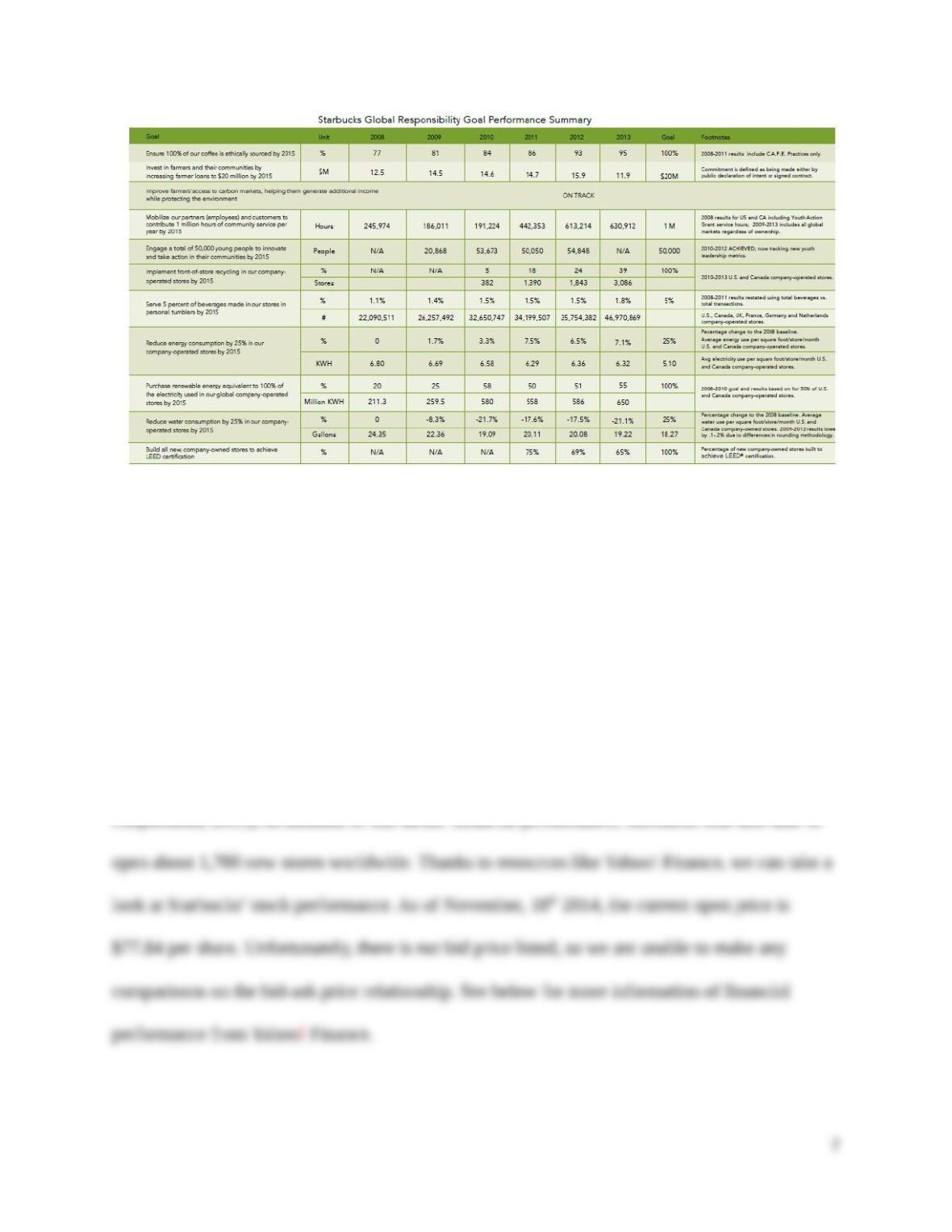
It is evident after examining the CSR practice of Starbucks that they are an impressive company
with a hands-on approach to CSR. Since we have examined the CSR practices, we can now examine the
financial performance of Starbucks.
Starbucks Financial Performance
In 2013, Starbucks once again achieved and exceeded their performance goals.
Consolidated revenues reached 14.9 billion, which was a 12% increase over the prior year! The
earning per share (EPS) for 2013 were $2.26, which was 26% higher than 2012 (Starbucks