To be presented at the 10th international conference of the Greening of Industry Network
June 23-26, Göteborg, Sweden
CORPORATE SOCIAL RESPONSIBILITY: DO MANAGERS
AND CONSUMERS HAVE THE SAME CONCEPTION OF
“DOING GOOD”?
Valérie Swaen
Research fellow with the National Belgian Fund for Scientific Research and the
Bernheim Foundation, Université Catholique de Louvain, Institut d’Administration et
de Gestion, Place des Doyens, 1, B 1348 Louvain-la-Neuve, Belgium.
Tel : +32.10.47.91.56; Fax : +32.10.47.83.24; Email : swaen@mark.ucl.ac.be
Part-time research assistant, Université Catholique de Lille, Institut d’Economie
Scientifique et de Gestion, Rue de la Digue 3, B 59800 Lille, France.
Tel.: + 33.3.20.54.58.92; Fax: +33.3.20.57.48.55; Email: v.swaen@ieseg.fupl.asso.fr
To be presented at the 10th international conference of the Greening of Industry Network
June 23-26, Göteborg, Sweden
ABSTRACT
More companies than ever before are investing in Corporate Social
Responsibility (CSR) activities such as cause-related marketing, minority support
programs and socially responsible manufacturing practices.
However, the emergent concepts of corporate citizenship, corporate social
responsibility and sustainability are defined and operationalized in a lot of different
ways. No consensus exists on a precise definition of what a socially responsible
company is. Furthermore, most of existing CSR definitions are based on managers’
point of view only ; the stakeholders’ expectations and opinions are rarely taken into
account.
In that framework, our research objective is to analyse the content of the CSR
concept, by integrating consumers’ expectations and perceptions of the socially
responsible activities of companies delivering products and services.
After an extensive literature review on the CSR concept, focus groups with
customers and case studies dealing with socially responsible companies will be
carried out in Belgium.
The originality of this poster is to compare managers’ and consumers’
conceptions of CSR and to identify potential gaps between what consumers expect
from companies’ CSR activities and what companies propose and communicate.
By highlighting such gaps, suggestions will be made in order to fit CSR
activities with consumers’ ideals, desires and needs. Suggestions for improvement
include on the one hand the establishment of a continuous dialog with consumers in
order to identify the environmental, ethical and social issues they value. On the other
hand, this paper illustrates the importance for companies to show a certain level of
coherence between their philosophy, their activities and their communication policies.
This will bring some positive impacts as far as reputation, attraction of new
consumers and customer retention are concerned. These benefits are far from being
negligible in the current context of intensive competition.
This poster is based on the doctoral project we are currently carrying out with
the Institut d’Administration et de Gestion from Louvain-La-Neuve (Belgium), as
well as the precious collaboration of the Institut d’Economie Scientifique et de
Gestion from Lille (France). The purpose of our doctoral research is to better
understand the concept of Corporate Social Responsibility (CSR) in the context of
France and Belgium, as well as to identify the CSR impacts on consumers’ attitudes
and behavior intentions.
KEYWORDS : Managers’ perceptions, Consumers’ perceptions, Gap model, Case
studies, Focus groups.
To be presented at the 10th international conference of the Greening of Industry Network
June 23-26, Göteborg, Sweden
1. INTRODUCTION
More companies than ever before are investing in Corporate Social
Responsibility (CSR) activities such as cause-related marketing, minority support
programs and socially responsible manufacturing practices.
However, the emergent concepts of corporate citizenship, CSR and
sustainability are defined and operationalized in a lot of different ways. No consensus
exists on a precise definition of what a socially responsible company is. Furthermore,
most of existing CSR definitions are based on managers’ point of view only ; the
stakeholders’ expectations and opinions are rarely taken into account.
In that framework, our research objective is to analyse the content of the CSR
concept, by integrating consumers’ expectations and perceptions of the socially
responsible activities of companies delivering products and services.
After an extensive literature review on the CSR concept, focus groups with
customers and case studies dealing with socially responsible companies will be
carried out in Belgium.
The originality of this poster is to compare managers’ and consumers’
conceptions of CSR and to identify potential gaps between what consumers expect
from companies’ CSR activities and what companies propose and communicate.
By highlighting such gaps, suggestions will be made in order to fit CSR
activities with consumers’ ideals, desires and needs. Suggestions for improvement
include on the one hand the establishment of a continuous dialog with consumers in
order to identify the environmental, ethical and social issues they value. On the other
hand, this paper illustrates the importance for companies to show a certain level of
coherence between their philosophy, their activities and their communication policies.
This will bring some positive impacts as far as reputation, attraction of new
consumers and customer retention are concerned. These benefits are far from being
negligible in the current context of intensive competition.
This poster is based on the doctoral project we are currently carrying out with
the Institut d’Administration et de Gestion from Louvain-La-Neuve (Belgium), as
well as the precious collaboration of the Institut d’Economie Scientifique et de
Gestion from Lille (France). The purpose of our doctoral research is to better
understand the concept of Corporate Social Responsibility (CSR) in the context of
France and Belgium, as well as to identify the CSR impacts on consumers’ attitudes
and behavior intentions.
The paper is developed on the following structure. The theoretical framework
is detailed in part 2. The proposed methodology is presented in a third part. Finally,
the conclusion gives an overview of the principal anticipated learnings of this research
as well as some directions for future research.
To be presented at the 10th international conference of the Greening of Industry Network
June 23-26, Göteborg, Sweden
2. THEORETICAL FRAMEWORK
2.1. CSR definitions
The behaviors characterizing good corporate citizenship have been
investigated under various labels : corporate social responsibility (e.g., Carroll, 1979;
Sethi, 1979), corporate social responsiveness (e.g., Frederick, 1978; Strand, 1983),
corporate social performance (e.g., Stanwick and Stanwick, 1998; Wood, 1991) and
corporate citizenship (e.g., Maignan, Ferrell and Hult, 1999; Reilly and Myron, 1994).
While corporate citizenship and corporate social responsibility are commonly
used terms (e.g., Andriof and McIntosh, 2001; Brandeleer, 1997; McIntosh et al.,
1998), no single definition has been widely accepted and multiple conceptualizations
coexist.
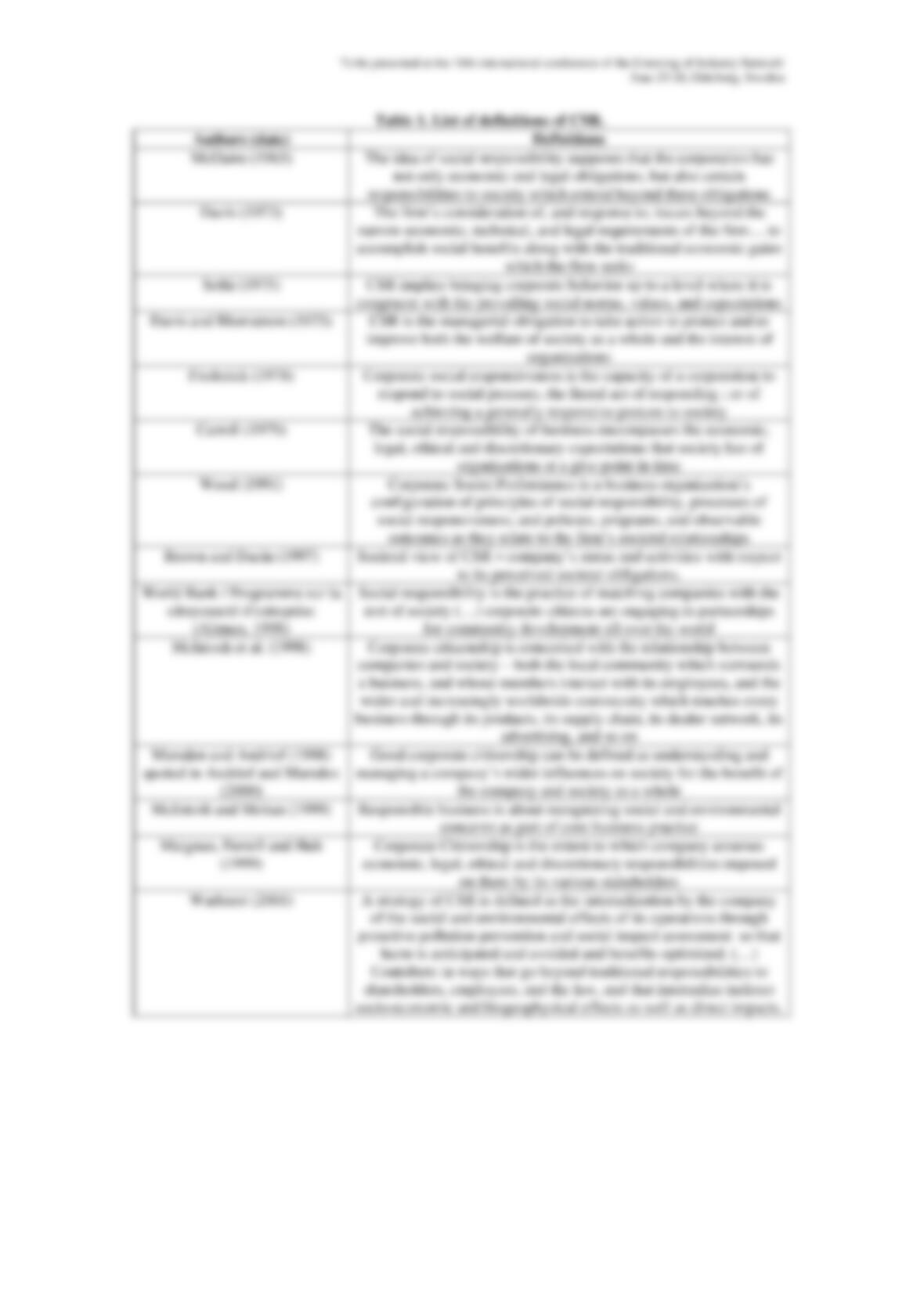
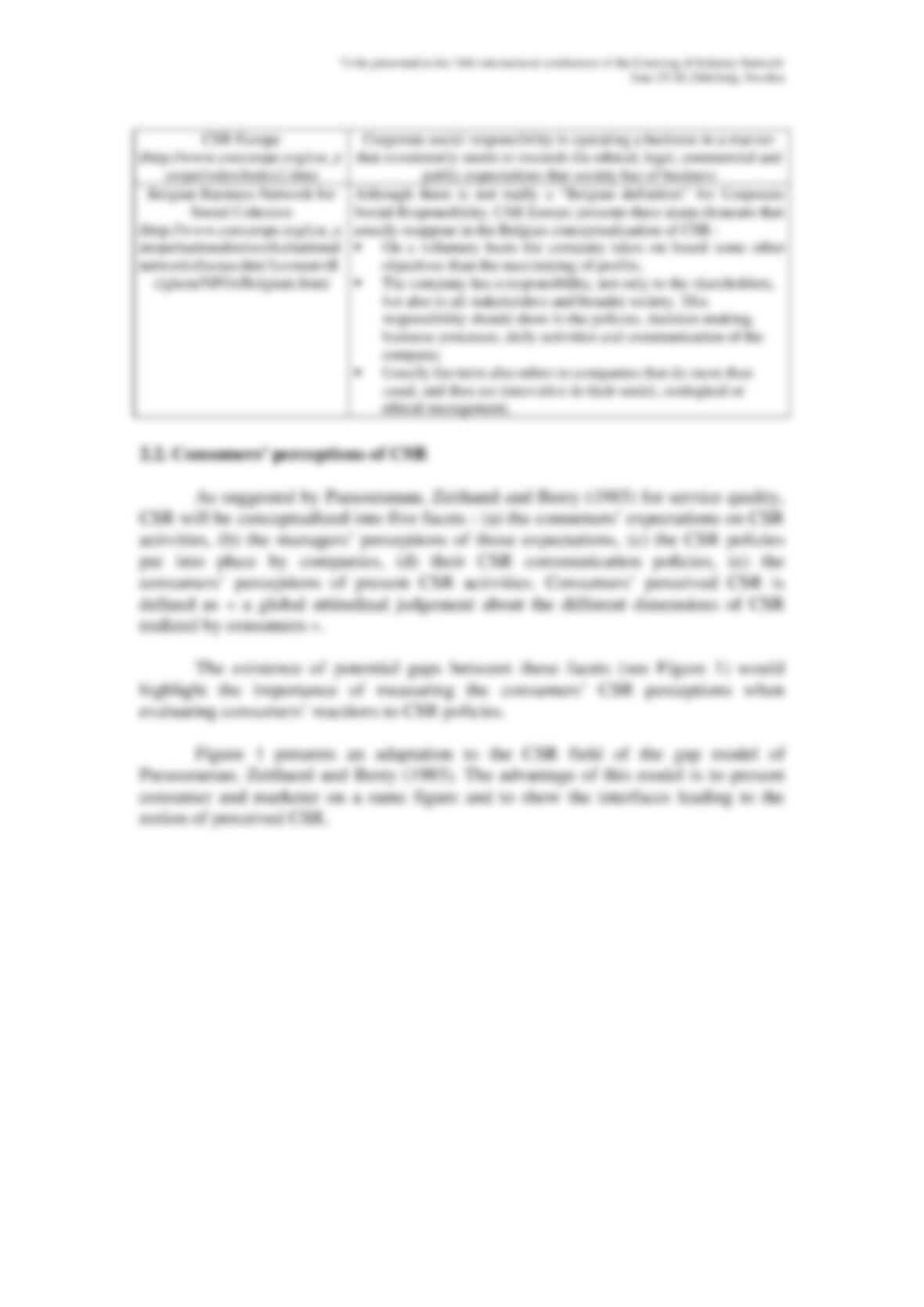
Many different business organizations and researchers have attempted to
provide their own definitions of CSR, as illustrated in Table 1.
However, two common features appear in existing CSR conceptualizations:
(1) companies have social obligations in addition to economic responsibilities; and (2)
a socially responsible firm has the duty to address the concerns and satisfy the
demands of its main stakeholders – employees, shareholders, customers, suppliers, the
media, regulators, and pressure groups.
According to Carroll (1979) and Maignan, Ferrell and Hult (1999), CSR has