1
Corporate Culture Preference
Hossein Soflue (1911949)
University Canada West
MGMT 601: Leadership in the global context
Dr. Ashli Komaryk
May 23, 2021

2
Introduction
People hold different personality traits so that, Individual differences arise from these
characteristics that are appeared in the forms of thoughts, feelings, and actions (Lan and Jintao,
2018). Human resource departments have the opportunity to select people who are well-suited with
the way the organization works based on their personal traits. Hiring and recruiting have long been
focused on the applicant’s skills, but when the new hire’s personality traits are aligning with the
culture of the firm, it will definitely perform better for the organization.
On the other hand, improper hiring and turnover rate after that will cost about 6000 Dollars
in the united state (Edgington and Bruce, 2008). Unfortunately, one in three newly hired employees
is fired voluntarily or involuntarily during the first year of employment, and this number has
steadily increased in recent years.
According to Ramadista and Kismono. (2020), The highest level of adaptation between
corporate culture and human resource practices will lead to the optimization of organizational
performance. choosing employees who are not aligned with the organization also has its
drawbacks. The biggest mistake that organizations make is that they misrepresent themselves when
attracting applicants. The newly recruited workforces will not be happy if they find out that they
have been deceived; They probably do not stay in the organization or if they do, they lose their
moral.
Corporate culture categories:
To identify a corporate culture in which I would most want to work, based on my preferred
work environment and the values and priorities of the employer, a self-assessment test has been
done and After completing the test, the results are described on the next page.
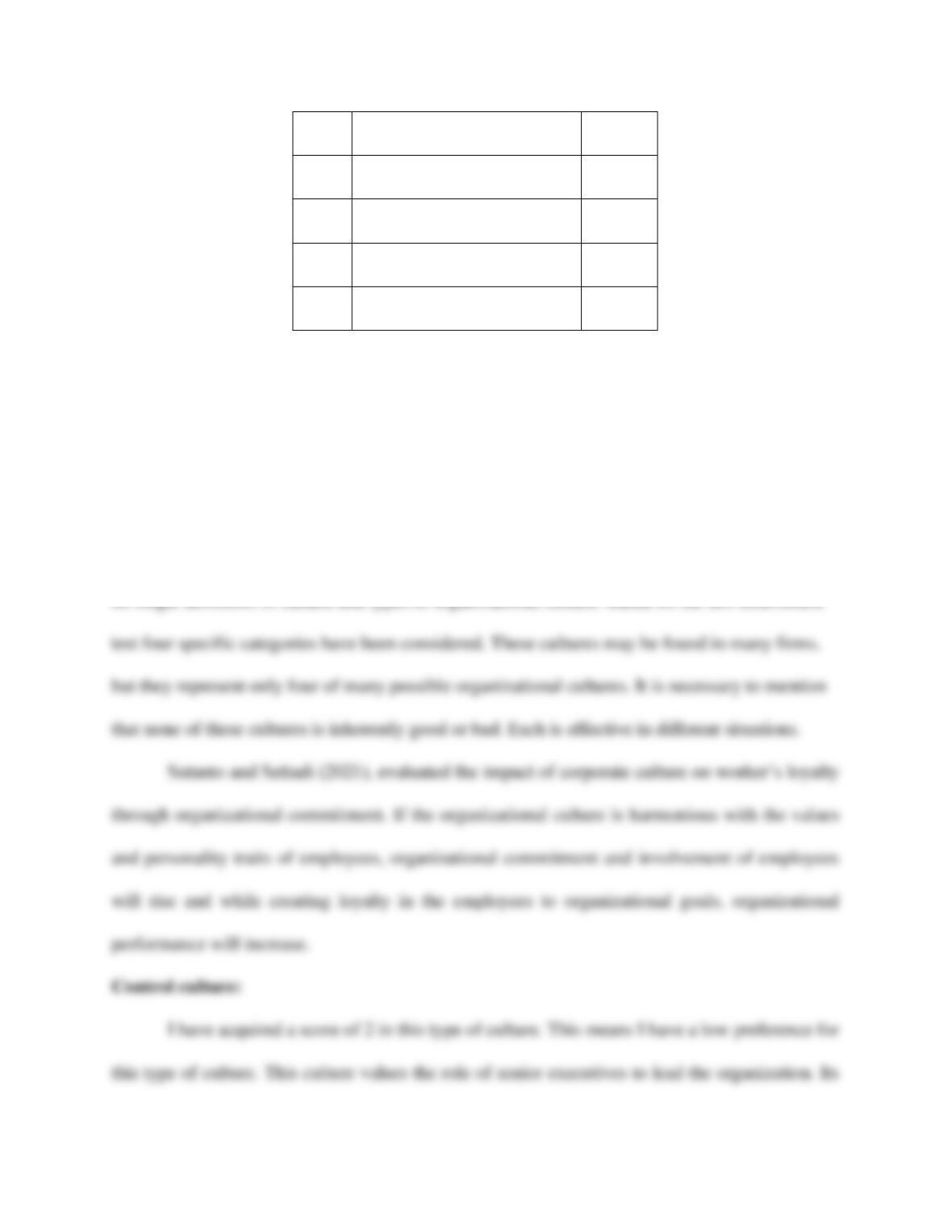
3
Row
Culture type
Score
1
Responsive culture
6
2
Performance culture
4
3
Relationship culture
2
4
Control culture
2
According to the table, cultural preferences are sorted from top to bottom. As it turns out,
the most appropriate form of culture for me is a responsive one and the most misfit work
environment is the control culture.
Organizational culture has been considered as supportive, innovative, and bureaucratic
culture (Wallach, 1983). Fard, Rostamy, and Taghiloo (2009) have categorized corporate culture
as Bureaucratic culture, Competitive culture, Participative culture, and Learning culture. There is