Macroeconomics
The correlation between investment and decreased unemployment is undeniable, and
this essay serves to discuss the investment and employment problems faced by South
Africa’s slow growing two-tier economy in the framework of Neo-Classical and
Keynesian models of economics. After which the solutions for these problems, as
presented by the South African government will be examined.
Investment is an amount that is spent in hoped of gaining future benefit from
investment[ CITATION Wor00 \l 1033 ] It is central to the creation of larger
economy and the eradication of unemployment. The importance of this concept is
explained using the. Classical Model approach[CITATION Par08 \l
1033 ]
[ CITATION Jas09 \l
1033 ]
.Figure A illustrates a self-regulated economy that is always in full employment
whereby structural and frictional unemployment still exists, hence the vertical
aggregated supply curve. Point P1 is the point of initial equilibrium, if any element of
spending were to decrease, all of which are represented by the aggregate demand
curve, for example investors became pessimistic about current markets or markets in
the future and started to move production else where there would be a downward shift
Figure A
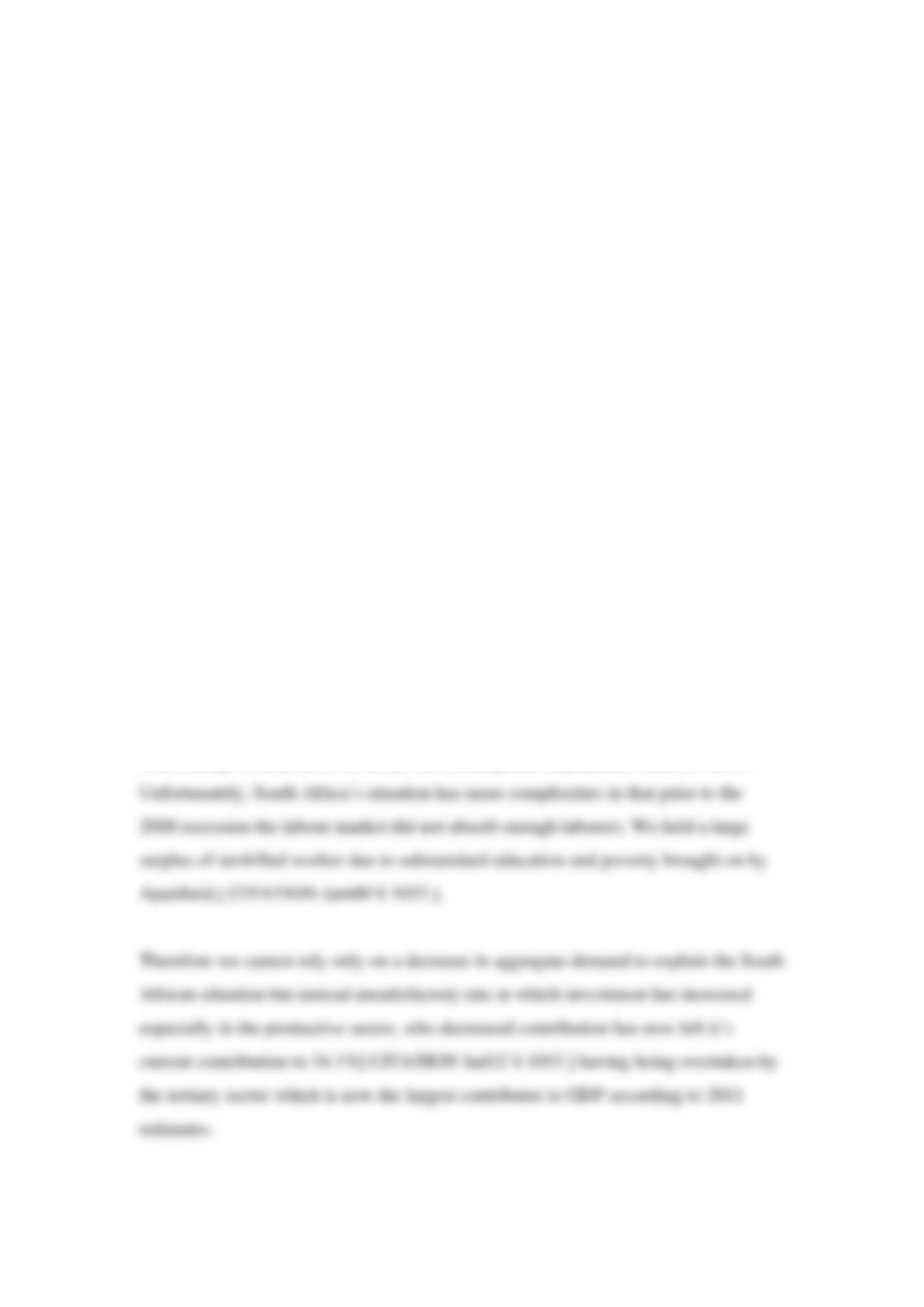
in the aggregate demand curve to left, AD1. A decreased economy would fall to a
point of disequilibrium denoted by P2 commonly known as a recession on depression.
At this point there is a loss of customers which in turn means decreased turnover, with
less income within the business workers are retrenched or dismissed, increasing the
rate of unemployment. The loss of employment is also an indication of less income,
as people have no money to consume of goods and services.
Unusually there is a surplus of workers who are unable to find employment and
investment is needed to transfer capital into the business sector in order to create
employment opportunities and growth in the economy. In a recession, the need to
create any form of employment is favorable for investors as the adjustment process
back to equilibrium means that they can pay lower wages which in turn means
decreased operating costs. Lower operating costs incentivize businesses to lower
prices of goods and services, which in turn encourages consumption. With more
people with jobs who can consume goods and services businesses must hire additional
laborer’s, which moves the economy to P3, reduced prices and wages but increased
consumption and employment.
Gross fixed investment and investment in general therefore plays a critical role in
maintaining stability in an economy and insuring that employment remains secure.