4/20/2025
1
LEADERSHIP SKILLS
Trần Thị Bích Nhung
Email: tranthibichnhung.cs2@ftu.edu.vn
Contents:
Unit 1: Introduction to leadership
Unit 2: Power and influence
Unit 3: Trait, Skill and behavioral approaches
to leadership
Unit 4: Situational approaches

4/20/2025
2
Contents:
Unit 5: Contemporary approaches
Unit 6: Team leadership
Unit 7: Developing leadership skills
Unit 3: Trait, skill and
behavioral approaches to
leadership
Trần Thị Bích Nhung
Email: tranthibichnhung.cs2@ftu.edu.vn

4/20/2025
3
Contents
Leadership traits
Leadership skills
Leadership behaviors
LEADERSHIP TRAITS

4/20/2025
4
1. Leadership traits
In the early 20th century, leadership traits were studied to determine what
made certain people great leaders. The theories that were developed were
called “great man” theories
It was believed that people were born with these traits, and that only the
“great” people possessed them. During this time, research concentrated on
determining the specific traits that clearly differentiated leaders from
followers
1. Leadership traits
In the mid-20th century, the trait approach was challenged by research that questioned
the universality of leadership traits. In a major review, Stogdill (1948) suggested that no
consistent set of traits differentiated leaders from non-leaders across a variety of
situations
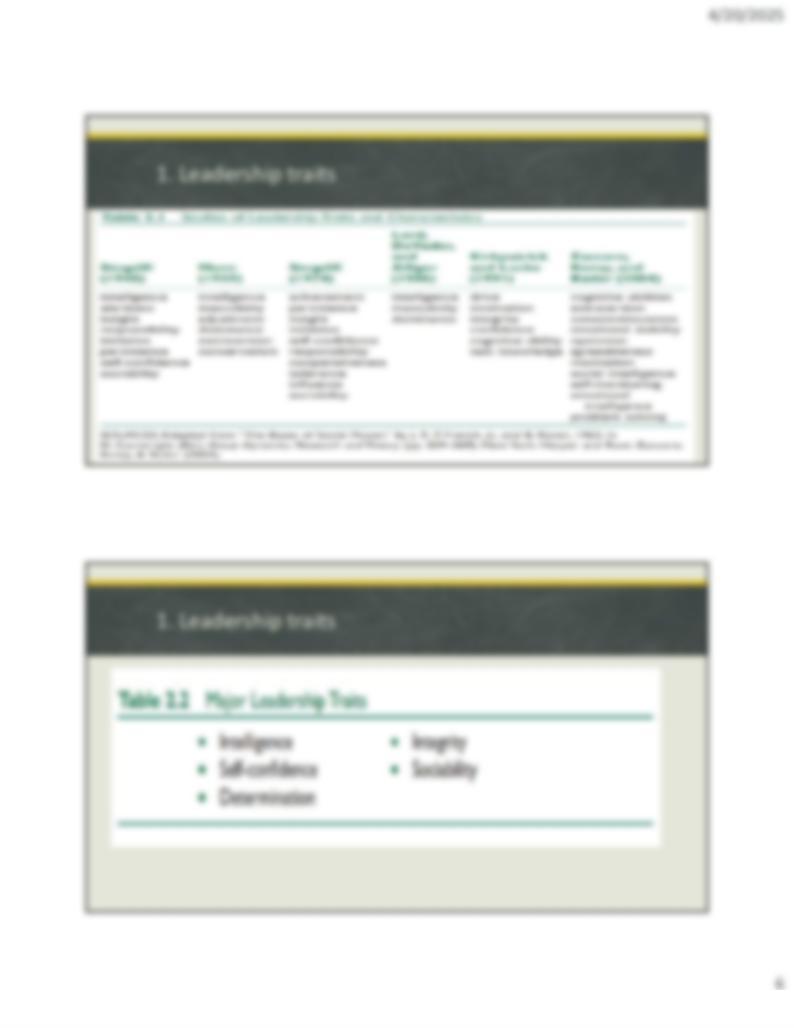
Stogdill’s first survey: (1) Intelligence; (2) Alertness; (3) insight; (4) responsibility; (5)
initiative; (6) persistence; (7) self-confidence; (8) sociability.
4/20/2025
5
1. Leadership traits
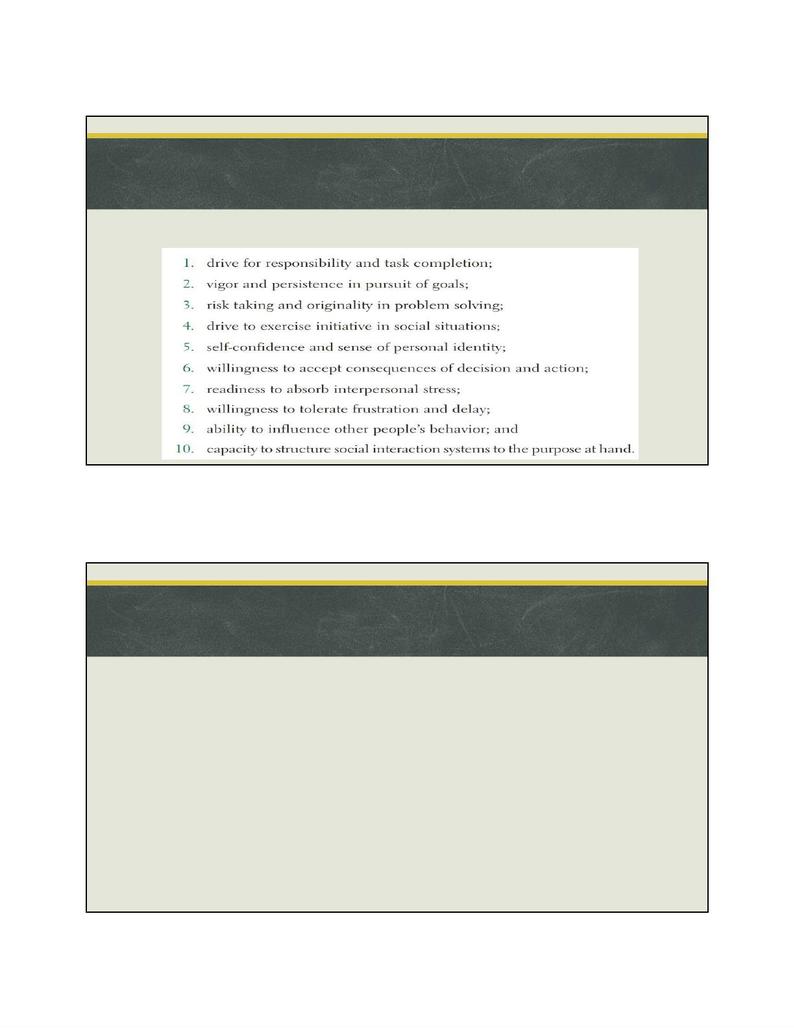
Stogdill’s second survey:
1. Leadership traits
Mann (1955): (1) Intelligence; (2) masculinity; (3) adjustment; (4) dominance; (5)
extraversion; (6) conservatism
Kirkpatrick and Locke (1991): (1) drive; (2) motivation; (integrity); (4) confidence; (5)
cognitive ability; (6) task knowledge