Consumers’intentions to use
online food delivery systems
in the USA
Nefike Gunden,Cristian Morosan and Agnes DeFranco
Conrad N. Hilton College of Hotel and Restaurant Management,
University of Houston, Houston, Texas, USA
Abstract
Purpose –The recent development of online food delivery systems (OFDS) consolidated the restaurant
industry’s representation in the electronic distribution landscape. The purpose of this study is to examine
consumers’intentions to use OFDS.
Design/methodology/approach –A comprehensive structural model was developed based on
UTAUT2 and extended the model with three additional constructs: impulse buying tendency, congruity with
self-image and mindfulness. Data were collected from 605 US respondents. Confirmatory factor analysis and
structural equation modeling were used to test the model.
Findings –Performance expectancy was the strongest predictor of intentions to use OFDS, followed by
congruity with self-image. Low-magnitude predictors included habit and mindfulness, while impulse buying
tendency had a negative impact on intentions to use OFDS.
Research limitations/implications –The study validates a comprehensive yet parsimonious
conceptual model that explains consumers’intentions to use OFDS. The model brings together constructs that
capture the essence of the online food ordering tasks and the consumers’cognitive processes that inform such
tasks.
Practical implications –This study offers substantial practical implications for two types of
practitioners: OFDS developers and restaurants and provides a mapping of the factors influencing consumers’
intentions to use OFDS.
Originality/value –This study provides a first theoretical perspective on consumers’intentions to use
OFDS, which have not been studied so far. Studying such intentions provides insight into consumers’
adoption behaviors, which are critical to the success of OFDS.
Keywords Mindfulness, Restaurants, Electronic commerce, Technology adoption, Delivery systems
Paper type Research paper
Introduction
Conforming to a predominant 2010’s trend, distribution using Online Foodservice Delivery
Systems (OFDS) is becoming a significant part of restaurant industry distribution (Muller,
2018). In 2018, online ordering was the most liked method for ordering restaurant food for 45
per cent of the US population (Morning Consult, 2018). The OFDS market is growing with
estimated revenues of $715m in 2019 and a forecast exceeding $950m by 2023 in the USA
(Statista, 2019a) and $82bn globally (Statista, 2019b). While initial efforts to develop OFDS
have emerged in mid 2010s (Grubhub Holdings Inc, 2019a), the recent advancements in
integration/middleware have created opportunities for restaurants to integrate their point-
of-sale software with today’s OFDS (Grubhub Holdings Inc, 2019b). The resulting
This research has been conducted with the support of Hospitality Financial and Technology
Professionals (HFTP).
Consumers’
intentions
1325
Received 30 June 2019
Revised 12 September 2019
5 December 2019
27 February 2020
Accepted 6 March 2020
International Journal of
Contemporary Hospitality
Management
Vol. 32 No. 3, 2020
pp. 1325-1345
© Emerald Publishing Limited
0959-6119
DOI 10.1108/IJCHM-06-2019-0595
The current issue and full text archive of this journal is available on Emerald Insight at:
https://www.emerald.com/insight/0959-6119.htm

integration facilitated the aggregation of supply into OFDS that offer consumers various
choices in terms of platforms, restaurants and product customization. Such features give
OFDS the unique potential of radically disrupting the restaurant industry, illustrated by
OFDS revenues that are expected to surpass the revenues from restaurants’direct-to-
consumer deliveries in 2020 (Statista, 2019b).
Characterized by user interfaces that are grounded on the same generic retail principles
as websites (Suhartanto et al., 2019), the user experience that OFDS offer and the way the
primary consumer task of food ordering is carried out require unique consumer behaviors
that are substantially different from those used on typical retail websites. While general
consumer behavior on retail websites has been explained in prior research, consumers’
behavior relative to OFDS remains unknown to date. Understanding such behaviors helps
to explain how OFDS can become successful permanent hospitality actors. Most
importantly, as OFDS are generally commission-based, their success is entirely dependent
on consumers’adoption. However, despite the potential ramifications of the mass adoption
of OFDS and the meritorious findings of the scarce previous research (Cho et al., 2019;
Suhartanto et al., 2019;Yeo et al., 2017), there is no systematic program of research or study
that has examined consumers’adoption of OFDS in the USA to date, marking a critical
lacuna.
Indubitably, OFDS are poised to cause substantial disruption to the distribution system
of US restaurants (Cho et al.,2019) and other industries (Statista, 2019b). By design, OFDS
deprive consumers of a legacy element of foodservice consumption: dining in a public
environment of the restaurant (Jeong and Jang, 2016). Yet, as more than 80 per cent of the
orders are placed from home (Hirschberg et al., 2016), OFDS facilitate the reconstruction of
this experience within consumers’residences where the success of a dining episode is no
longer conditioned by the legacy elements of restaurant service (e.g. atmospherics, server
interactions and appearance), but rather by a combination of familiar home-related elements
(e.g. socialization, combination of food and beverages from multiple vendors). While the
general adoption literature provides insight into the factors influencing consumers’
intentions to purchase such digitized experiential products such as customizable hotel stay
experiences (Morosan and DeFranco, 2019), it does not offer insight into purchasing
hospitality products that can be digitized on the web while being reconstructed at the
consumer’s residence (Correa et al.,2019), marking a second research lacuna.
The types of products being sold using OFDS are unique: highly perishable and
heterogeneous (Kotler et al., 2016), thus adding a layer of complexity to consumers’
purchasing decisions and the purchasing environment. First, OFDS aggregate supply from
a large variety of restaurants with different degrees of brand equity and awareness among
consumers (Duncan, 2019), which requires consumers to undergo learning processes that
inform their purchasing behaviors (Suhartanto et al.,2019). Second, fulfillment time causes
the degradation of certain organoleptic properties of the purchased products. However, such
degradation is different from one type of product to another (e.g. a salad may lose its
properties faster than a pizza during a relatively long delivery during the rush hour). Thus,
consumers are likely to undergo highly involving cognitive processes that require a state of
permanent awareness throughout their purchasing experience. Yet, there is no evidence in
the literature that documents the adoption of systems delivering products where consumers
have to go through such highly involving and complex decisions (Bujisic et al.,2014),
marking a third research lacuna.
Addressing the three research lacunae simultaneously, the goal of this study is to
examine US restaurant consumers’intentions to use OFDS based on antecedents that fully
capture the nature of consumers’food ordering task. To this end, this study validates a
IJCHM
32,3
1326

conceptual model built on the classic technology adoption theory that provided system
perception constructs (i.e. performance expectancy) and consumer inherent characteristics
associated with adoption (e.g. habit) (Venkatesh et al.,2012). This theoretical foundation was
augmented with constructs describing the state of mind facilitated by the characteristics of
the purchasing environment (Rook, 1987) or consumer characteristics (e.g. impulse buying
tendency) (Wells et al., 2011), congruity with self-image (Jeong and Jang, 2018) and
constructs describing the cognitive processes necessary to make a risk-free decision when
buying a product such as a food item (i.e. mindfulness) (Sun et al., 2016). To accomplish its
goal, this study follows two specific objectives:
(1) to examine the differential role of perceptions and consumer characteristics in
influencing intentions; and
(2) to ascertain the multidimensional role of mindfulness in stimulating intentions.
Review of literature
Theoretical foundations
The study’s conceptual model was designed to fulfill three important criteria:
(1) provide a theoretical base that comprehensively captures the unique context of the
food ordering task;
(2) provide a sufficiently broad scope by including constructs that captures the unique
nature of products sold via OFDS while addressing the three aforementioned
research lacunae; and
(3) retain parsimony.
According to the first criterion, this study developed a conceptual model that revisited the
legacy adoption theory – Unified Theory of Acceptance and Use of Technology (UTAUT2)
(Venkatesh et al.,2012). UTAUT2 was revisited by retaining two original constructs –
performance expectancy and habit – and adding three constructs (impulse buying tendency,
congruity with self-image and mindfulness) to investigate consumers’intentions to use
OFDS. UTAUT2 was the preferred theoretical framework for three reasons:
(1) it has been validated as a strong framework for predicting behavioral intentions in
multiple service contexts (Morosan and DeFranco, 2016a);
(2) it captures the specific task-technology environment of consumer-oriented tasks
(Morosan and DeFranco, 2016a); and
(3) it lends itself to extension via constructs capable of providing comprehensive yet
parsimonious illustrations of system adoption.
Of the seven independent variables of the original UTAUT2, only two were retained.
Performance expectancy was retained because it remains the most fundamental antecedent
of adoption (Venkatesh et al.,2003). Habit was retained because of its ability to explain
adoption of IS where the consumers are familiar with the task from other contexts (e.g.
ordering food from restaurants, shopping online for other products) (Okumus et al.,2018).
Five variables that were originally included in UTAUT2 were not retained in this study
because they could not capture the motivational fabric of using OFDS while preserving
parsimony. Specifically, effort expectancy was not retained as generally OFDS are designed
with intuitive interfaces, which guide the consumers through the purchasing task in ways
that are similar to other retail environments. Social influence was not retained as generally
Consumers’
intentions
1327

ordering via OFDS is already influenced by the social interactions that naturally occur
within the consumption party (e.g. couple/family/friends, coworkers), regardless of which
member of the group places the order. Facilitating conditions was not retained because of
the ubiquity of the OFDS and restaurant products in the US market. Hedonic motivation
was not retained as the current model includes the concept of congruity with self-image,
which provides a more comprehensive basis of a consumer’s self-image evaluations (Stets
and Burke, 2005). Finally, price value was not retained because there is no cost associated
with the use of OFDS, as intended in the original model (Venkatesh et al., 2012).
While keeping two independent variables from the UTAUT2 represents a substantial
modification of the original model, this new theoretical foundation retains the same
perception-behavior path that has characterized this model since inception and allows it to
explain adoption behavior based on users’perceptions and consumer characteristics
(Benbasat and Barki, 2007). The retained path between performance expectancy and
intentions remains fundamental to IS adoption because it is present in one form or another in
a variety of theoretical models, beyond the UTAUT (Jahanmir and Cavadas, 2018). In
particular, this path reflects the primary cognitive processes that evaluate the ability of a
system to facilitate the task (Venkatesh et al., 2003) and stimulate users’evaluations of
systems when facing a task (Venkatesh et al.,2012). However, habit reflects the users’
automatic behavior tendency that impact IS use (Lymayem et al., 2007) and explains
motivations that are not necessarily thoroughly elaborated by users but rather
automatically evoked in certain familiar contexts (Escobar-Rodríguez and Carvajal-Trujillo,
2014) (e.g. when sufficient similarity exist with other routine tasks). Thus, based on the
contrasting nature of the two variables, performance expectancy and habit were used as a
core UTAUT-based foundation without compromising parsimony; therefore, this model
allows to address the first research lacuna.
In line with the second and third criteria, this study incorporated additional constructs to
address the three lacunae while retaining parsimony. UTAUT2 was reconstructed by the
addition of three concepts based on the thesis that this particular extension from UTAUT2
must comprehensively and parsimoniously capture the task-technology environment of
OFDS. While the literature offers a rich variety of constructs that could influence intentions
to use a new system, the unique environment of OFDS called for three types of constructs.
First, as OFDS are geared toward persuading consumers to engage in target behaviors in
the absence of face-to-face communication (Cho et al.,2019), this model needs a construct
that reflects consumers’constant mind-changing as a result of discovering new information
available about or on OFDS. To capture this critical aspect, impulse buying tendency (Wang
and Tsai, 2017) was added to theoretical foundation. Impulse buying reflects consumers’
buying behaviors that occur suddenly (Piron, 1991). As restaurants have begun to shift their
focus to online delivery options (Morgan Stanley Research, 2017), OFDS started to offer
various options such as multiple product selections, different time ranges for delivery,
personalization and online payments (Hirschberg et al.,2016). Simultaneously, their
advertising power has increased. As a result, the way consumers make their decisions to
purchase using OFDS is different than in other online retail environments. For example, a
critical aspect is the state of relative hunger or consumers’anticipation of the meal. This
may precipitate the decision-making process, thus creating situations when consumers may
spontaneously purchase food.
Second, recent data show that certain consumers (e.g. younger and urban) are likely to be
attracted more by OFDS (Statista, 2019b). Therefore, recognizing the intrinsic motivations
that can lead to OFDS utilization, this theoretical foundation required a construct reflecting
such motivational fabric and added congruity with self-image to the core foundation.
IJCHM
32,3
1328

Congruity with self-image reflects the level of match between the consumers’perception of a
brand or experience with their identities (Luna-Cortés et al., 2019). The design of OFDS is in
line with the design of other similar retail platforms, which could be found appealing only
by certain segments of consumers. Thus, it is possible that consumers who view themselves
as typical users of such systems to be attracted by OFDS. Such motivations may originate
in the user interface characteristics (e.g. inherently intuitive) but also in task characteristics
(e.g. desire to try something new). Overall, the inclusion of impulse buying tendency and
congruity with self-image positioned this conceptual model to address the second research
lacuna.
Third, recent consumer behavior insight shows that consumers are not merely passive
users of an IS; instead they like to interact with the system to maximize value in use (Tu
et al.,2018). Important elements of the use of IS include consumers’continuous awareness of
the task and their continuous adaptation of their behavior to make the systems work for
them in accomplishing the tasks (Pickert, 2014). Scholars’attention increased toward the
consumer-oriented tasks in online shopping as a continuous process of using IS (Wang et al.,
2015). This is especially important in context where tasks –such as ordering via OFDS –are
addressing needs that are situated at various levels within a consumers’hierarchy of needs
(i.e. hunger as a physiological needs and customization of an online platform as self-
actualization). Thus, to capture OFDS’interactive environment’sinfluence on consumers
intentions (e.g. modifying food items and adding tips for drivers) mindfulness was added to
the core foundation (Thatcher et al.,2018), which allows this conceptual model to address the
third research lacuna.
Hypotheses development
Performance expectancy. Derived from the perceived usefulness construct of the original
technology acceptance model (Davis, 1989), performance expectancy reflects the perception
of a user that IS helps the user complete a task better than its rival systems (Venkatesh et al.,
2003). Performance expectancy has been validated as a strong predictor of intentions to use
IS in various contexts, including hospitality (Okumus et al., 2018). OFDS have been designed
to facilitate food ordering task completion in lieu of or addition to traditional systems (e.g.
direct phone or web ordering). Compared to phone ordering, consumers can check the
information about multiple food items on a unified platform, therefore optimizing the task
(Quevedo-Silva et al.,2016). Compared to restaurants’websites, OFDS allow consumers to
compare offers from multiple restaurants. Moreover, consumers can optimize ordering on
OFDS by browsing information about future purchases without a task being imminent.
This process enhances the information search phase of their purchasing, which can result in
effective task completion. Based on the discussion above and the recent literature (Yeo et al.,
2017), the following hypothesis was developed:
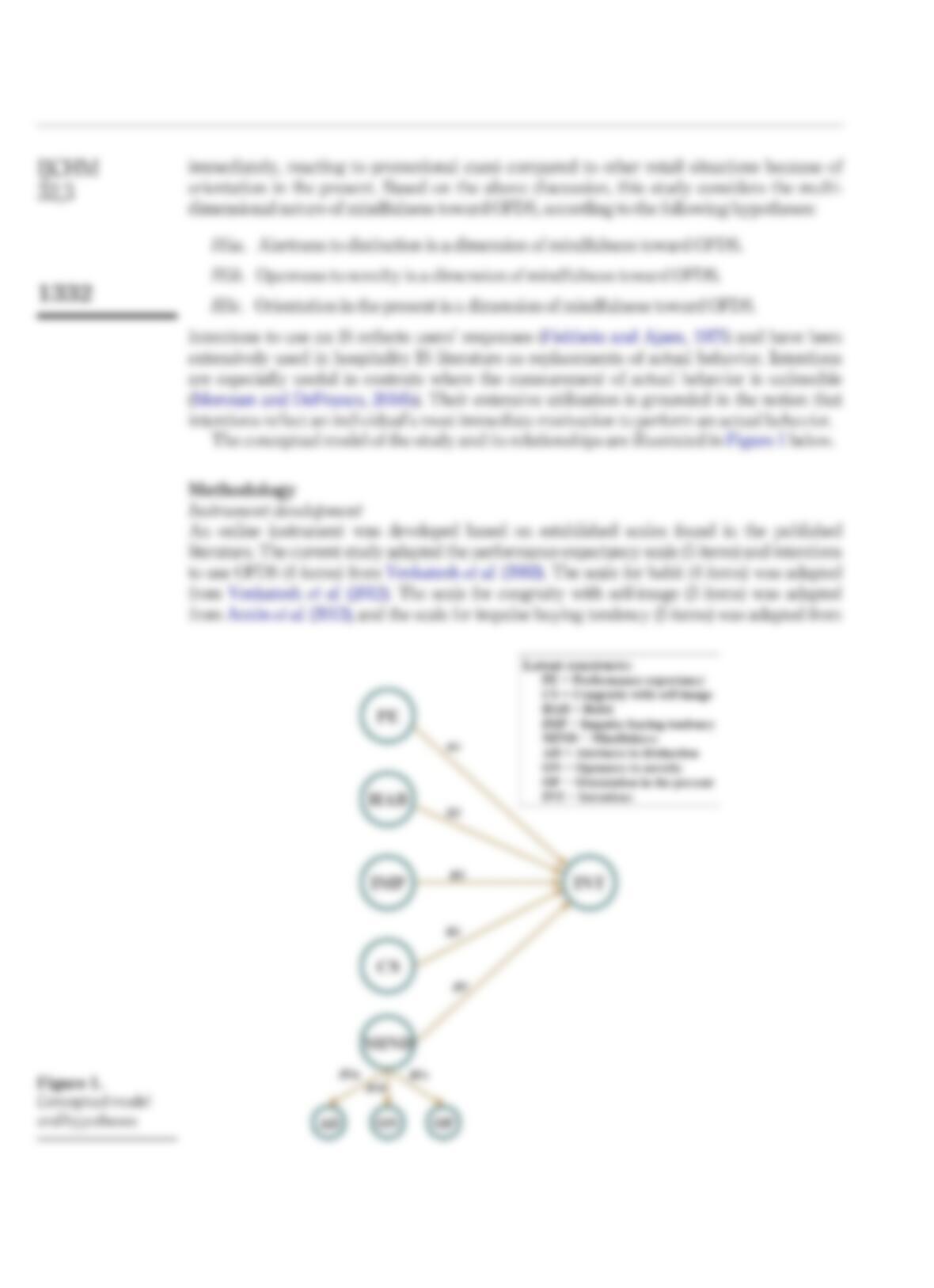
H1. Performance expectancy is positively related to the consumers’intentions to use
OFDS.
Habit. Habit reflects a relationship between a person’s past and future behaviors (Kim and
Malhotra, 2005). Habit has been validated as an antecedent of users’behaviors, especially
when repetitive behaviors manifest in IS use (Limayem and Cheung, 2008). Thus, habit
reflects consumers’continuous use of IS, in alignment with their satisfaction from previous
purchasing experiences (Khalifa and Liu, 2007). Given the ubiquity of today’s IS devices,
consumers develop habitual use patterns (Jasperson et al.,2005), which facilitates
subsequent use. Most contemporary online retail environments are grounded in the same
principles: guiding consumers through a linear path from information to decision-making,
Consumers’
intentions
1329

purchasing and fulfillment. OFDS makes no exception. Consumers ordering a food item are
guided by OFDS through this linear path, which enhances their learning effects and
optimizes subsequent episodes of use. Corroborated with similar processes from other online
retail environments (e.g. software, education and food service) (Correa et al.,2019), the
resulting habit can lead to intentions to use such systems in the future. Thus, it is expected
that consumers’habits influence their intentions to use OFDS, according to the following
hypothesis:
H2. Habit is positively related to the consumers’intentions to use OFDS.
Impulse buying tendency. Impulse buying reflects the tendency that leads consumers to
spontaneously purchase a product (Chan et al.,2017). In online shopping, various IS
attributes (e.g. website quality) (Wells et al.,2011) and value retained by shoppers (Chung
et al.,2017) were found to influence consumers’impulse buying tendencies, which can
influence their intentions to purchase (Chung et al., 2017). The value that consumers could
retain can be assessed based on persuasive information/advertising in the retail
environment. As advertising stimulates impulse purchasing (Madhavaram and Laverie,
2004), consumers who are impulse buyers may be tempted to use OFDS. Such behaviors
may be exacerbated by the innate appetizing presentation of food items in retail and the
urgency to eat. Moreover, impulsive consumers may purchase using OFDS based on
browsing because OFDS offer intangible benefits that can stimulate purchasing (e.g.
removing certain ingredients and creating a product bundle) (Sharma et al., 2010). Therefore,
characterized by persuasive information OFDS are environments where impulsive buyers
can determine stimuli that can guide them from information to purchasing, therefore
suggesting a relationship between impulse buying tendency and intentions to use OFDS:
H3. Consumers’impulse buying tendency is positively related to their intentions to use
OFDS.
Congruity with self-image. Congruity with self-image reflects the match between the
consumers’self-image and a brand or product image referencing the purchasing motivation
(Sirgy and Su, 2000). Self-image congruity is important to OFDS as both the food service
(Jeong and Jang, 2018) and IS literature (Carter and Grover, 2015) have recognized its role in
influencing consumers’intentions. Specifically, an individual can attach himself/herself to
an IS, which eventually integrates into his/her identity (Schwarz and Chin, 2007). OFDS
reflect marketing strategies designed to attract specific segments of consumers, stimulating
them to recognize the match between their self-image and the OFDS. Most importantly, the
cognitive evaluation of the match between a consumer’s perceived image of himself/herself
and that of the OFDS that is characterized by novelty (e.g. new technology, disruptive
business model, creating an identity with a third-party company that is not part of the
legacy hospitality industry) could reflect a high level of match, which could result in
intentions (Sirgy, 1982). Thus, consumers high in self-image congruity with OFDS could
display high intentions to use OFDS:
H4. Consumers’congruity with self-image is positively related to their intentions to use
OFDS.
Mindfulness. Mindfulness refers to individuals’awareness about the context and content of
information (Langer, 1997). It is a condition of being open to use IS where individuals
consider both details and features (Thatcher et al., 2018). When being mindful, users are
likely to consider various uses of IS (Roberts et al.,2007), which is fundamental to
IJCHM
32,3
1330
stimulating intentions to use IS (Sun et al., 2016). Mindful users continuously scan the task
environment to determine the best opportunities to interact with an IS (Thatcher et al.,2018).
Moreover, consumers’cognition when immersed in a task may influence their level of
performance in task completion (Butler and Gray, 2006) because they adapt to new
situations for accomplishing tasks (Teo et al.,2017). Accordingly, consumers are likely
to acknowledge the details and features of OFDS, which range from system design features
(e.g. shopping cart management), to the mix of hard products (e.g. customization) and soft
product features (e.g. rewards, coupons). For example, a consumer using an OFDS may see
an option for a food item made from local ingredients. Changing the consumer’s initial
choice may result in an optimized task completion because the new choice can be more
beneficial. The consumer can further optimize his or her purchasing task by applying
coupons found on the OFDS. Thus, OFDS-mindful consumers are likely to develop
intentions to use OFDS:
H5. Consumers’mindfulness toward OFDS is positively related to consumers’intention
to use OFDS.
Mindfulness comprises four dimensions:
(1) alertness to distinction;
(2) awareness of multiple perspectives;
(3) openness to novelty; and
(4) orientation in the present (Thatcher et al., 2018).
Alertness reflects the users’tendency to be aware of the differences between the way they
Consumers’
intentions
1331