Discussion Questions
1. Design an inventory control system for this business.
2. Describe how the system you have designed will help the company meet
customer-service and cost objectives.
Consolidated Electric is a wholesale distributor of electrical products primarily to electrical
contractors. The company wants to design a system for inventory management of the
20,000 line-items carried in stock. A description is given in the case of the business
environment and the current inventory control system in use.
The purpose of this case is to expose students to many of the issues encountered in
inventory system design. These issues include: forecasting, replenishment decision rules,
error control, multiple item interactions, ABC analysis, and top management control. The
case also asks the student to describe how the system they design will help improve
inventory management in the company.
Analysis
One issue that needs to be considered during inventory system design is whether the
system will utilize periodic or continuous review. Periodic review should be used in order
to take advantage of purchase discounts and shipping economies. With periodic review,
different items from the same supplier can be consolidated into a single order/single
shipment. Since most product lines are reviewed on a weekly basis, this practice should be
continued for control and shipping purposes, unless a bi-weekly cycle becomes an obvious
choice.
Items should be consolidated by line for ordering purposes. Thus, an entire line must be
reviewed before ordering decisions are made. The case indicates there are about 200
different lines to consider on a weekly basis.
An inventory control system is shown in Exhibit 1. The forecasting model receives actual
demand and produces a forecast for each item on a weekly basis. The forecast should
extend through the ordering lead time for each item.
The order module accepts the forecast along with management inputs for service level and
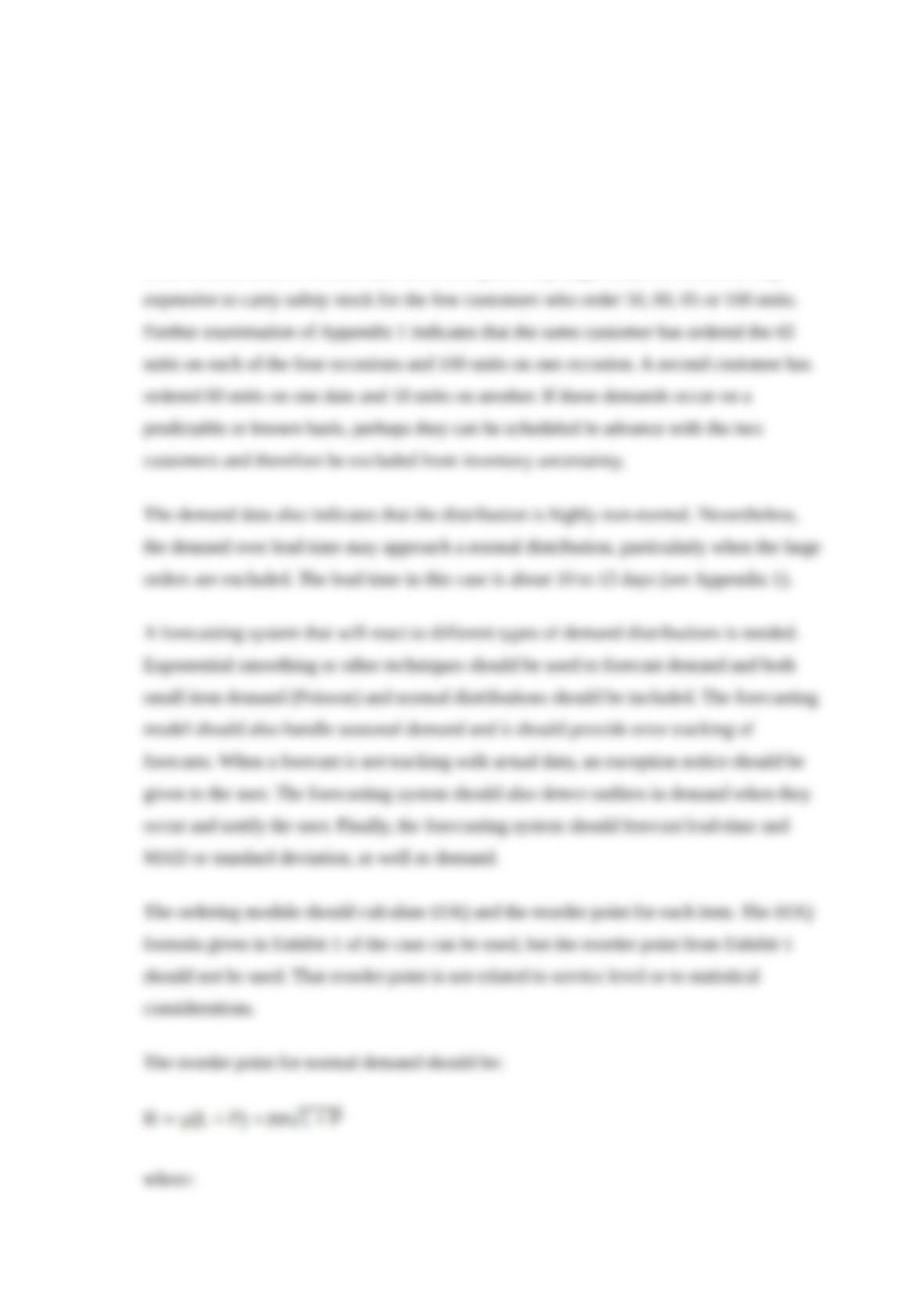
costs. As a result, orders are calculated for each line and aggregate control information is
fed back to management prior to order placement. Orders are then placed, shipments occur
from the vendor, and disbursements are made to customers.
Before designing the forecasting module we should examine the data in Appendix 1 of the
case. A frequency distribution of the individual customer demands for seven months is
shown in Exhibit 2. The distribution indicates there are two types of customers, those who
order a small number of units and those who place very large orders. It would be very