1
Question 1:
You are required to help Mr. Syed Nadzhan by:
(i) Identify the problem facing by Mr. Syed Nadzhan relating to the financial assets.
Mr. Syed Nadzhan faced problem to meet the long-term financial goals in order to survive in the
recent economic recession in Malaysia. He made an extensive change in the management team
and proposed different options to diversify the financial resources for the company. He believed
that a little stream of water from different directions can lead to a flood. Mr. Syed Nadzhan
proceed with his proposal to secure the financial sources for the company in the current
recession. He suggested that the company to have an investment to meet the long-term financial
goals through investment in financial assets.
(ii) Analyze the problem by referring to MFRS 139 financial Asset in terms of the
classification of financial assets, accounting treatments and converting from one
category to another.
Classification Of Financial
Assets
Accounting Treatments
Converting From One
Category To Another
Financial asset at fair value
through profit or loss
(FVTPL)
Fair value with the changes
in fair value recognised in
profit or loss
Cannot be reclassified
Held-to-maturity(HTM)
Investments
Amortised cost, using the
effective interest method, less
impairment loss
Must be reclassified as
available for sale when there
is change in intention or
ability or tainting rules
triggered
Loans and receivables
Amortised cost, using the
effective interest method, less
impairment loss
Cannot be reclassified
Available-for-sale (AFS)
financial assets
Fair value with the changes
in fair value recognised in
equity, until the financial
asset is impaired or
derecognised, at which time
May be reclassified as held to
maturity investment when
there is a change in intention
or ability or tainting rules
expire

2
the cumulative gain or loss
recognised in equity should
be transferred to profit or loss
(iii) Help him to make a decision related to the conversion.
He can choose alternative 1 which is bonds investment. The company will receive interest from
issuer until there is change in intention or ability or tainting rules triggered. On top of that, when
this held to maturity investment is reclassified as available for sale, the company is invested in
terms of shares and be part of issuer company’s owner. This means Sisman Bhd will receive
dividend as investor or owner in that company. Moreover, bonds usually have a defined term, or
maturity, after which the bond is redeemed, whereas shares are typically outstanding indefinitely.
This will continuously generate income to Sisman Bhd.
Question 2:
If the board of directors accepts the first scenario and the company performed it;
(i) Prepare the journal entry at the date of the bonds purchase.
Date
Accounts
Debit
(RM)
Credit
(RM)
2017 Jan 1
Investment in bond
1,038,609
Cash
1,038,609
(ii) Prepare a bond amortization schedule through 2021. Round up your answers.
Date
Interest received
(Cash)
Interest revenue
Bond premium
amortization
Carrying
amount of bond
1/1/2017
RM1,038,609
30/6/2017
RM55,000
RM51,930
(RM3,070)
1,035,539
31/12/2017
55,000
51,777
(3,223)
1,032,316
30/6/2018
55,000
51,616
(3,384)
1,028,932

3
31/12/2018
55,000
51,447
(3,553)
1,025,379
30/6/2019
55,000
51,269
(3,731)
1,021,648
31/12/2019
55,000
51,082
(3,918)
1,017,730
30/6/2020
55,000
50,887
(4,113)
1,013,617
31/12/2020
55,000
50,681
(4,319)
1,009,297
30/6/2021
55,000
50,465
(4,535)
1,004,762
31/12/2021
55,000
50,238
(4,762)
1,000,000
(iii) Prepare the journal entry to record the interest received and the amortization for
2017.
Date
Accounts
Debit
(RM)
Credit
(RM)
2017 Jun 30
Cash
55,000
Interest revenue
51,930
Investment in bond
3,070
Cash
55,000
Interest revenue
55,000
2017 Dec 31
Cash
55,000
Interest revenue
51,777
Investment in bond
3,223
(iv) Prepare the maturity journal entry for the bonds at the date of maturity.
Date
Accounts
Debit
(RM)
Credit
(RM)
2021 Dec 31
Cash
55,000
Interest revenue
50,238
Investment in bond
4,762
Cash
1,000,000
Investment in bond
1,000,000
Question 3:
If the board of directors accepts the second scenario and the company performed it;
(i) Prepare the journal entries for the available for sale financial asset.
Date
Accounts
Debit
(RM)
Credit
(RM)
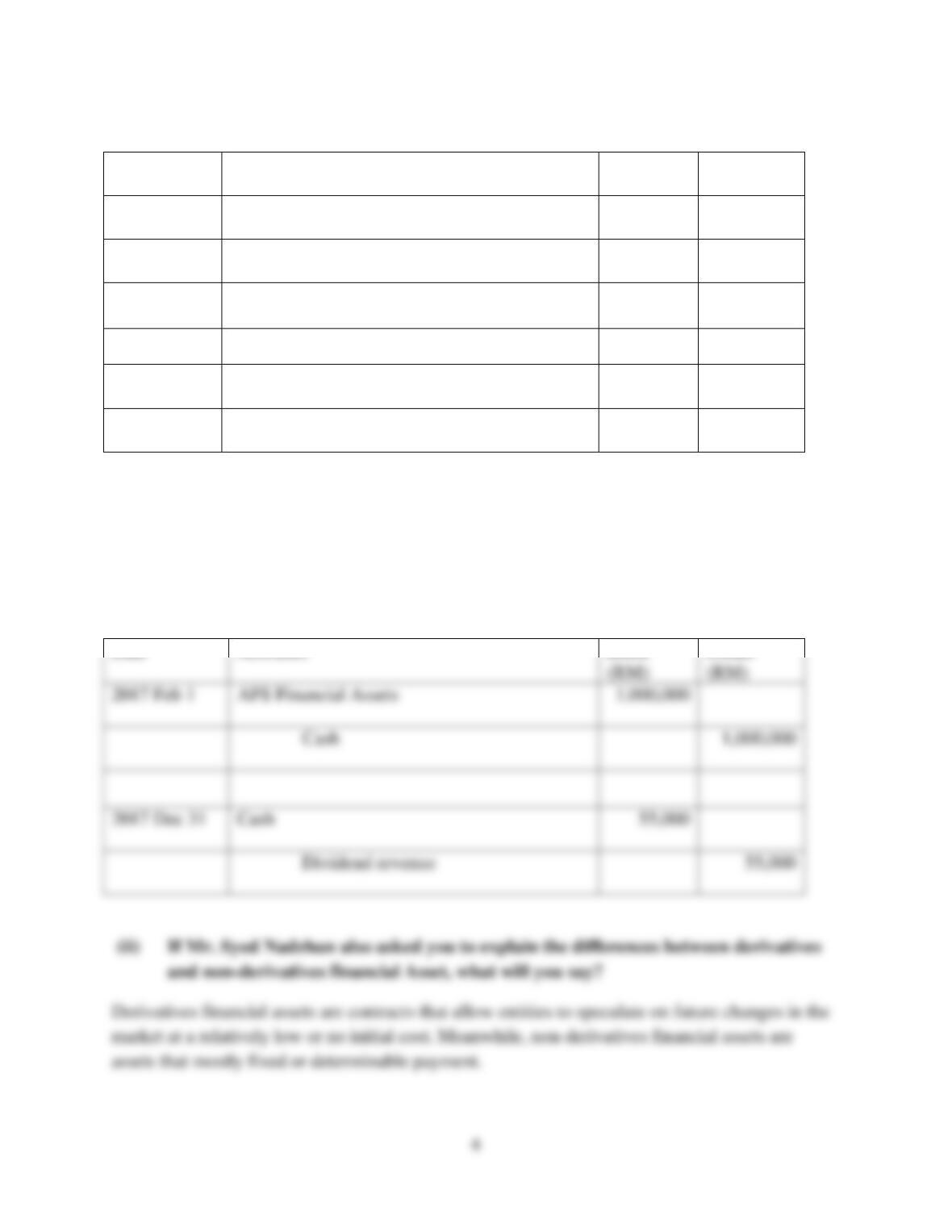
2017 Feb 1
AFS Financial Assets
1,000,000
Cash
1,000,000
2017 Dec 31
Cash
Dividend revenue