COMPETENCY OF FACILITIES MANAGER FOR HOSPITAL
CONSTRUCTION
N. Jenuwa1, M. S. Misnan2 and M. N. Abdullah3
1, 2 Faculty of Built Environment & Surveying, UTM Johor, MALAYSIA
(E-mail: norsyazwanajenuwa@gmail.com, b-saidin@utm.my)
3 Faculty of Built Environment & Surveying, UTM Johor, MALAYSIA.
(E-mail: matnaim@utm.my)
ABSTRACT
Research Design: Literature Review
Objective: Identify the ability of a facility manager. Decide the competence of the
construction facility manager at the pre-
construction phase of the hospital
construction. The viability of facility management is regularly connected with
consumer satisfaction of a building. While the expense for facility management is
the second biggest expense in the activity of a structure. This study is significance
of early involvement of the facility manager in the design stage. As of now design
stage of a building construction is hoarded by architects. What is anticipated from
this study is that the early involvement of the facility manager will have a major
effect particularly in monitoring the future use and care of the facility and evaluating
the arrangement of the facility in accordance with the objectives of a building.
Keywords : Facility Manager, Operation, Design Stage, Competency and Hospital
INTRODUCTION
Facility managers are responsible for
building management within the
organization, their tasks often incorporate
activities such as planning, setting up,
and managing security. In fact, this
aspect is becoming increasingly important
feature of facility management. It is
therefore important to identify areas with
potential risks and to establish steps to
mitigate or eliminate such risks. (Sarel
Lavy and Manish K. Dixit, 2010)
The facility manager is described as a
person who needs to provide strong
support to the key business operations as
well as contribute to the achievement of
an organization’s objectives and
strategies to ensure effective, safe and
secure building, equipment, services,
systems, and workforce (Hafizi et al,
2010). This statement is supported by
Hamimah et al (2012) stating that the
facility managers are known as property
managers and provide services for
supporters of an organization’s
operations.
COMPETENCY OF FACILITIES
MANAGER
Williams and Sutrisna (2010), stated that
the scope of work for facility managers
637
includes the responsibility of customer
premises, planning and provision of
accommodation services and support to
businesses and residents, building
security and maintenance, human
management, time, cost and performance
building. Meanwhile, Meng (2014), claims
that facility managers must balance the
economic, environmental and social
considerations in building management
by linking strategic levels with operational
stages.
The commitment of a manager is an
important part of corporate sustainability
(Visser and Crane, 2010). Facilities
management is at the forefront of
delivering sustainable management in
practice (Elmualim et al., 2010). They can
make a significant difference by using
sustainable management in terms of their
areas of responsibility (British Facilities
Management Institute, 2013). However,
some studies have so far been explored
by the role of a facility manager.
Among research efforts, some of them
focused on the task of the facility
manager. For example, Williams and
Sutrisna (2010) identified the duties of the
facility manager, including full
responsibility for business premises,
planning and provision of accommodation
and support services to businesses and
residents, building security and
that enable a person to perform his work
excellently in the field of work
(Vathanophas and Thaingam, 2007).
Williams and Sutrisna (2010) also
emphasize the task of the facility
manager, including great responsibility for
the building itself, planning and provision
of accommodation and support services
to businesses and residents, building
security and maintenance, human
management, time, cost and performance
improvement, and others.
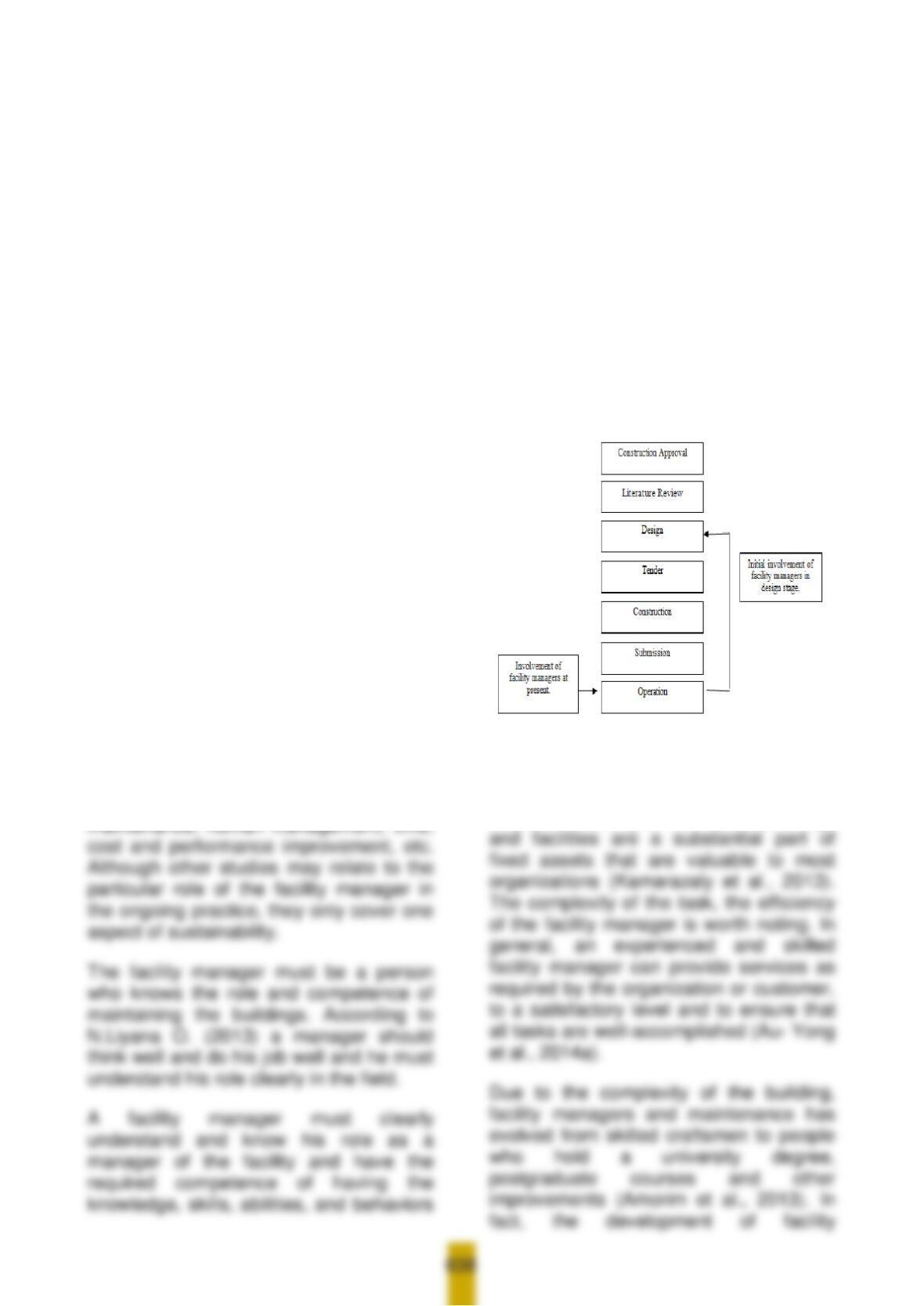
According to Meng X, 2014, refer figure 1,
the project life cycle is divided into
several phases.
Figure 1: Project life cycle
The management of buildings and
facilities is complex because buildings