Comparing Forecasting Models in Marine Fish Landings
Outlines
Abstract
1. Introduction
2. Objective
3. Literature Review
4. Methodology
4.1 Model Type
(i) Naive with Trend Model
(ii) Average Change Model
(iii) Double Exponential Smoothing
(iv) Holt’s Model
(v) Holt-Winter’s with Trend and Seasonality
4.2 Error Measure
(i) Mean Square Error (MSE)
(ii) Mean Absolute Percentage Error (MAPE)
4.3 The Estimation and Evaluation Procedures of the Forecasting
5. Results and Discussions
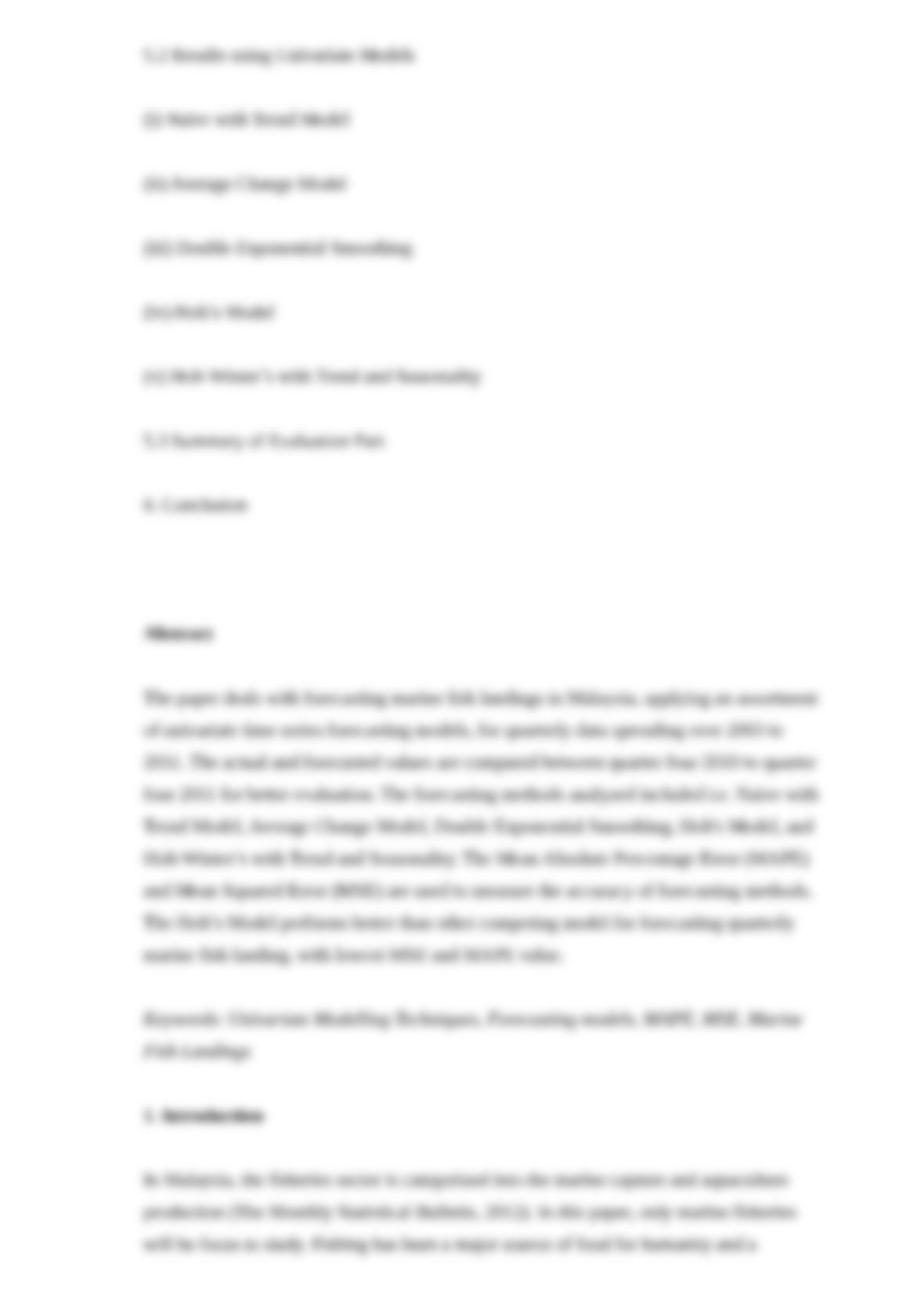
5.1 Discussions of Original Data
5.2 Results using Univariate Models
(i) Naive with Trend Model
(ii) Average Change Model
(iii) Double Exponential Smoothing
(iv) Holt’s Model
(v) Holt-Winter’s with Trend and Seasonality
5.3 Summary of Evaluation Part
6. Conclusion
Abstract
The paper deals with forecasting marine fish landings in Malaysia, applying an assortment
of univariate time series forecasting models, for quarterly data spreading over 2003 to
2011. The actual and forecasted values are compared between quarter four 2010 to quarter
four 2011 for better evaluation. The forecasting methods analyzed included i.e. Naive with
Trend Model, Average Change Model, Double Exponential Smoothing, Holt’s Model, and
Holt-Winter’s with Trend and Seasonality. The Mean Absolute Percentage Error (MAPE)
and Mean Squared Error (MSE) are used to measure the accuracy of forecasting methods.
The Holt’s Model performs better than other competing model for forecasting quarterly
marine fish landing, with lowest MSE and MAPE value.
Keywords: Univariate Modelling Techniques, Forecasting models, MAPE, MSE, Marine
Fish Landings
1. Introduction
In Malaysia, the fisheries sector is categorized into the marine capture and aquaculture
production (The Monthly Statistical Bulletin, 2012). In this paper, only marine fisheries
will be focus to study. Fishing has been a major source of food for humanity and a
provider of employment and economic benefits to those engaged in this activity. The
fishery sector plays an important role in the social and economic development in Malaysia.
The deep sea and offshore fishery industries are the main contributors to the nation’s
fisheries (Akbar Ali et al., 2009).
With increased knowledge and the dynamic development of fisheries, it was realized that
marine resources although renewable, are not infinite and need to be properly managed
(Akbar Ali et al., 2009). According to Selected Agricultural Indicators 2012 published by
Department of Statistics Malaysia, in 2011, marine fish landings decreased to 1,373.1
thousand tonnes (3.9%) as compared to the previous year and international comparison in
2010 for production of fish capture showed Malaysia is ranked 17th in the world and 11th
in Asia.
Forecasting is defined as the prediction of future events based on known past values of
relevant variables (Makridakis et al., 1998). Due to the uncertainty of the future, there
must always be forecasting errors (Hilborn, 1987). An inappropriate forecasting method,
such as incorrect construction of equations, can produce poor forecasts and biased
estimates will be misguided (Chen et al., 2008).
This paper will use five forecasting methods, i.e. Naive with Trend Model, Average
Change Model, Double Exponential Smoothing, Holt’s Model, and Holt-Winter’s with
Trend and Seasonality. The accuracy of the forecasting methods was measured using Mean
Squared Error (MSE) and Mean Absolute Percentage Error (MAPE).
The rest of the paper is organized into six sections. After the introduction, section two
describes the objectives, section three present related literature reviews of the study, and
section four describes the methodology of this study including the experimental design and
the assumptions. The results and discussions are found in section five, conclusion of the
chosen model is summarized and future research directions are suggested in section six.
2. Objective
The objective of this paper was to identify the most appropriate forecasting method for
marine fish landings in Malaysia. The best forecasting model will be used as a guide for
projection of future production.
3. Literature Review

Malaysia is surrounded by the Straits of Malacca, the Straits of Johore, the Sulu Sea and
the South China Sea which is an extensive fishing ground. In 1984, Malaysia declared its
Exclusive Economic Zone (EEZ) up to 200 nautical miles (Mohd. Mazlan, 2000). With
such a large marine habitat, the fisheries sector in Malaysia plays a significant role in
supporting the country’s economic growth through provision of employment and providing
source of much needed protein to the population (Mahendran Shitan et al., 2008).
Previous research on fisheries has been done to show and describe the importance of the
application of fish forecasting in fisheries management. Stergiou et al (1996 and 1997) has
shown the comparison between various regressions, univariate, multivariate time series
techniques to model and forecast the monthly and annual fisheries catches. Hae-Hoon Park
(1998) analyzed and predicted fisheries landings in Korea. Pierce and Boyle (2003) also
used time series models to model inter-annual variation squid abundance in Scottish
waters. In Malaysia, Mahendran Shitan et al (2004) used an ARIMA (0, 1, 1) model and
bootstrap estimation to forecast the annual total marine fish production. Intan Martina et
al., (2010) have conducted a research to select the suitable controlled variables in forecast
fish landing and used multiple linear regressions for the research because there were more
than one controlled variables.
In a study of factors that affect catch rates of hake Merlucciusmerluccius, also known as
one of the main groundfish species in North-Western Mediterranean trawl fisheries, the
researcher identified the several factors affecting catch rates such as time (months, and
years), vessel characteristics of the fleets related with their vessel fishing power (length of
the vessel, and Gross Registered Tonnage), fishing regulations (closures and geographic
area (harbour)). Data records contained monthly landings of main commercial species by
vessel and number of days fished. The Generalized Linear Modelling was applied to total
hake catch rates in each fishing area (Goi, R et. al, 2004).
Kisang Ryu and Alfonso Sanchez,(2003) stated that the forecasting methods analyzed