2
Chapter Preview
In the first chapter, we ex-
plored the marketing process,
the process by which companies create value for consumers in order to
capture value from them in return. In this chapter, we dig deeper into
steps two and three of that process: designing customer-driven mar-
keting strategies and constructing marketing programs. First, we look
at the organization’s overall strategic planning, which guides market-
ing strategy and planning. Next, we discuss how, guided by the strate-
gic plan, marketers partner closely with others inside and outside the
firm to create value for customers. We then examine marketing strat-
Nike powered its way through the early 1990s, moving ag-
gressively into a dozen new sports, including baseball, golf,
skateboarding, wall climbing, bicycling, and hiking. The still-
brash young company slapped its familiar swoosh logo on
everything from sunglasses and soccer balls to batting gloves
and golf clubs. It seemed that things couldn’t be going any better.
In the late 1990s, however, Nike stumbled, and its sales
slipped. As the company grew larger, its creative juices seemed to
run a bit dry. Its ads began to look like just more of the same, and
its ho-hum new sneaker designs collected dust on retailer shelves’
as buyers seeking a new look switched to competing brands.
Looking back, Nike’s biggest obstacle may have been its own in-
credible success. As sales approached the $10 billion mark, the
swoosh may have become too common to be cool. Instead of be-
ing antiestablishment, Nike was the establishment, and its hip,
once-hot relationship with customers cooled. Nike needed to
rekindle its meaning to its customers.
To turn things around, Nike returned to its roots: new-product
innovation and a focus on customer relationships. Its newly
minted mission: Nike wants “to bring inspiration and innova-
tion to every athlete* in the world (*if you have a body, you are
an athlete.)” With its deep pockets, as in the past, Nike can out-
spend most competitors on marketing by a wide margin. But
this time around, the sports marketer set out to create a new kind
of customer relationship—a deeper, more involving one. Now,
Nike no longer just talks at its customers through media ads and
celebrity endorsers. Instead, it uses cutting-edge marketing tools
to interact with customers to build brand experiences and deep
brand community.
The Nike swoosh—it’s everywhere! Just for fun, try count-
ing the number of swooshes whenever you pick up the
sports pages, watch a pickup basketball game, or tune
into a televised golf match. Through innovative market-
ing, Nike has built the ever-present swoosh into one of the best-
known brand symbols on the planet.
Some 47 years ago, when young CPA Phil Knight and col-
lege track coach Bill Bowerman cofounded the company, Nike
was a brash, young upstart in the athletic footwear industry. In
1964, the pair chipped in $500 apiece to start Blue Ribbon Sports.
In 1970, Bowerman cooked up a new sneaker tread by stuffing a
piece of rubber into his wife’s waffle iron. The Waffle Trainer
quickly became the nation’s best-selling training shoe. In 1972,
the company introduced its first Nike brand shoe, named after
the Greek goddess of victory. And, in 1978, the company
changed its name to Nike. By 1979, Nike had sprinted ahead of
the competition, owning 50 percent of the U.S. running shoe
market.
In the 1980s, Nike revolutionized sports marketing. To build
its brand image and market share, Nike lavishly outspent its com-
petitors on big-name endorsements, splashy promotional events,
and big-budget, in-your-face “Just Do It” ads. Nike gave cus-
tomers much more than just good athletic gear. Whereas competi-
tors stressed technical performance, Nike built customer
relationships. Beyond shoes, apparel, and equipment, Nike mar-
keted a way of life, a genuine passion for sports, a just-do-it atti-
tude. Customers didn’t just wear their Nikes, they experienced them.
As the company stated on its Web page, “Nike has always known
the truth—it’s not so much the shoes but where they take you.”
egy and planning—how marketers choose target markets, position
their market offerings, develop a marketing mix, and manage their
marketing programs. Finally, we look at the important step of measur-
ing and managing return on marketing investment (marketing ROI).
Let’s begin by looking at Nike. Over the past several decades, Nike
has built the Nike swoosh into one of the world’s best-known brand
symbols. Nike’s outstanding success results from much more than just
making and selling good sports gear. It’s based on a customer-focused
mission and strategy through which Nike creates valued brand experi-
ences and deep brand community with its customers.
Part 1: Defining Marketing and the Marketing Process (Chapters 1–2)
Part 2: Understanding the Marketplace and Consumers (Chapters 3–6)
Part 3: Designing a Customer-Driven Strategy and Mix (Chapters 7–17)
Part 4: Extending Marketing (Chapters 18–20)
Company and Marketing
Strategy
Nike’s Mission: Creating Valued Brand Experiences and Deep Brand Community
Partnering to Build
Customer Relationships

Chapter 2 |Company and Marketing Strategy: Partnering to Build Customer Relationships 37
Nike still invests hundreds of mil-
lions of dollars each year on creative
advertising. However, it now spends
less than one-third of its $593 million
annual promotion budget on television
and other traditional media, down
from 55 percent 10 years ago. These
days, behind the bright lights, Nike
has developed a host of innovative
new relationship-building approaches.
Using community-oriented, digi-
tally led, social-networking tools, Nike
is now building communities of cus-
tomers who talk not just with the com-
pany about the brand but with each
other. “Nike’s latest masterstroke is so-
cial networking, online and off,” says
one Nike watcher. Whether customers
come to know Nike through ads, in-
person events at a Niketown store, a
local Nike running club, or at a one of
the company’s many community Web
sites, more and more people are
bonding closely with the Nike brand
experience. Consider this example:
Twice a week, 30 or more people gather at a Nike store in
Portland, Oregon, and go for an evening run. Afterward,
the members of the Niketown running club chat in the store
over refreshments. Nike’s staff keeps track of their per-
formances and hails members who have logged more than
100 miles. The event is a classic example of up-close-and-
personal relationship building with core customers.
Nike augments such events with an online social net-
work aimed at striking up meaningful and long-term interac-
tions with even more runners. The Nike⫹running Web site
lets customers with iPod-linked Nike shoes monitor their
performances—the distance, pace, time, and calories burned
during their runs. Runners can upload and track their own per-
formances over time, compare them with those of other run-
ners, and even participate in local or worldwide challenges.
Talk about brand involvement. Nike⫹can be the next
best thing to your own personal trainer or jogging buddy. The
Nike⫹Web site offers a “Nike Coach” that provides advice
and training routines to help you prepare for competitive
races. When running, if you have earphones, at the end of
every mile a friendly voice tells you how far you’ve gone and
then counts down the final meters. If you hit the wall while
running, the push of a button brings up a personally selected
“power song” that gives you an extra boost and gets you go-
ing again. Back home again, after a quick upload of your run-
ning data, Nike⫹charts and helps you analyze your run.
In four years, two million Nike⫹members have logged
more than 233 million miles
on the site. Collectively,
the Nike⫹community has
run the equivalent of 9,400
trips around the world or
490 journeys to the moon
and back. Last October, a
million runners competed
virtually in the second annual global
“Human Race” 10K, posting their
times on Nike⫹, comparing them-
selves with runners worldwide, and
seeing how their cities or countries
performed. The long-term goal is to
have 15 percent of the world’s 100 mil-
lion runners using the system.
Thanks to efforts like Nike⫹, Nike has
built a new kinship and sense of commu-
nity with and between its customers. More than just something
to buy, Nike products have once again become a part of cus-
tomers’ lives and times. As a result, the world’s largest sports-
wear company is once again achieving outstanding results. Over
the past five years, Nike’s global sales and profits have surged
nearly 40 percent. In the past three years, Nike’s share of the U.S.
running shoe market has grown from 48 percent to 61 percent. In
2008 and 2009, as the faltering economy had most sports apparel
and footwear competitors gasping for breath, Nike raced ahead.
It’s global sales grew 14 and 3 percent, respectively. In troubled
2010, despite flat sales, Nike’s profits shot ahead 28 percent. By
contrast, at largest rival Adidas, sales fell 7 percent, and profits
dropped by 68 percent.
In fact, Nike views uncertain economic times as “an incredible
opportunity” to take advantage of its strong brand. As in sports
competition, the strongest and best-prepared athlete has the best
chance of winning. With deep
customer relationships comes
a powerful competitive advan-
tage. And Nike is once again
very close to its customers. As
one writer notes, “Nike is blur-
ring the line between brand
and experience.”1
Nike creates deep
brand community
with its customers.
For example, the
Nike⫹running
system can be the
next best thing to
your own personal
trainer or jogging
buddy.
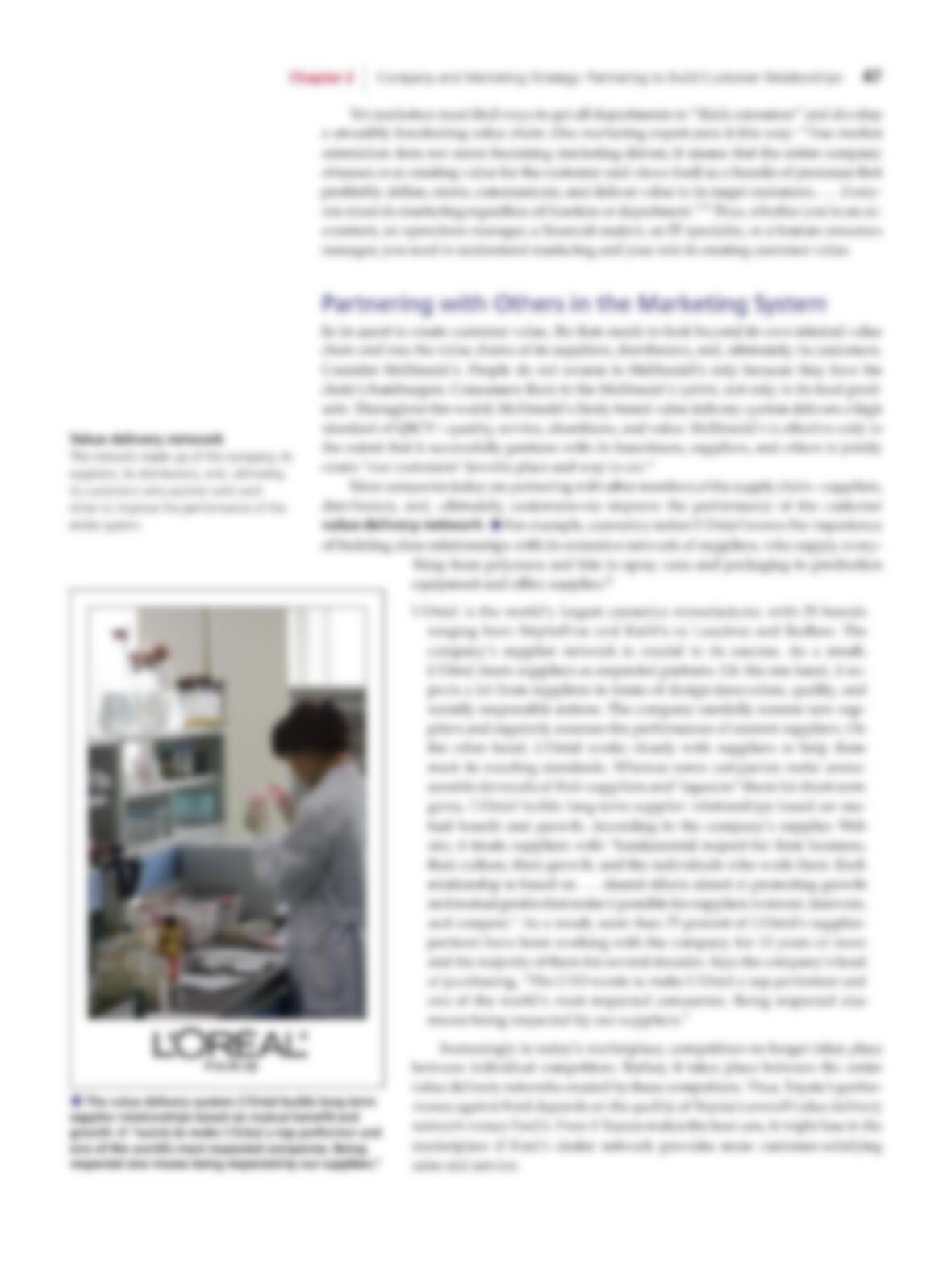
Nike’s customer-focused mission and strategy have
helped Nike to build strong customer relationships and
a deep sense of brand community. As a result, while
other sports gear companies are gasping for breath,
Nike is sprinting ahead.
Like Nike, outstanding marketing organizations employ strongly customer–
driven marketing strategies and programs that create customer value and relationships.
These marketing strategies and programs, however, are guided by broader company-wide
strategic plans, which must also be customer focused. Thus, to understand the role of mar-
keting, we must first understand the organization’s overall strategic planning process.
Company-Wide Strategic Planning:
Defining Marketing’s Role (pp 38–45)
Each company must find the game plan for long-run survival and growth that makes the
most sense given its specific situation, opportunities, objectives, and resources. This is the
focus of strategic planning—the process of developing and maintaining a strategic fit be-
tween the organization’s goals and capabilities and its changing marketing opportunities.
Strategic planning sets the stage for the rest of planning in the firm. Companies usually
prepare annual plans, long-range plans, and strategic plans. The annual and long-range
plans deal with the company’s current businesses and how to keep them going. In contrast,
the strategic plan involves adapting the firm to take advantage of opportunities in its con-
stantly changing environment.
At the corporate level, the company starts the strategic planning process by defining its
overall purpose and mission (see Figure 2.1). This mission is then turned into detailed
supporting objectives that guide the entire company. Next, headquarters decides what port-
folio of businesses and products is best for the company and how much support to give
each one. In turn, each business and product develops detailed marketing and other depart-
mental plans that support the company-wide plan. Thus, marketing planning occurs at the
business-unit, product, and market levels. It supports company strategic planning with
more detailed plans for specific marketing opportunities.
38
Objective
OUTLINE
Explain company-wide strategic planning and its four steps.
Company-Wide Strategic Planning: Defining Marketing’s Role (38–40)
Discuss how to design business portfolios and develop growth strategies.
Designing the Business Portfolio (40–45)
Explain marketing’s role in strategic planning and how marketing works with its partners
to create and deliver customer value.
Planning Marketing: Partnering to Build Customer Relationships
(45–47)
Describe the elements of a customer-driven marketing strategy and mix and the forces
that influence it.
Marketing Strategy and the Marketing Mix (48–53)
List the marketing management functions, including the elements of a marketing plan,
and discuss the importance of measuring and managing return on marketing investment.
Managing the Marketing Effort (53–57)
Measuring and Managing Return on Marketing Investment (57–58)
Strategic planning
The process of developing and
maintaining a strategic fit between the
organization’s goals and capabilities and
its changing marketing opportunities.
Company-wide strategic
planning guides
marketing strategy and planning. Like
marketing strategy, the company’s
broad strategy must also be customer
focused.
Author
Comment

Chapter 2 |Company and Marketing Strategy: Partnering to Build Customer Relationships 39
Planning marketing
and other functional
strategies
Corporate level
Business unit, product,
and market level
Designing
the business
portfolio
Setting company
objectives
and goals
Defining
the company
mission
Like the marketing strategy,
broad company strategy
must be customer focused.
Company-wide strategic planning guides
marketing strategy and planning.
FIGURE |2.1
Steps in Strategic Planning
Defining a Market-Oriented Mission
An organization exists to accomplish something, and this purpose should be clearly stated.
Forging a sound mission begins with the following questions: What is our business? Who is
the customer? What do consumers value? What should our business be? These simple-sounding
questions are among the most difficult the company will ever have to answer. Successful
companies continuously raise these questions and answer them carefully and completely.
Many organizations develop formal mission statements that answer these questions. A
mission statement is a statement of the organization’s purpose—what it wants to accom-
plish in the larger environment. A clear mission statement acts as an “invisible hand” that
guides people in the organization.
Some companies define their missions myopically in product or technology terms
(“We make and sell furniture” or “We are a chemical-processing firm”). But mission state-
ments should be market oriented and defined in terms of satisfying basic customer needs.
Products and technologies eventually become outdated, but basic market needs may last
forever. Under Armour’s mission isn’t just to make performance sports apparel; it’s “to
make all athletes better through passion, science, and the relentless pursuit of innovation.”
Likewise, Chipotle’s mission isn’t to sell burritos. Instead, the restaurant promises “Food
with Integrity,” highlighting its commitment to the immediate and long-term welfare of
customers and the environment. Chipotle’s serves only the very best natural, sustainable,
local ingredients raised “with respect for the animals, the environment, and the farmers.”
Table 2.1 provides several other examples of product-oriented versus market-oriented
business definitions.2
Mission statement
A statement of the organization’s
purpose—what it wants to accomplish in
the larger environment.
TABLE |2.1 Market-Oriented Business Definitions
Company Product-Oriented Definition Market-Oriented Definition
Charles Schwab We are a brokerage firm. We are the guardian of our customers’ financial dreams.
Hulu We are an online video service. We help people find and enjoy the world’s premium video content
when, where, and how they want it—all for free.
General Mills We make consumer food products. We nourish lives by making them healthier, easier, and richer.
Home Depot We sell tools and home repair and
improvement items.
We empower consumers to achieve the homes of their dreams.
Nike We sell athletic shoes and apparel. We bring inspiration and innovation to every athlete* in the world.
(*If you have a body, you are an athlete.)
Revlon We make cosmetics. We sell lifestyle and self-expression; success and status; memories,
hopes, and dreams.
Ritz-Carlton
Hotels & Resorts
We rent rooms. We create the Ritz-Carlton experience—one that enlivens the senses,
instills well-being, and fulfills even the unexpressed wishes and needs
of our guests.
Walmart We run discount stores. We deliver low prices every day and give ordinary folks the chance to
buy the same things as rich people. “Save Money. Live Better.”
40 Part One |Defining Marketing and the Marketing Process
Mission statements should be meaningful and specific yet motivating. They should em-
phasize the company’s strengths in the marketplace. Too often, mission statements are writ-
ten for public relations purposes and lack specific, workable guidelines. Says marketing
consultant Jack Welch:3
Few leaders actually get the point of forging a mission with real grit and meaning.
[Mission statements] have largely devolved into fat-headed jargon. Almost no one can
figure out what they mean. [So companies] sort of ignore them or gussy up a vague
package deal along the lines of: “our mission is to be the best fill-in-the-blank company
in our industry.” [Instead, Welch advises, CEOs should] make a choice about how your
company will win. Don’t mince words! Remember Nike’s old mission, “Crush
Reebok”? That’s directionally correct. And Google’s mission statement isn’t something
namby-pamby like “To be the world’s best search engine.” It’s “To organize the
world’s information and make it universally accessible and useful.” That’s simultane-
ously inspirational, achievable, and completely graspable.
Finally, a company’s mission should not be stated as making more sales or profits; prof-
its are only a reward for creating value for customers. Instead, the mission should focus on
customers and the customer experience the company seeks to create. Thus, McDonald’s mis-
sion isn’t “to be the world’s best and most profitable quick-service restaurant”; it’s “to be our
customers’ favorite place and way to eat.” If McDonald’s accomplishes this customer-
focused mission, profits will follow (see Real Marketing 2.1).
Setting Company Objectives and Goals
The company needs to turn its mission into detailed supporting objectives for each level of
management. Each manager should have objectives and be responsible for reaching them. For
example, Kohler makes and markets familiar kitchen and bathroom fixtures—everything
from bathtubs and toilets to kitchen sinks. But Kohler also offers a breadth of other products
and services, including furniture, tile and stone, and even small engines and backup power
systems. It also owns resorts and spas in the United States and Scotland. Kohler ties this
diverse product portfolio together under the mission of “contributing to a higher level of
gracious living for those who are touched by our products and services.”
This broad mission leads to a hierarchy of objectives, including business objectives and
marketing objectives. Kohler’s overall objective is to build profitable customer relationships
by developing efficient yet beautiful products that embrace the “essence of gracious living”
mission. It does this by investing heavily in research and design. Research is expensive and
must be funded through improved profit, so improving profits becomes another major ob-
jective for Kohler. Profits can be improved by increasing sales or reducing costs. Sales can
be increased by improving the company’s share of domestic and international markets.
These goals then become the company’s current marketing objectives.
Marketing strategies and programs must be developed to support these marketing ob-
jectives. To increase its market share, Kohler might increase its products’ availability and
promotion in existing markets and expand into new markets. For example, Kohler is boost-
ing production capacity in India and China to better serve the Asian market.4
These are Kohler’s broad marketing strategies. Each broad marketing strategy must
then be defined in greater detail. For example, increasing the product’s promotion may re-
quire more salespeople, advertising, and public relations efforts; if so, both requirements
will need to be spelled out. In this way, the firm’s mission is translated into a set of objec-
tives for the current period.
Designing the Business Portfolio
Guided by the company’s mission statement and objectives, management now must plan
its business portfolio—the collection of businesses and products that make up the com-
pany. The best business portfolio is the one that best fits the company’s strengths and weak-
nesses to opportunities in the environment. Business portfolio planning involves two steps.
First, the company must analyze its current business portfolio and determine which busi-
nesses should receive more, less, or no investment. Second, it must shape the future portfo-
lio by developing strategies for growth and downsizing.
Business portfolio
The collection of businesses and products
that make up the company.
Chapter 2 |Company and Marketing Strategy: Partnering to Build Customer Relationships 41
Real
Marketing
2.1
McDonald’s: On a Customer-Focused Mission
More than half a century ago, Ray Kroc, a
52-year-old salesman of milk-shake-mixing
machines, set out on a mission to transform
the way Americans eat. In 1955, Kroc discov-
ered a string of seven restaurants owned by
Richard and Maurice McDonald. He saw the
McDonald brothers’ fast-food concept as a
perfect fit for America’s increasingly on-the-
go, time-squeezed, family-oriented lifestyles.
Kroc bought the small chain for $2.7 million,
and the rest is history.
From the start, Kroc preached a motto of
QSCV—quality, service, cleanliness, and value.
These goals became mainstays in McDonald’s
customer-focused mission statement. Apply-
ing these values, the company perfected the
fast-food concept—delivering convenient,
good-quality food at affordable prices.
McDonald’s grew quickly to become the
world’s largest fast-feeder. The fast-food gi-
ant’s more than 32,000 restaurants worldwide
now serve 60 million customers each day, rack-
ing up system-wide sales of more than $79 bil-
lion annually. The Golden Arches are one of
the world’s most familiar symbols, and other
than Santa Claus, no character in the world is
more recognizable than Ronald McDonald.
In the mid-1990s, however, McDonald’s
fortunes began to turn. The company appeared
to fall out of touch with both its mission and its
customers. Americans were looking for fresher,
better-tasting food and more contemporary at-
mospheres. They were also seeking healthier
eating options. In a new age of health-conscious
consumers and $5 lattes at Starbucks,
McDonald’s seemed a bit out of step with the
times. One analyst sums it up this way:
McDonald’s was struggling to find its identity
amid a flurry of new competitors and changing
consumer tastes. The company careened from
one failed idea to another. It tried to keep pace
by offering pizza, toasted deli sandwiches, and
the Arch Deluxe, a heavily advertised new burger
that flopped. It bought into nonburger franchises
like Chipotle and Boston Market. It also tinkered
with its menu, no longer toasting the buns,
switching pickles, and changing the special sauce
on Big Macs. None of these things worked. All
the while, McDonald’s continued opening new
restaurants at a ferocious pace, as many as 2,000
per year. The new stores helped sales, but cus-
tomer service and cleanliness declined because
the company couldn’t hire and train good work-
ers fast enough. Meanwhile, McDonald’s in-
creasingly became a target for animal-rights
activists, environmentalists, and nutritionists,
who accused the chain of contributing to the na-
tion’s obesity epidemic with “super size” French
fries and sodas as well as Happy Meals that lure
kids with the reward of free toys.
Although McDonald’s remained the
world’s most visited fast-food chain, the once-
shiny Golden Arches lost some of their luster.
Sales growth slumped, and its market share fell
by more than 3 percent be-
tween 1997 and 2003. In
2002, the company posted its
first-ever quarterly loss. In the
face of changing customer
value expectations, the com-
pany had lost sight of its fun-
damental value proposition.
“We got distracted from the
most important thing: hot,
high-quality food at a great
value at the speed and con-
venience of McDonald’s,” says
current CEO Jim Skinner. The
company and its mission
needed to adapt.
In early 2003, a troubled
McDonald’s announced a turn-
around plan—what it now calls
its “Plan to Win.” At the heart
of this plan was a new mission
statement that refocused the
company on its customers. Ac-
cording to the analyst:
The company’s mission was
changed from “being the
world’s best quick-service
restaurant” to “being our
customers’ favorite place and
way to eat.” The Plan to Win
lays out where McDonald’s
wants to be and how it plans
to get there, all centered on
five basics of an exceptional
customer experience: people,
products, place, price, and promotion. While
the five Ps smack of corny corporate speak,
company officials maintain that they have pro-
foundly changed McDonald’s direction and pri-
orities. The plan, and the seemingly simple shift
in mission, forced McDonald’s and its employ-
ees to focus on quality, service, and the restau-
rant experience rather than simply providing the
cheapest, most convenient option to cus-
tomers. The Plan to Win—which barely fits on a
single sheet of paper—is now treated as sacred
inside the company.
Under the Plan to Win, McDonald’s got
back to the basic business of taking care of
customers. The goal was to get “better, not
just bigger.” The company halted rapid expan-
sion and instead poured money back into
improving the food, the service, the atmo-
sphere, and marketing at existing outlets.
McDonald’s redecorated its restaurants with
clean, simple, more-modern interiors and
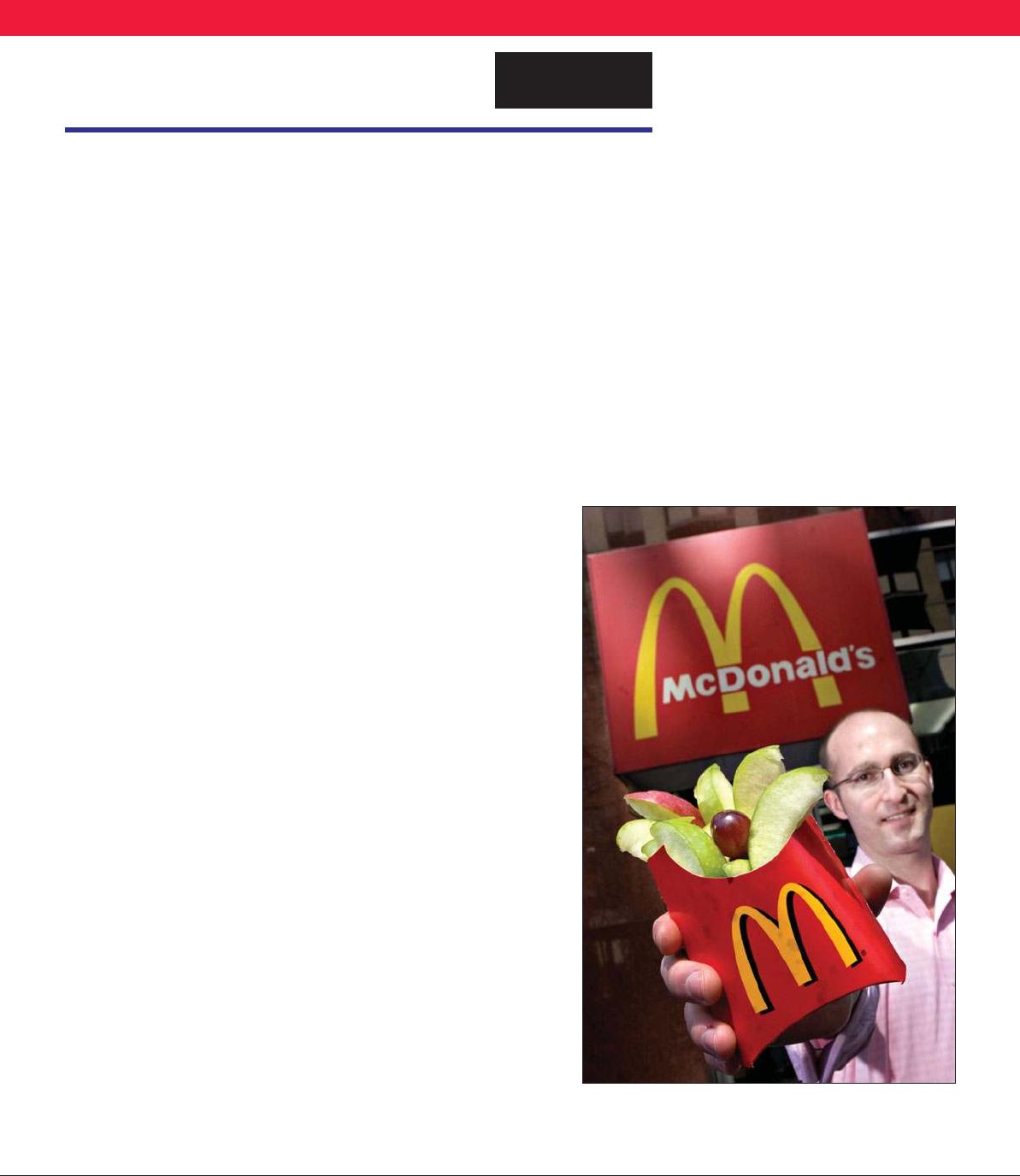
McDonald’s new mission—“being our customers’ favorite
place and way to eat”—coupled with its Plan to Win, got
the company back to the basics of creating exceptional
customer experiences.
Continued on next page
42 Part One |Defining Marketing and the Marketing Process
Analyzing the Current Business Portfolio
The major activity in strategic planning is business portfolio analysis, whereby manage-
amenities such as live plants, wireless Internet
access, and flat-screen TVs showing cable
news. Play areas in some new restaurants now
feature video games and even stationary bicy-
cles with video screens. To make the customer
experience more convenient, McDonald’s
stores now open earlier to extend breakfast
hours and stay open longer to serve late-night
diners—more than one-third of McDonald’s
restaurants are now open 24 hours a day.
A reworked menu, crafted by Chef Daniel
Coudreaut, a Culinary Institute of America
graduate and former chef at the Four Seasons
in Dallas, now provides more choice and vari-
ety, including healthier options, such as
Chicken McNuggets made with white meat, a
line of Snack Wraps, low-fat “milk jugs,” apple
slices, Premium Salads, and the Angus burger.
Within only a year of introducing its Premium
Salads, McDonald’s became the world’s largest
salad seller. The company also launched a ma-
jor multifaceted education campaign—themed
“it’s what i eat and what i do . . . i’m lovin’
it”—that underscores the important interplay
between eating right and staying active.
McDonald’s rediscovered dedication to cus-
tomer value sparked a remarkable turnaround.
Since announcing its Plan to Win, McDonald’s
sales have increased by more than 50 percent,
and profits have more than quadrupled. In 2008,
when the stock market lost one-third of its
value—the worst loss since the Great Depres-
sion—McDonald’s stock gained nearly 6 percent,
making it one of only two companies in the Dow
Jones Industrial Average whose share price rose
during that year (the other was Walmart).
Through 2010, as the economy and the restau-
rant industry as a whole continued to struggle,
McDonald’s outperformed its competitors by a
notable margin. Despite the tough times,
McDonald’s achieved a lofty 15.5 percent three-
year compound annual total return to investors
versus the S&P 500 average of ⫺5.6 percent.
Thus, McDonald’s now appears to have
the right mission for the times. Now, once
again, when you think McDonald’s, you think
value—whether it’s a college student buying a
sandwich for a buck or a working mother at the
drive-through grabbing a breakfast latte that’s
a dollar cheaper than Starbucks. And that has
customers and the company alike humming
the chain’s catchy jingle, “i’m lovin’ it.”
Sources: Extracts based on information found in Andrew Martin, “At McDonald’s, the Happiest Meal Is Hot
Profits,” New York Times, January 11, 2009; Jeremy Adamy, “McDonald’s Seeks Ways to Keep Sizzling,” Wall Street
Journal, March 10, 2009, p. A1; and John Cloud, “McDonald’s Has a Chef?” Time, February 22, 2010, pp. 88–91.
Financial and other information and facts from www.aboutmcdonalds.com/mcd/media_center.html/invest.html,
accessed October 2010.
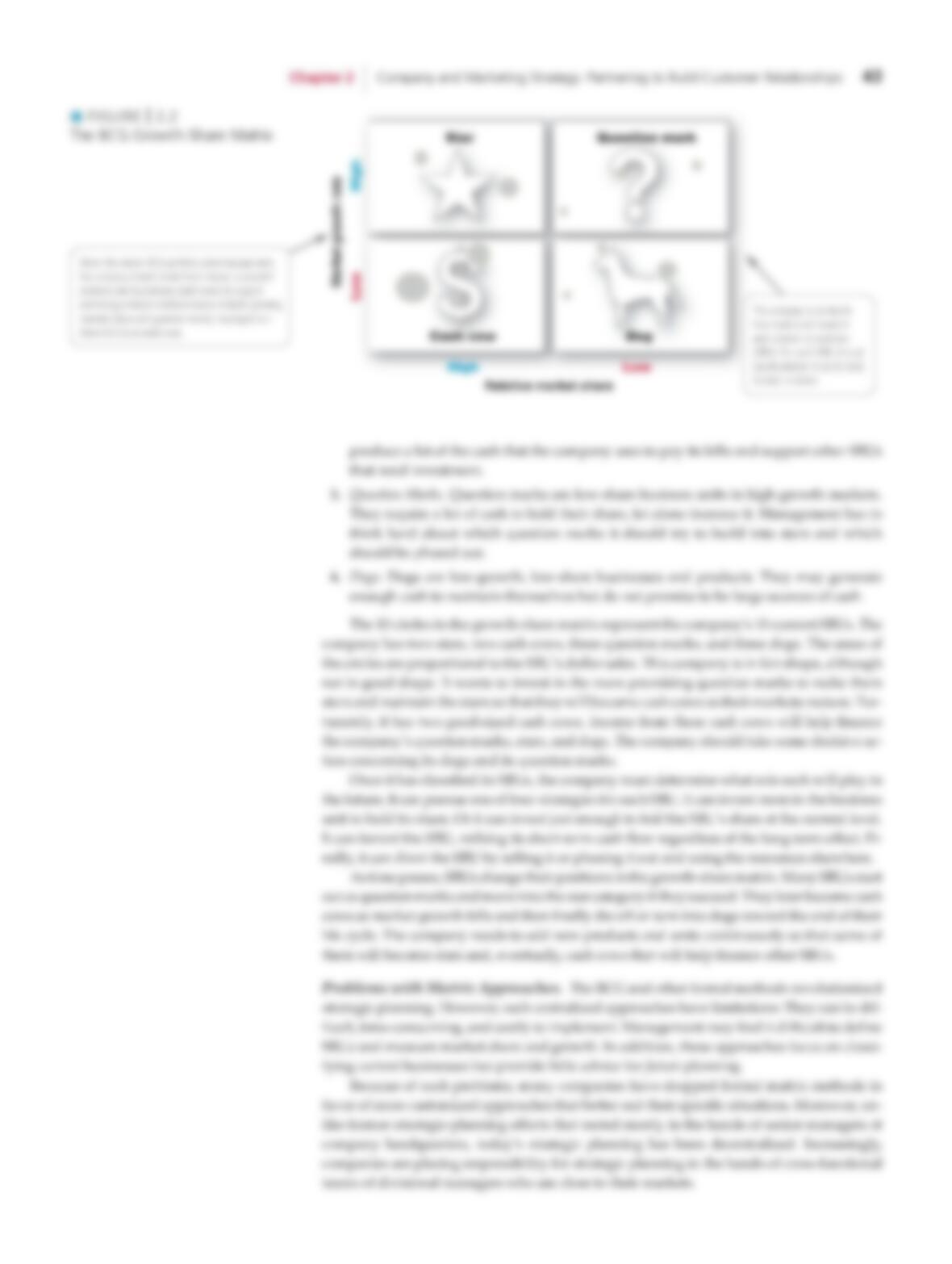
Portfolio analysis
The process by which management