Running head: LABOR AND EMPLOYMENT ANALYSIS
1
Submitted to Dr. Joseph Martelli in partial fulfillment of requirements for:
MBA 620: Management of Human Resources
Summer, 2015
Block I
Company and Industry Labor and Employment Analysis
Final Research Paper
Team 5
Anthony Cangelosi
cangelosia@findlay.edu
Student ID: 558558
Bailey Koester
koesterb@findlay.edu
Student ID: 541370
Christopher Reaper
reaperc@findlay.edu
Student ID: 372260
LABOR AND EMPLOYMENT ANALYSIS
2
Table of Contents
LABOR AND EMPLOYMENT ANALYSIS
3
Abstract
This is a research-based paper exploring labor and employment statistics for Caesar’s
Entertainment Corporation and the Casino Hotel industry (NAICS #721120) as a whole.
The main purpose of this paper was for our team to select and agree upon a current
Fortune 500 company and prepare a comprehensive report on the labor and employment issues
facing the company and the industry it operates in. The research paper will describe and analyze
the company and the industry and include an analysis and description of the industry in which
the organizations operates in; especially from a labor and employment related perspective.
Caesars Entertainment Corporation may be commonly referred to throughout this paper
as “Caesars,” “them,” and “it”.
LABOR AND EMPLOYMENT ANALYSIS
4
Company and Industry Labor and Employment Analysis
Section One: Introduction and Review of the Company, Category, and Industry
Caesars Entertainment Corporation is registered in Delaware as a corporation and
headquartered in Las Vegas, Nevada. They define themselves as a casino- entertainment and
hospitality services provider. In their business overview of their 2014 annual report they state
“We are the world’s most diversified casino-entertainment company with entertainment facilities
in more areas throughout the United States than any other participant in the gaming industry.”
Opening their doors in 1937, they had a large amount of brand equity stored that is currently
threatened by a looming bankruptcy. The majority of their properties feature several
entertainment options in the gaming and non-gaming space. (Caesars Entertainment Corporation,
2014). Their company culture statement is “we inspire grown-ups to play” said Cherece Vina,
Director of Employment – Las Vegas Region at Caesars Entertainment Corporation. She also
identified their values as integrity, service with passion (employees take ownership and pride),
celebrating success (big and little things), diversity (embracing everything that makes us unique),
creating a caring culture (every team member has tools to be the best they can be) and rigor.
(Vina, 2015)
According to the Economic Census Bureau Caesars falls into the Casino Hotel category
(721120). The casino hotel business is an operation that undergoes constant change and
evolution. Casino companies must be able to face and adapt to external challenges involving
legal, political, global, environmental, technological, and social issues. According to the United
States Census Bureau, “This industry comprises establishments primarily engaged in providing
short-term lodging in hotel facilities with a casino on the premises. The casino on premises
LABOR AND EMPLOYMENT ANALYSIS
5
includes table-wagering games and may include other gambling activities, such as slot machines
and sports betting. These establishments generally offer a range of services and amenities, such
as food and beverage services, entertainment, valet parking, swimming pools, and conference
and convention facilities” [ CITATION USC12 \l 1033 ].
According to the American Gaming Association, the casino industry generates more new
jobs per $1 million in revenue than other industries that provide discretionary services and
products. For every $1 million in revenues generated by the casino industry, 13 jobs were created
compared with seven jobs in the video industry; five jobs in the cellular phone and cable TV
industries; and three jobs for the soft drink industry.
Caesars generates revenue in four main ways. The first is through real estate holdings.
“As of December 31, 2014, through their consolidated entities they owned and operated
or managed 49 casinos in 14 U.S. states and 5 countries. Based on those properties they
have over three million square feet of gaming space and over 39,000 hotel rooms.
Of the 49 casinos, 37 were in the United States and primarily consist of land-based and riverboat
or dockside casinos. Their 12 international casinos were land-based casinos, most of
which are located in England” (Caesars Entertainment Corporation, 2014).
The second way Caesars generates revenue is through the operation of casinos around the
country. Caesars Entertainment Operating Company, Inc. does the heavy lifting for the company
with 19 casinos in the United States and 9 international all owned and operated by Caesars. A
great example of this would be Caesars Palace in Las Vegas. They own the property, the building
itself, and operate the resort and gaming aspects of the business internally.
Caesars is known as being one of the best operators in the business. Therefore, they have
a second arm of their business that goes to third party casino properties and manages the
LABOR AND EMPLOYMENT ANALYSIS
6
operations portion. This business accounts for 15 casinos under their operation as of December
31, 2014. They staff, brand and manage the property for a fee but they have no power to sell the
real estate or building if they wanted to. This segment is mainly run through their Caesars
Entertainment Resort Properties, LLC. And Caesars Growth Partners, LLC. “Caesars casino
entertainment operations include revenues from over 55,000 slot machines and 3,600 table
games, as well as other games such as keno, poker, and race and sports books that comprised
approximately 64% of their total net revenues in 2014” (Caesars Entertainment Corporation,
2014).
The third key way in which Caesars generates revenue is by providing other
entertainment services. These consist of hotel operations (Caesars has 39,000 guest rooms and
suites worldwide), conventions, sports events, restaurants, shopping, music and theater.
According to Caesars Entertainment Annual Report, the traditional ways that they make money
are as follows: “Our facilities typically include gaming offerings, food and beverage outlets,
hotel and convention space, and non-gaming entertainment options” (Caesars Entertainment
Corporation, 2014). The rooms and hotel operations revenue comprised approximately 14% of
their total net revenues in 2014 and is primarily generated from hotel stays.
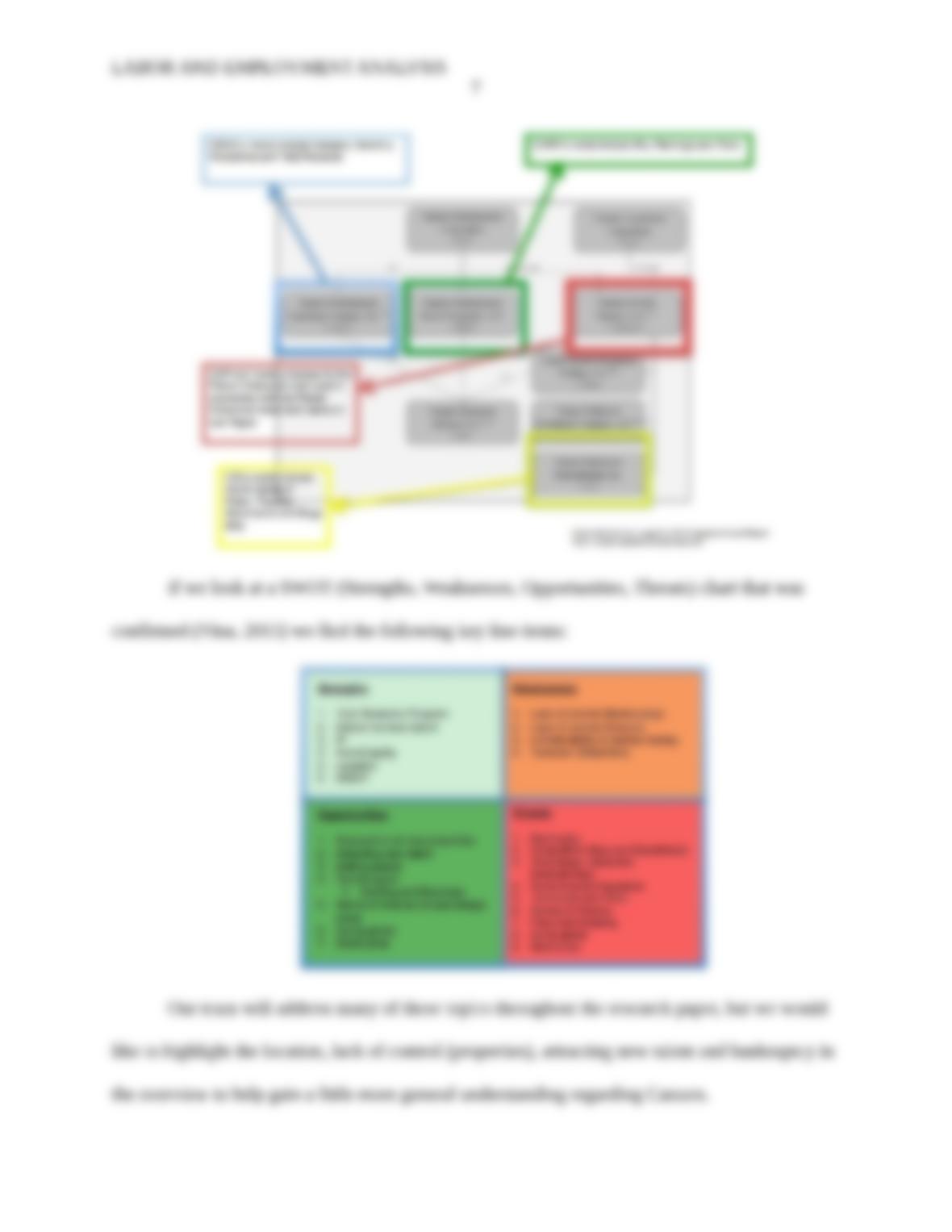
The last key way in which Caesars generates revenue is through their international
intellectual property (IP). Caesars holds several trademarks in the industry such as Horseshoe
and WSOP (World Series of Poker) featured on ESPN. While these trademarks do not carry
much weight on their balance sheet, if Caesars decided to sell one of these trademarks they
would be worth a lot of money in brand equity. Please see the chart below for a list of trademarks
and under what operation segment owns the rights to them. (Caesars Entertainment Corporation,
2014).
LABOR AND EMPLOYMENT ANALYSIS
7
If we look at a SWOT (Strengths, Weaknesses, Opportunities, Threats) chart that was