Community Participation in Forest Management
Background
Forest has been defined as An area with a high density of trees. These plant communities
cover large areas of the globe and function as carbon dioxide sinks, animal habitats,
hydrologic flow modulators, and soil conservers, constituting one of the most important
aspects of our biosphere . Forests are the storehouse of natural resources, without which
the very sustenance of human population would be under threat. Yet forests have been the
first to bear the brunt of civilization. Growing human population has consistently put
pressure on the forest cover.
Out of the total geographic area of 328.73 million hectare of the country, the area under
forest cover is reported to be 69.02 million hectare [22.9% of the total area] . Of which,
about 41% is estimated to have already been degraded. Many of the degraded forests are
also the habitat of some of the poorest of the poor in the country. The proportion of this
population living below poverty line is significantly higher than the national average [e.g.
69% in south Orissa and 44% in Chhattisgarh]. These forest dwellers, living in the forest
fringe areas, are heavily dependent on forests for their livelihood and thus are at conflict
with the interests of forests conservation.
Existing Policy Framework
Government of India has set itself an ambitious target of achieving 33% forest and tree
cover by the year 2012. This goal cannot be achieved without active cooperation and
participation of forest dependent communities. That community participation is important
for sustainable forest development was recognized for the first time by the National Forest
Policy, 1988, which called for Creating a massive peoples movement with the involvement
of women . to minimize pressure on existing forests . This shift in policy stance towards
forest dependent communities was institutionalized by the Joint Forest Management (JFM)
Resolution of the Ministry of Environment & Forests in 1990. Further guidelines on JFM
have been issued by the Ministry in the year 2000. This policy stance has been reiterated in
the New Environment Policy of 2006.
Status of JFM & Concerns
As a consequence of this emphasis placed by the Government on community participation,
over 83000 Forest Protection Committees are currently operational in different parts of the
country, managing over 17 million hectare of forest area. The chart below shows state wise
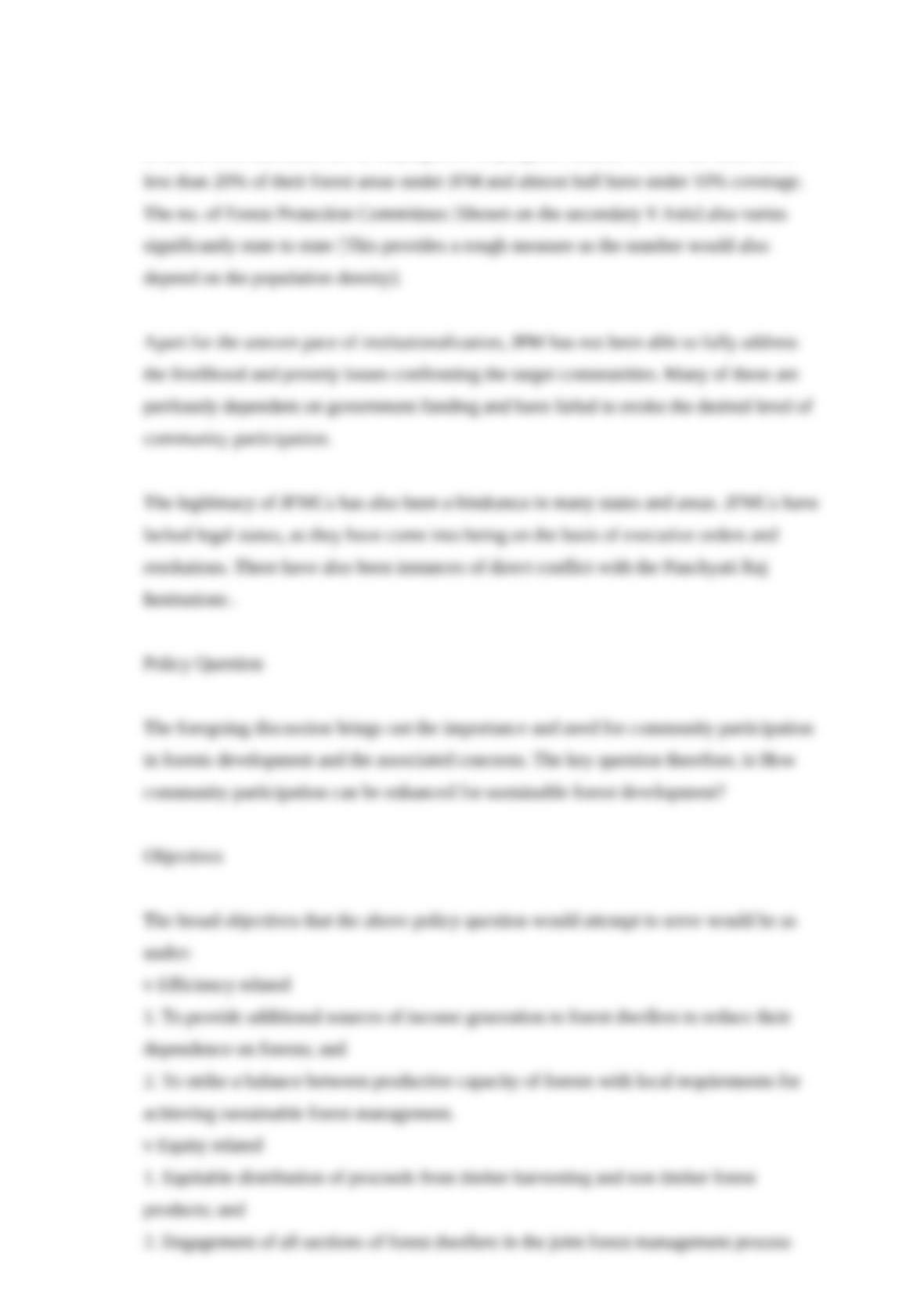
status of JFM. The area under JFM is normalized with respect to stateforest area.
Data Source : www.indiastat.com
It can be seen that states are at varying level of progress. Almost 70% of the states have