SRH Hochschule Hamm
Research Paper
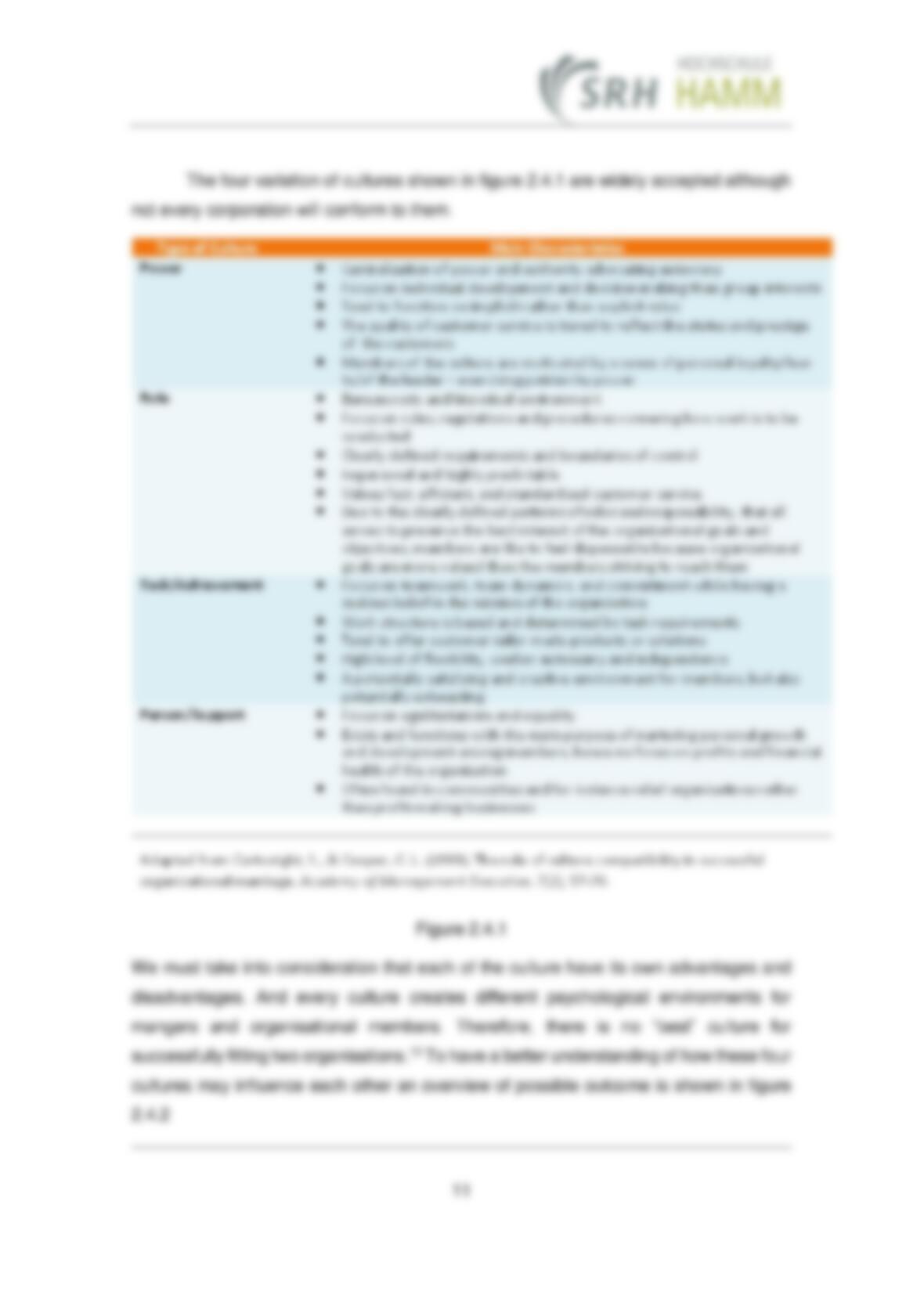
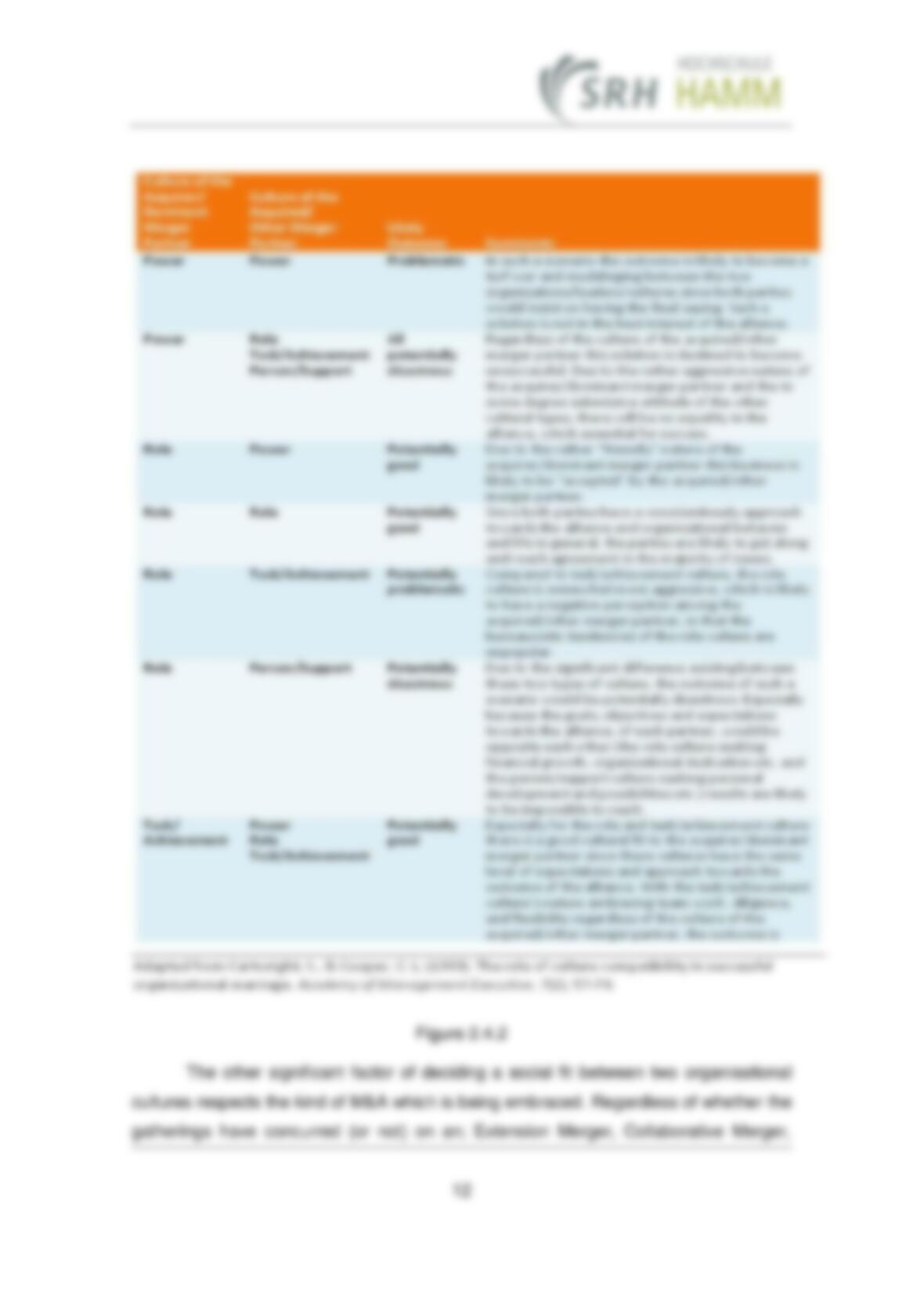
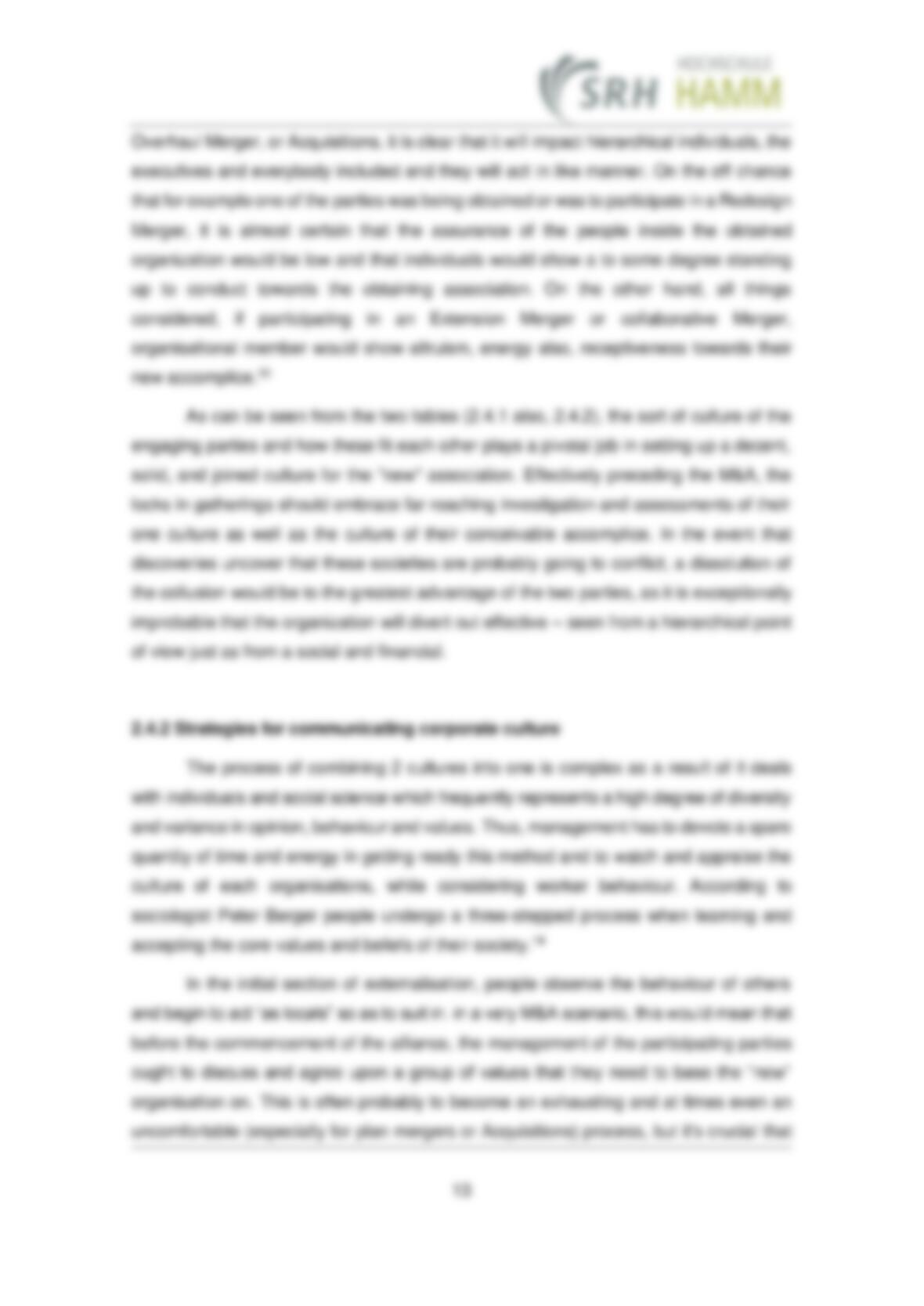
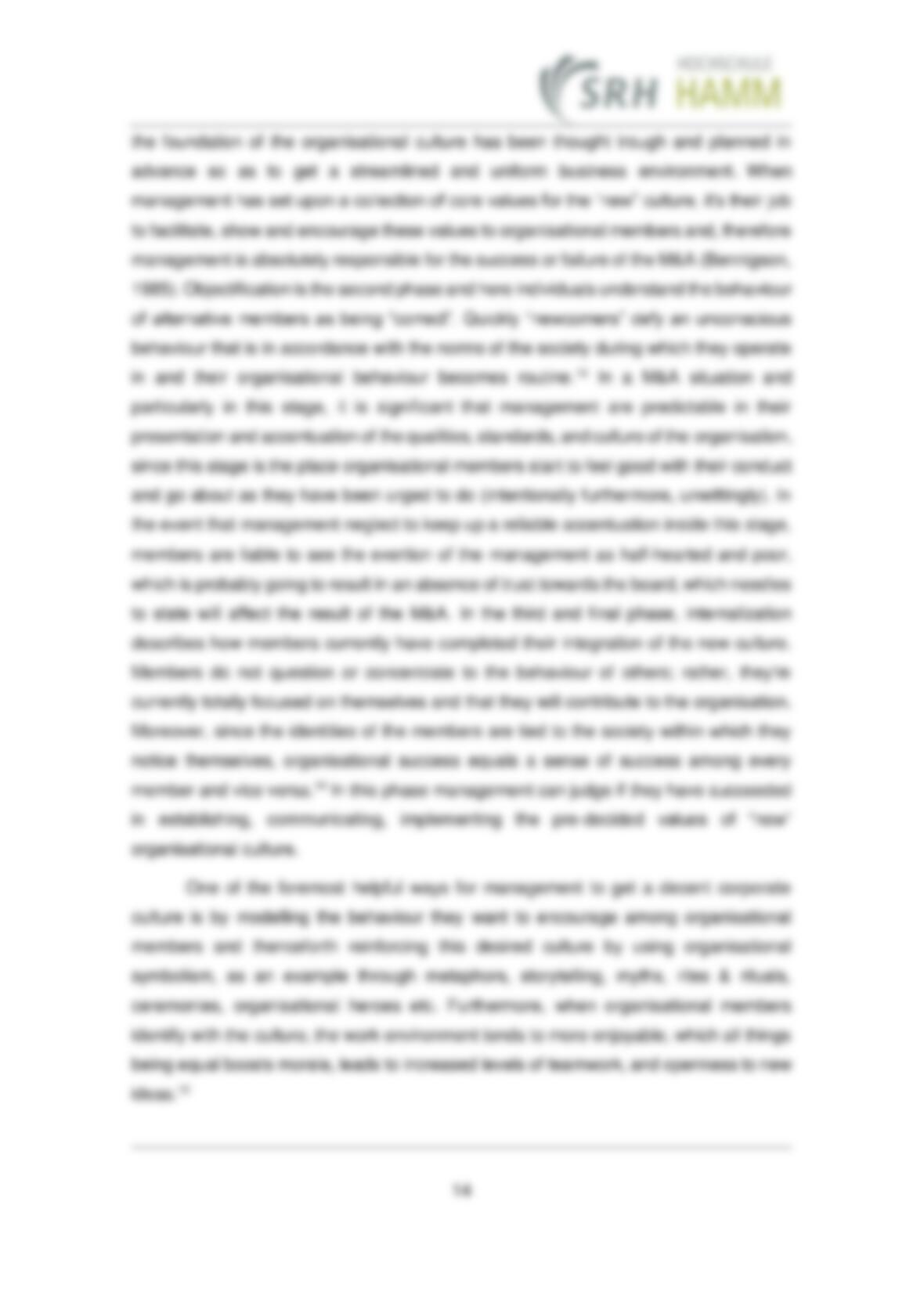
Summer Semester 2019
Supervisor: Prof. Sarah Grenzler
TOPIC – Importance Of Communication In Merger And Acquisitions
Name
Tejas Dalvi
Street
Ahlener str. 90
City
59073 Hamm
Matriculation
number
3401314
Semester
1
E-Mail
tejas8dalvi@gmail.com

I
Table of Contents
Table of Contents …………………………………………………………………………………… I
Abstact ………………………………………………………………………………………………… II
1. Introduction …………………………………………………………………………………. 3
1.1.Problem statement ………………………………………………………………………… 4
2. Literature ……………………………………………………………………………………. 5
2.1. Definitions ………………………………………………………………………………… 5
2.2. Communication and change management …………………………………….. 6
2.2.1. Change Management …………………………………………………………… 6
2.2.2. Strategies For Communicating Change …………………………………… 7
2.3. Communication And Conflict management ……………………………………. 8
2.3.1 Conflict Management…………………………………………………..8
2.3.2 Strategies For Communicating Conflict………………………………9
2.4 Communication And Management Of Corporate culture………………….10
2.4.1 Corporate Culture………………………………………………………10
2.4.2 Strategies For Communicating Corporate Culture………………….13
3. Conclusion ………………………………………………………………………………… 15
List Of References ……………………………………………………………………………….. 17
List of Figures ……………………………………………………………………………………… 19
Declaration of Own Work………………………………………………………………………. 20

II
Abstract
Over the years world has witnessed many mergers & acquisitions. Whenever the
idea of merger or acquisition is proposed to shareholders it is presented as a strategy
for wealth creation. However, the statistics shows that number of mergers or acquisition
actually achieving ‘success’ is comparatively low. Mergers and acquisition fail to
recognise the importance of communicating with existing employees. Knowledge and
feelings of employees, together with other integration techniques can impact overall
success of mergers and acquisition. The literature suggests that post-acquisition
integration of M&As is the phase where expectations are fulfilled or broken and where
there is potential for employee motivation to reduce dramatically.
Beginning with an introduction of topic and presentation of related issues.
Leading to a problem statement a concrete objective for the report has been established
and presented. Subsequently, the theoretical framework and foundation for the report is
presented, accounting for various theorists, fields, and concepts and how these will
contribute to an achievement of the report’s main objective. Representing the foundation
of the theoretical framework, structure Communication by Katherine Miller are going to
be frequently applied and said, as her work spans over a large vary of topics and fields,
all being relevant to the report. other than this main supply of theoretical resources, a
large vary of theorizer, academics, professional, and business professionals are going
to be enclosed so as to confirm that each connected subject are going to be coated. With
the topic being management communication, 3 subcategories square measure proposed
so as to supply structure and summary of the excellent topic.
Resource material with change management, conflict management and
corporate culture is well examined to give brief idea about all three. Then the strategies
to communicate all these are explained.
Finally, an evaluation of the entire report, including all its phases and findings will
lead to a conclusion, answering the research question posed in the problem statement.

Introduction
3
1. Introduction
When observing the field of business with special focus on past 30 years, it is evident
that the world has become significantly smaller, in the sense that people’s perception of
space, human capabilities, and what is actually achievable has changed. Rather than
regarding distances and differences as obstacles and hindrances, today these are often
considered as a presenting possibilities and opportunities. Globalism has affected the
business world so that rather than being active in “only” in one or few markets global
presence is seen as clear advantage. This development has led to fierce competition. In
order to keep up with competitors many organisations throughout the world are using
various tools like outsourcing, value chain optimisation and corporate venturing.
However, it seems that in past 30 years one trend has spread more wider and faster than
all of the others.
If we study the development of Mergers & Acquisitions
1
since 1980s industrial
reconstruction activities have raised important issues in terms of business decisions. No
firm is regarded safe from takeover possibility. M&A is clearly a popular choice in today’s
business environment (Mitleton-Kelly, 2006). Exxon‐Mobil, Sony‐Ericsson, and Time
Warner‐AOL are example of many companies who have decided to explore business
opportunities, growth and success through corporate collaborations and considering the
engaging parties’ underlying motives, it is recognisable how factors like; synergy,
economies of scale, market expansion etc. is appealing and thus cause them to
undertake this form of organisational behaviour. But not every M&A is successful. In fact,
more than half M&A prove financially unsuccessful.12 Statistics taken from IBM (2000),
show that only 37% of acquisitions are considered to be ‘very successful’, in the eyes of
the companies undergoing the process; this suggests that reality often falls short of the
ideal. Furthermore, studies indicate that the overall reason for the relatively high failure
rate of M&A activities is the lack of one very important, however often forgotten, factor –
communication. More specifically, it is management’s lack of open, clear, and
unambiguous communication that creates the issue and too often causes organisations
to “break up” and thus leave the merger unsuccessfully (Valant, 2008).
1
Mergers & Acquisitions will be referred to as M&As through the report.

4
Despite having access to all the data and information, why is it that success rate of
M&A is still not improving and moreover how does managers apply all this available
information to make M&A successful.
Considering the fact that M&A is the most common choice above all of high-level
transaction‐specific investment, it is necessary to do thorough analysis of this poor
development of M&As and the influence of effective communication, so managers can
approach such a situation in the right manner and thus become successful.
1.1 Problem Statement
The overall purpose of this report is to highlight the importance of communication in
M&A situation and what steps should management take in order to establish the
right prerequisites for a successful outcome? Answer to this question will help reach
better overview and understanding of importance of communication and how manger
could approach M&A.

5
2. Literature
2.1 Definitions
Merger is the aggregation of two or more firms which results in continuous
function of one firm.1 A merger is a unification of two businesses where one exists
and the other moves out of business.2 All the liabilities and assets of merged
company are taken care by acquiring company.
An acquisition occurs when one company takes a controlling ownership interest
in another firm, a legal subsidiary of another firm, or selected assets of another firm
such as a manufacturing facility.3 Difference between merger and acquisition is given
in the Table 1.
Table 1: The difference between Mergers and acquisition
Basis
Mergers
Acquisition
Meaning
Voluntary fusion of
companies to form a new
company
One firm purchases the
business of another firm.
New company formation
Yes
No
Nature of decision
Mutual decision
Friendly and hostile decision
Minimum. number of
companies
3
2
Purpose
To increase operational
efficiency and to decrease
competition
Immediate growth
Business Size
More or less same
Bigger than the size of the
acquired company
Legal Formalities
More
Less

2.2 Communication and Change Management
2.2.1 Change Management
Change is constant, inevitable and will always affect the people’s lives in one way
or other. While some people welcome it with open arms and with curious, positive mind
some people are very reluctant towards change. One of the factors that for many people
cause the negative conception of the concept is that change not always can be controlled
or planned, which leaves them with a feeling of uncertainty and anxiety.4 Having different
outlooks towards change is what makes the communicating change a comprehensive
challenge for all managers. As much as rewarding it can be if done successfully; it can
be as much damaging if not regarded as a high priority task. Key reason for any manger
to consider devoting time and energy in communicating change.
Having said that change inevitable, to get benefited from change it must be well
planned by management. According to K. Miller (2006:220), planned change is well
prepared, thought through, and has a deeper meaning to it and rather than just letting
the “organisational life cycle” take its course, organisations should strive to manage
change. Planned change is long term process which eventually demands superior