1
COMMUNICATION
Basic Model Of Communication
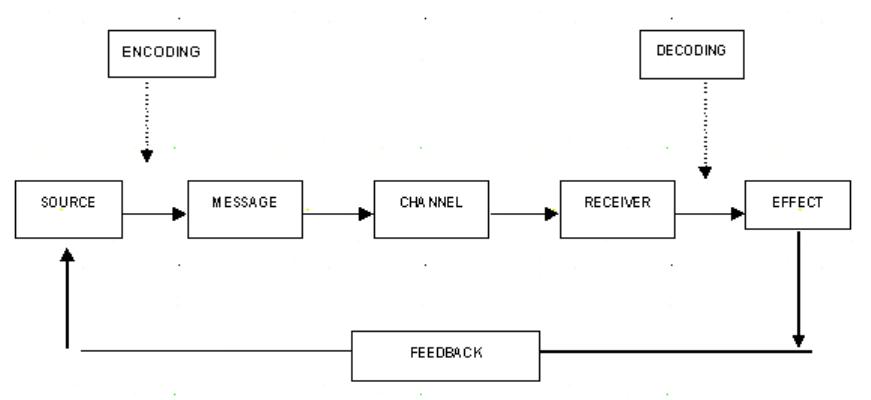
Communication is the process of sending and receiving messages between parties.
While all of the complexities of human communication can not be captured in a
single model, this diagram will offer a reasonable begining. A sender source has a
message in mind. The source intends to “encode” the message into language that
will be understood by the receiver. Perhaps it is a statement of the sender’s
preference for a particular outcome in a negotiation. The message may be encoded
into verbal language or it may be encoded into nonverbal expression. Once encoded,
the message is then transmitted –sent via voice or facial expression, or written
statement, and through face–to-face interaction, video, letter, telegram, etc.- to the
receiver.The receivers receptors pick up the transmission, and “recode” the message
to give it meaning to the receiver. In a one way of communication cycle this would
constitute a completed transmission. A source who puts his message in writing and
sends it by mail to the receiver generally assumes that the message is received and
understood. However, most communication –particularly in negotiation- involves
continued dialogue and discussion between at least two parties. As a result, the
receiver takes on a more active role in the communication process in two ways.
First the receiver provides information on how the message was received,
and second, the receiver becomes a “sender” himself and respons to, or builds upon,
the earlier message of the sender. For the current discussion, we shall refer to both
of these processes as “feedback.” In the feedback process, the receiver encodes the
message –through reading or listening– to assure his own understanding and
comprehension of what the sender said , and what the message meant. He then
ascribes “ meaning” to the communication –a comprehension of the information
content of the message, as well as an “interpretation” of that content. The receiver
then becomes a “sender” of communication back to the source. The encoded
message may take multiple forms: questions or other communications to obtain
2
clarification or better understanding of the earlier message; exclamations or reactions
to the information content of the message; or rebuttals to the content of the first
message. All of these are encoded, transmitted through various channels, received,
and decoded by the original source. The entire sequence may be as simple as a
question by one person, “Want to go for a cup of coffeee?” and an affirmative
headshake by the other, to complex statements and responses used by negotiators
in shaping a contract.
This model of communication “works” to the degree that a wide variety of
information –facts, opinions, feelings, preferences, and experiences- are completely
and thoroughly shared between parties. However, human communication systems
seldom perform with this high degree of efficiency and effectiveness. Most of the
linking elements in the model are subject to external factors that distort messages
and their meaning, hampering them from getting through accurately.
THE NATURE OF COMMUNICATION
What does it mean to communicate? Everyone read and talk a lot about
communication, but it means different things to different people. Someone may think
of communication as casual conversation, the formal use of mass media, books,
letters, friendly notes, or formal public speeches. Regardless of the many different
meanings that people give to the word communication, everyone seems to agree that
it is important.
Each elements in the sequence;
1-Senders and Receivers
Senders and receivers each have goals and objectives –things that they want
to accomplish. The sender may want to change the receiver’s mind, or secure
concessions toward a negotiated agreement. The receiver may not want to have his
mind changed, and not want to make concessions; moreover, the receiver may have
the identical objective in mind fo his opponent. The more diverse the goals of the
sender and receiver, or the more antaonistics they are in their relationship, the
greater likelihood of distortion and error in communication. Similarly, senders and
receivers differ in their individual makeup –each is likely to have a different pattern of
personel values, attitudes toward certain issues and objectives, previous
experiences, life history, and personality characteristics. Each of these elements
contributes to a different way of viewing the world.
2-Transmitters and Receptors
Tranmitters and receptors are simply the equipment by which information is
sent. Information can be sent verbally and nonverbally. The choice of transmitters
can affect outcomes, i.e., some messages may be better spoken, while others need
to be written. Moreover, when presenting information face–to-face, congruence or
incongruence between multiple transmission channels is often a problem. The old
expression that “your lips tell me ‘no,no’ but there is ‘yes,yes’ in your eyes” highlights
the incongruity of messages sent simultaneously by both verbal and nonverbal
channels, and the possible error introduced by this dublicitous communication. On
3
the receiver’s end, poor eyesight or faulty hearing may similarly diminish the ability to
accurately receive a message.
3-Messages and Channels
Messages and channels are the vehicles by which information is
communicated. As noted by many writers on communication, human beings are
unique in their ability to use “symbolic” forms of communication –primarily the written
or spoken language- to transmit information. Some messages are direct expressions
of meaning –I lean over the table and grab the pencil that I want– while others are
“symbolic representations” –I ask the person seated across the table, “Please pass
me the pencil.” The more we are prone to use symbolic communication, the more
likely that symbols may not accurately communicate the meaning we intend. In the
simplest example, if the person does not understand English, or if there are several
pencils on the table, there is increased likelihood that the communication will be less
than effective.
Channels are the vehicles by which messages are carried. If we speak
directly, it is the airwaves; if we write, it is the paper and pen or type-writer; if we talk
over the telephone, it is the telephone circuitry and microwaves. Both messages and
channels are prone to disortion from “noise,” which we will use as a broad descriptive
category of various forms of interference in the communication process. Messages
can be transmitted more clearly in a quiet room than in a loud, distracting hotel
ballroom. The greater the sources of distraction and confusion in the communication
environment, the more that “noise” will interfere with accurate and complete message
transmission.
4-Decoding, Meaning, and Encoding
Decoding, meaning and encoding are the processes that the individual uses to
interpret the messages of others, and to formulate messages themselves. Decoding
is the process of translating messages from their symbolic form into interpretations
that we can understand.
If the parties speak the same language, or use the same common nonverbal
gestures to communicate messages, the process is reasonably simple and error-free;
if they do not, decoding is prone to contribute a high degree of error. While
“translators” may help to decode the other’s messages, full translation may not be
possible, i.e., understanding the other’s meaning or tone, as well as the words –or
may introduce additional error into the communication.
Meanings are the facts, ideas, feelings, reactions, or thoughts that exist whitin
individuals, and act as a set of “filters” through which the decoded messages are
interpreted. If a party has asked the other to “please pass me that pencil,” and the
other party has said “no,” the encoded “no” back to us is likely to stimulate a variety
of reactions in the search for “meaning.” Did the other hear the message? Was the
“no” a direct refusal to the request? Why did the other say “no”? Does he need the
pencil too? Is he being obstinate and intentionally blocking me? Answers to these
questions will vary depending upon a variety of other aspects of the communication
sequence and the relationship between the parties, and will lead to different
ascriptions of “meaning” to the word “no.”
Finally, encoding is the process by which messages are put into symbolic
form. The encoding process will be affected by varying degrees of skills in encoding,
e.g., fluency in language, skill at expression in written and verbal form, etc. It will also
4
be affected by the meaning attached to earlier communication– what we want to
communicate, how we have reacted to earlier communications, etc. Senders are
likely to choose to encode messages in a preffered form; this form may not be the
same preffered by receivers. Two managers may need to distinguish a negotiated
contract; while one may prefer to “get together and discuss it over lunch,” the other
may prefer to have each one prepare a written draft that they can exchange and
revise individually. How this contract will eventually be prepared may thus be the
subject of the negotiation itself.
5-Feedback
Feedback is the process by which the receiver “reacts” to the sender’s
message. Even in a one-way communication cycle, feedback is essential. It is
necessary to let the sender know that the message was (a) actually received,
(b)encoded, and (c) ascribed with the same meaning that the sender intended. The
absense of feedback can contribute to significant distortions in communication, since
senders never know whether their message is being received, much less understood.
Anyone who has ever talked to a large audience may find himself directing his
comments to the individual who is nonverbally shaking her haed “yes”, or similing, or
in some other way acknowledging that the communication is being received and even
appreciated. The sender is unlikely to direct comments to a receiver who is shaking
his head “no”, or asleep, unless the comments are specifically designed to change
the receiver’s disposition.
BASIC PRINCIPLES OF COMMUNICATION
• It is impossible to avoid communicating
• Communication is largely nonverbal
• Context affects communication
• Meanings are in people, not in words
• Communication is irreversible
• Noise affects communication
• Comination is circular
• Creating common goal is essential
• Communication has effects
A first principle of communication is that it is impossible to avoid
communicating. In other words, there is no such thing as noncommunication. DeVito
(1988) notes that communication is inevitable, that people cannot not communicate
and people cannot not respond. Some of ramifications of this principle are obvious,
and some may not be as clear.
Communication is largely nonverbal. Impressions are made largely in
response to nonverbal cues.
A third principle that has a direct relationship to successful communication is
that context(environment) affects communication. Where (under what conditions)
ideas are presented makes a difference in how they are interpreted. Physical
conditions are one aspects of context.
A fourth principle important for success is that meanings are in people, not in
words. Meanings are in the perception of decoders; people “mean”, but words do not.
5
The message remembered by people often is not what communicator intended to
say. The message remembered is whatever the listeners interpret it to be.
An other important principle is that communication is irreversible. At once time
or another people may have wished they could change what they have said or done.
Unfortunately, that is simply impossible. People may give additional information or a
rationalization for their previous actions, but they can only modify the impession they
have already made.
A sixth principle of communication is that noise is a factor in any
communication situation. Noice is any factor that interferes with the clear and
accurate transmission of a given message.
Communication is circular, not linear. This means that people send and
receive communication simultaneously. Because of its simultaneously aspects, the
communication process could be considered a circle or spiral rather than a line.
People process feedback while they speak to others, and they speak to themselves –
think- while others are speaking.
An eight principle is that communication is most efficient when the participants
share a considerable amount of common experience. Common experience is
achieved by using shared symbols and speaking from a shared history.
Misunderstandings are less likely in such situations.
And the last principle is that communication always has an effect of some kind.
For every communication act, there will be consequences. People can even feel a
sense of accomplishment in a communication exchange in which a listener does not
respond verbally.
VERBAL AND NONVERBAL MESSAGES
Primary to effective communication is a message. Any human activity has
message value. That is, human activities can convey or symbolize meaning to others.
In its simplest sense, a message can be a idea, nemotion, desire, or emotion that
one person shares with another. This can be occur whether or not a person intends
to send such a message. When people think they are listening patiently to someone,
but their eyes drift away from that person and become fixed on some object, they
have sent a message. Another person, observing their behavior, can assign a
meaning to it.
Before a person can improve his or her skills he or she must be aware of the
basic ways in which people send and receive messages. These can be classified in
two major groups: verbal messsages and nonverbal messages.
Verbal Messages
Messages sent verbally are messsages expressed in words. Since we already
know that people communicate with words, it may seen unnecessary to talk about
that kind of behavior. However, people need to be aware that their effectiveness in a
given situation will often depend on the words they choose to use. There is a whole
science devoted to the study of meaning in words, the science of semantics.
Because of the study done by the specialists in this area, people know a great deal
more about meanings and how they are conveyed through words.
Meaning is a product of what goes on in the minds of both the sender and the
receiver. Meaning is not permanently assigned to words. It is carried about in the
human mind and is often the result of an individual’s experiences with language and
meaning. Thus, a word may have many shades of meaning. Effective communication
6
depends on finding meanings shared by the sender and the receiver. Understanding
this simple fact makes the role of feedback clear. People can not know if the other
person meanings are shared if they giving a reactions to each other in a
communication situation.
Language is symbolic. It stands for impressions and notions people have. It is
impotant in sending messages that the person knows as much as possible about
those with whom he communicating. People also need to aware that words stand for
things, but the words are not those things. Thus, labelling an idea or a person does
not make the label true. It merely indicates a feeling or an idea that one holds about
the thing or person.
Languages chances, too, and because it does, the meanings one person
attaches to a word or a group of words may not agree with another’s understanding
of that word or phrase. Slang and expressions used only in a small geographip area
or by one ethnic group can make communication difficult if some effort is not make to
discover the meanings carried by such expressions.
Nonverbal Messages
About 65 percent of the meanings people get from a communication situation
come to them from the nonverbal elements rather than from the words that are
spoken. Researc has shown that the nonverbal messsages will often override the
words spoken in interpersonal communication. For example, imagine that a friend
accuses a person of having played a pratical joke on him or her. The person deny it
but blush uncontrollably. The friend will believe the message sent by the blush rather
than the statement of innocance.
One very important concept aabout nonverbal messages is that they are often
sent and received subconsciously. That is, people may not realize that they are
sending or receiving any message at all. When a nonverbal message is sent, they
become aware of it through all their senses. They process and assign meaning to the
message at the same time, and often they are unaware that they have performed this
thought process. An important step in improving communication skills is to become
aware of nonverbal behavior and to make the sending and receiving of nonverbal
messages a concious process. Nonverbal behaviors that sent messages can be
grouped into three types: paralanguage, kinesics and proxemics.
• Voice
Paralanguage refers to the ways the voice is used in sending messages –the
inflection place on a particular word, how loudly, softly, quickly, or slowly a person
speaks, and so forth. Each quality of a person’s voice sends a particular messsage.
Most of time people use paralanguage deliberately. A person might say, for example,
“Oh, sure, i like him a lot,” using sarcastic inflections to make the words him exactly
the opposite. When a person choose to do this, she has sent her real messsage
nonverbally, not verbally.
Sometimes tha paralanguage message is not intentional. Suppose a person
are giving a speech and his voice shaky and halting. His words are strung together
with “uh…and, uh…” The audience gets a clear messsage that he is frightened,
uncomfortable, or possibly unprepared. That messsage may be strong that the words
he say are ignored by his listeners. In this case his nonverbal behavior is harmful to
his communication.
• Physical Movements
Kinestics is the physical movement of a person’s body as he or she
communicate with others. This is often called body language. Such beclothing, and
even breathing can send messsages. These messsages are often interpreted as
expressions of inner feelings and attitudes. If a person want to express an attitude of
openness and acceptance of the other with whom he is communicating, he will use
direct eye contact and face the person squarely, stand a little closer than normal.
When a person talks with someone who faces away from the person with crossed
arms and who refuses to look at her directly, she generally assume that the person is
closing her out. The communication is poor, not because of the verbal messsage but
because of the nonverbal behavior.
One interesting function of kinesics in conversation is that people use their
bodies to “punctuate” the conversation. People actually signal that they want to talk.
When they lean forward, or take a deep breath, or raise their eyebrows and open
their mouth slightly, they are sending messsages thaat say, “It is my turn to talk!” In
the same kinds of way, people signal to others that it is their turn. And also people
use kinesics to let the others know they do not want to comminicate.
• Space
Closely related to our physical movements is the idea of proxemics, or space,
as a nonverbal messsage unit. Where a person sit or stand in relationship to the