Ruiz 1
Colorism: A Huge Factor of Success in the Latinx Community
Final Paper
English 2010 MWF 8:00AM
Duxiana Ruiz
“‘She’s pretty for a dark-skinned girl…’ What is that supposed to mean?” Exactly, what
is that supposed to mean? That comment immediately comes across as a form of racism, but it is
actually colorism. Colorism is an issue not focused on one group but focused on subgroups. By
definition colorism is: prejudice or discrimination against individual with a dark skin tone,
typically among people of the same ethnic or racial group. Racism is the prejudice or
discrimination against a specific ethnic or racial group. Society believes, while causing others to
believe that racism cannot be a problem among minority groups. And in most cases that is true,
but of course racism occurs in larger group. Racism may not occur directly within a Mexican
community but racism can occur within a Latinx community. More externally though, colorism
is what follows, and this is an issue society has yet to fully learn and accept.
Colorism is a huge issue among all cultures. But it does occur predominantly among
cultures of people of color. Whereas there is already the issuing residing of racism when
compared to other races because of the factor that their skin color is already darker. This
transfers to the multiple shades in one culture which is where colorism is formed. In cases of
racism, two people of different races but identical skin colors will be treated differently. In cases
of colorism, two people of the same race but different skin colors will be treated differently. The
consensus is usually that colorism is a product or symptom of racism. (Webb, Sarah L., 2017)
Ruiz 2
Colorism is not a new concept just born overnight. It is a concept that originates out of
racism. But it is a new concept that is coming to terms with being recognized and worked
towards for improvement. The funny thing is, the word colorism doesn’t even exist. Not
officially. It autocorrects on one’s computer screen. It does not appear in the dictionary. Still, the
author and activist Alice Walker is the person most often credited with first using the word
colorism, out loud and in print.
Colorism can originate as early as colonialization. Societies with widespread issues of
colorism also have long histories of colonization and influence by European countries. In these
societies, European features such as white skin, straight hair, and light colored eyes were overtly
promoted as the standard of civilized existence, intelligence, beauty, wealth, and power. In these
societies, rights and privileges were also restricted to people of European decent. (Webb, Sarah
L., 2017.)
Colorism is a proven preference for lighter skin tones. Whether it be the preference for
blatantly lighter skin tones such as white over black. But as well as brown over black. It’s an
unconscious prejudice that is not focused on a single group like blacks so much as on blackness
itself. Regardless of how dark that shade of black is, there is still preference for the lighter black.
But not only it is skin tone alone. Colorism also deals with the white features; fairer hair instead
of curly course hair, smaller noses, proficiency in the English language, and awareness of white
culture. Our brains, shaped by culture and history, create intricate caste hierarchies that privilege
those who are physically and culturally whiter and punish those who are darker. (Vendantam,
Shankar., 2017.)
In this case those punished are those whose success is affected. There is a strong case that
Ruiz 3
colorism is a huge factor in success among the Latinx community. Not solely does colorism
affect financial success but all forms of success; happiness, feeling accomplished, feeling
accepted, but yes, success in the today’s world where money sometimes is the determining factor
is strongly affected. Success in the Latinx community can be specified in three more centered
points; views of beauty, skin color portrayal/ preference in media, and an overall implicit
unconscious bias. These three points can continue on to more distinctive areas, but they are the
points with the most research done on them.
When it comes to views on beauty, the preference for lighter skin tones strongly stands.
Beauty is a concept society, especially that of the Latinx community, holds on a high pedestal
that leads to happiness and to one’s success. If one is viewed as beautiful it is more likely that
they will have more opportunities given to them, feel happier, feel more accomplished, which all
results to the success they have and can achieve.
In the Latinx community lighter skin tones are related to multiple definitions for beauty.
That beauty comes across both internally as it does externally. Someone with a lighter skin not
only is viewed as more beautiful, but they come across as more desirable as a whole. They are
seen as more capable, more intelligent, as those whose blood line will prosper more than those of
darker skin tones. The concept of beauty here isn’t just what is viewed on the outer surface, but
the belief that they are superior in many other ways to those who are of darker skin tones.
When intelligence is reviewed that can also interfere with the possibilities of
opportunities. If you are not seen as intelligent as your lighter skin counterpart, the same
opportunities may not be presented. (Cole, Lisa N., 2016.) Latinx respondents with the lightest
Ruiz 4
skin are several times more likely to be seen by others as intelligent compared with those with
the darkest skin.
With the preference for a lighter skin toned because of the “sense of beauty” it presents,
opportunities are given with a bias. For example, the new Fusion network, aimed at English-
speaking Latinx millennials, is following in the footsteps of its Spanish-language counterparts
and so far is featuring only light-skinned Hispanics. If a market is interested in hiring a Latinx,
they will most likely hire a white Latinx, that is why a great number of Latinx on air are white
Latinx. And that just dates back to stereotypes on beauty and what is pleasing to a general
audience. This is one of the many examples of colorism in Latin media. Those who are fair/light-
skinned typically have on air positions, whereas Afro-Latinos are the ones working behind
camera. “Beauty is what sells,” and media has continued to show this with whom they highlight
in it. Showing that they believe and they believe society believes that light skin is a form of
beauty.
Consequently, specifically, in the United States because it is a country whose
predominate language is English, there is a term that goes along with this. That term is “light
skin.” Not just describing someone’s light skin, but it literally is categorizing a group of people.
Someone will say, “Oh I want myself a light skin.” Literally referring that they want to have
relations with someone who is of a very light skin tone. They want someone of Latinx descent
but with more of a caramel skin tone. Since that skin tone is brown enough to be seen as ethnic,
but not entirely brown. But it is darker than white. Light skin is not to be confused with a person
that has fair skin. (Ortiz, Laura., 2012.)

Ruiz 5
When it comes to the majority of Latinx countries a term commonly used is ‘moreno’.
Moreno is a term to refer to an individual of dark skin tones. It is not considered offensive, and is
commonly used an endearing term. Unfortunately, because of language and cultural differences,
it can be difficult to think of calling someone “moreno” as endearing. But if offensive is what is
intended, individuals will use the word “negroe” which literally translates to black.
Consequently, referring back to the concept of beauty in the Latinx community, it is not
just the lighter skin color that is viewed as beautiful. It is a white or lighter feature that is viewed
as more beautiful than others. For example, a huge determining factor in beauty is hair. In the
Latinx community it is common for someone of Latinx to have curly course hair. But someone
of white descent, is expected to have fine straight hair. Therefore, someone who has an afro of
sorts is not viewed as beautiful or as desirable as someone with straight hair.
Latina adolescents also describe an ideal body type that looks extremely similar to the white
norm and they report the desire to lose weight at similar rates to their white peers. Blue eyes are
viewed as a phenomenon amongst Latinx people instead of appreciating the brown and black
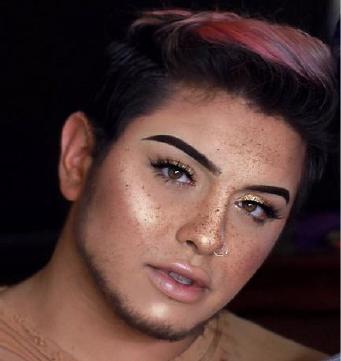
eyes of the majority. Freckles are also a common white feature, and not as common amongst
Latinx people, therefore are praised, and desired more. Faux freckles have actually started to
Ruiz 6
become a huge trend amongst Latinx makeup artists and push them on their clients to have
because it would “enhance” their beauty. (Munoz, Eduardo., 2017) Any feature that is seen as
“more white” constitutes beauty in the Latinx community.
People in the Latinx community go so far to try to try and achieve these “white beauty”
standards because of how in deep the concept of “white” beauty has been buried into their
society. Those with lighter skin tones will go out of their way to keep it as that, or even lighter if
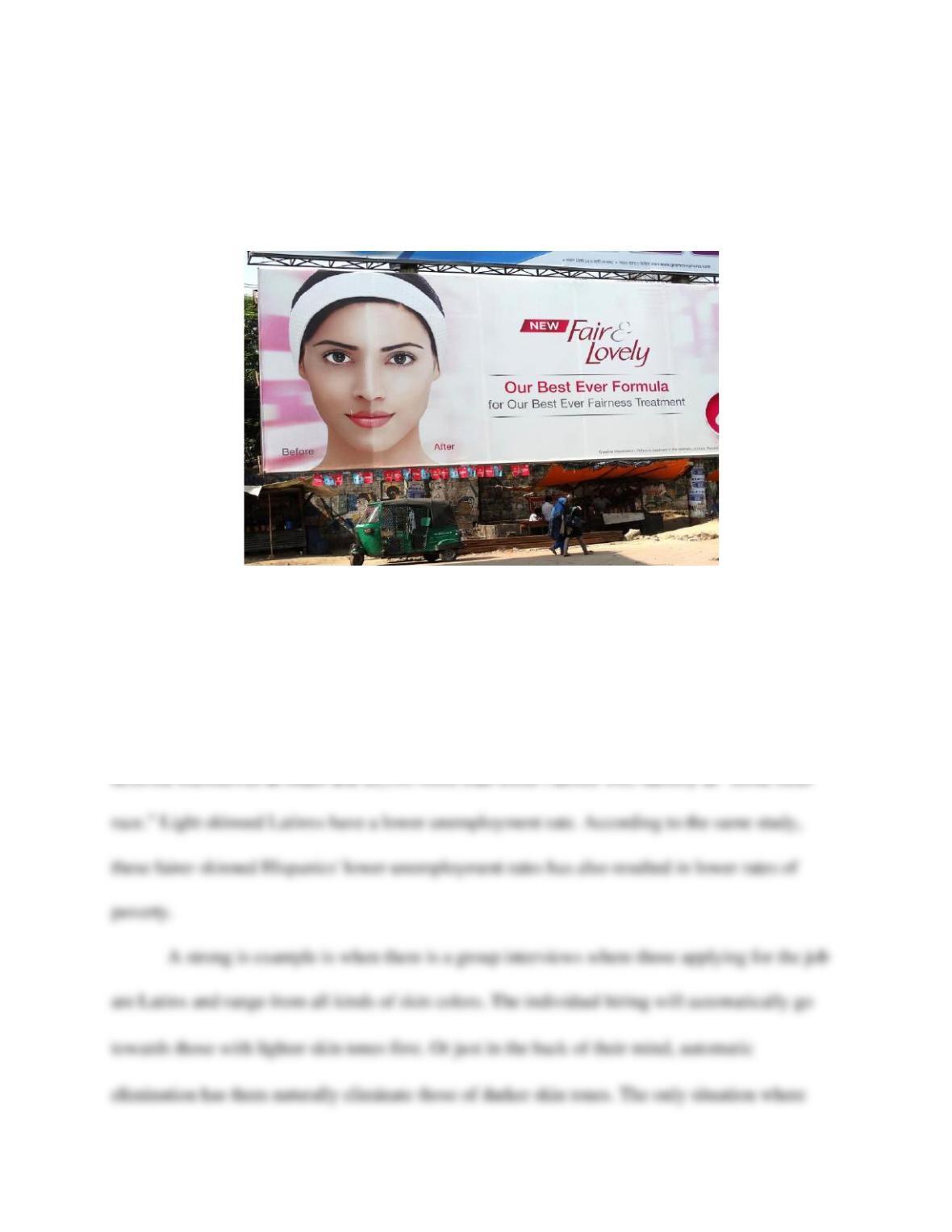
possible. Whereas those with darker skin tones will try to lighten their skin tone. There has been
research done that African and Latina women are the highest percentage of buyers for skin
lightening creams. (Sarmiento, Mariana., 2012.) And the highest percentage to go have chemical
straightening treatments on their hair.
The Harvard neuroscientist Allen Counter has found that in Arizona, California and
Texas, hundreds of Mexican-American women have suffered mercury poisoning as a result of
the use of skin-whitening creams. Even with all the damage that is does cause to the hair and
skin, the statistics have not gone down. Some argue that the skin lightening creams are much
better than all those who go out of their way to tan their skin under harmful UV ray lights. But
when both are just as harmful to the skin and the health of the individual. Even with its growing
popularity, skin lightening is also considered a taboo, so many who submit themselves to the
Ruiz 7
treatment strongly reject the fact that it’s taken place. The process itself is also not only
problematic, but it promotes the idea of self-hate, colorism, and denouncement of ethnic identity.
(Which why so many do reject that fact that they went through with the treatments.)
Beauty being a huge factor in colorism leads to opportunities that can form success for
Latinxs. This turn around success that is seen in more of a financial form and overall
opportunities to be recognized. Light-skinned Latinxs make more money. A study from 2003
found that Latinxs who identify as white made about $5,000 more a year than Latinxs who