SY
FVB30503
COLLISION TECHNOLOGY
PROF MD AMIN BIN MD NOR
NAME
STUDENT ID
MOHD SHALIHIN BIN MANSOR
50216114168
MOHAMAD HANIFAN BIN MOHD ALI
50216114279
MOHD LUQMAN AL-HAKIM BIN HAMIDI
50216114185

OBJECTIVE
• Select the right repair materials for the job
• Explain the basic purpose of common body shop materials
• Compare the use of similar shop materials
• Summarize when to use different kinds of body filler and putty
• Know how to select the right type of primer and paint
INTRODUCTION
• Collision repair materials include various fillers, primers, sealers, adhesives, sandpapers,
etc.
• When consumers look at a vehicle’s paint job they often see a shiny bright color
• Hidden technology under the surface of the paint
• Professional collision repair and refinishing technician understands the chemistry and
skill needed to do high-quality repairs

REFINISHING MATERIALS.
A vehicle body is protected by a complete finishing system. All parts of the system work
together to protect the vehicle from ultraviolet radiation, weathering, pollutant and corrosion.
refinishing materials is a general term referring to the products used to repair a vehicle,
refinishing material chemistry has changed drastically in the past few years. New paint last
longer but require more skill and safety measures for proper application.
the substrate is the metal, fiberglass or plastic material used in the vehicle’s construction.
It will affect the selection of refinishing materials.

TYPE OF PUTTY
Putty is a filler material that is used to provide a right and perfect level to the surface, and also
filler hollows, craters, cracks, dents and imperfections that may contain the surface.
The putty is a compound whose unique function is to fill and repair which after further
sanding to get a level and aesthetically correct surface, putty has no protective function or
specific to improve the properties of the applied surface, its only function is to achieve level
and restore small areas.
The putties must have the following characteristics:
• Adhesion – the putty should have an excellent adhesion on metals, plastics, paint coatings and
surfaces on which shall be on, for this is necessary to select the correct putty in order to have
good adhesion between the substrate where applied and the following layers of coatings.
• Filler power – putty must have a high filler power (the thickness of the putty before to curing
must be equal to the thickness of the filler after curing) as its main function is filler and
repair.
• Elasticity – the putty has to be able to withstand vibration and dynamic loads and sudden
temperature changes, avoiding that to crack or peel off the putty and subsequent layers of
paint.
• Easy sanding – The putty is sanded to achieve the desired level, as well as adherence to the
following processes of painting.
• Low porosity – The putty when dry will not produce excessive pores.
• Strength – The putty must have mechanical and chemical strength, in order to resist external
effects and agents
In the market exist in different types of putties, the selection of suitable putty depends mainly
on the surface (dimension, material , etc…) on which to apply, and the type of work to be
done.
Then you can find a summary of the characteristics of each of the families of putties used in
the paint area, which are available on the market:
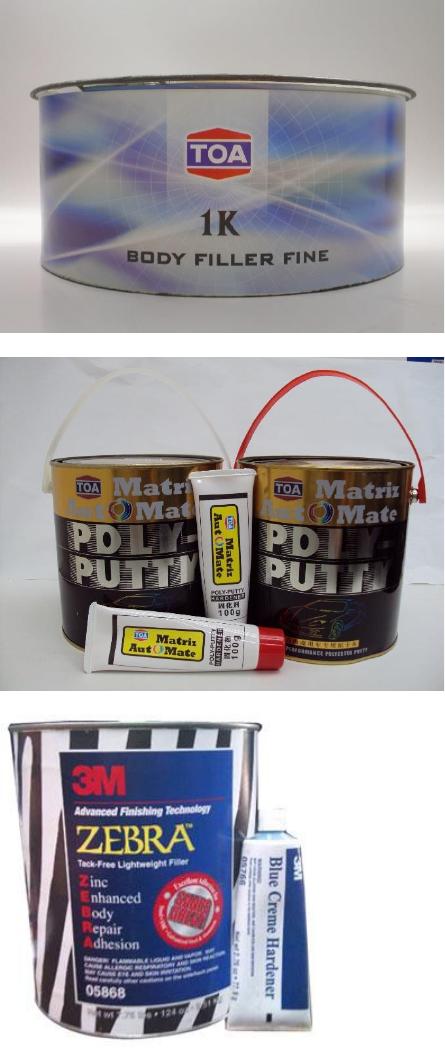
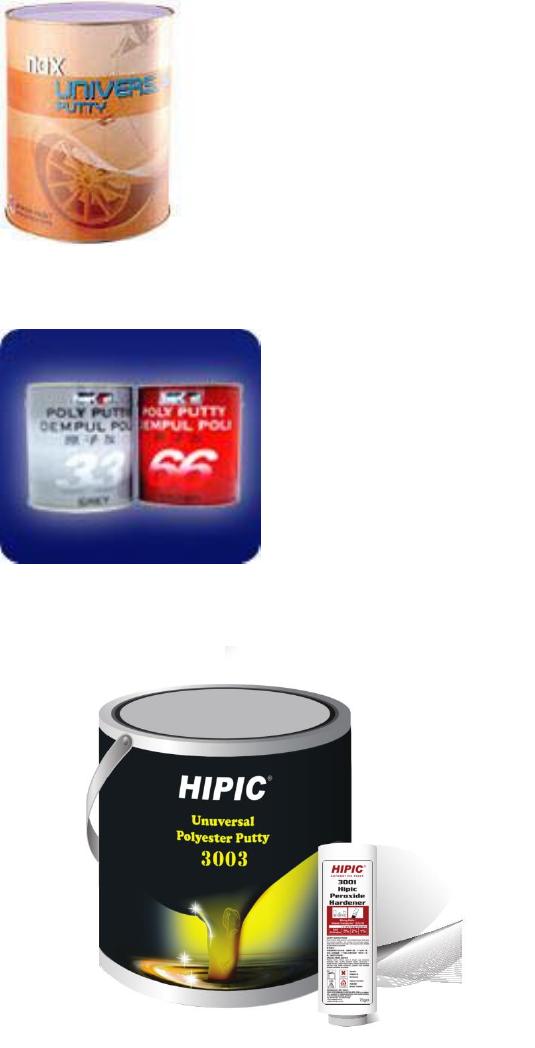
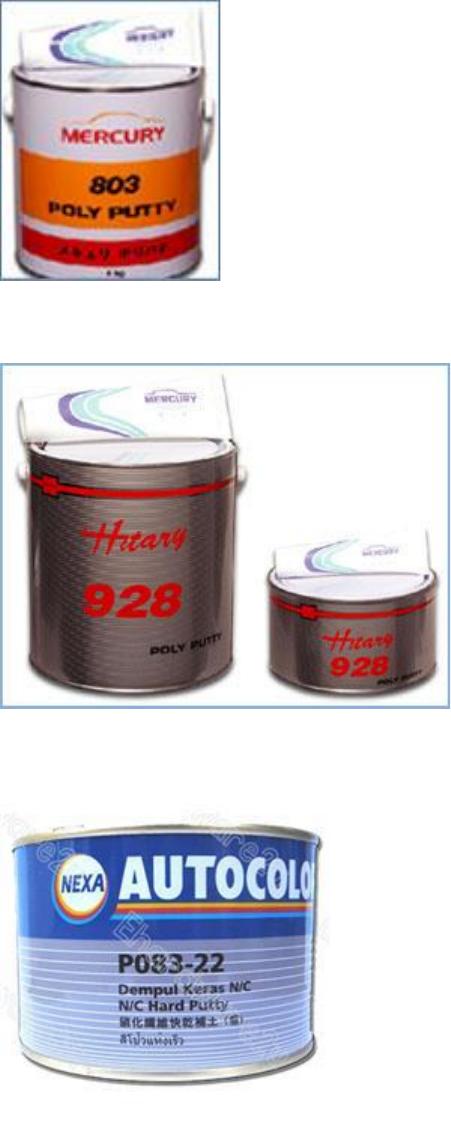
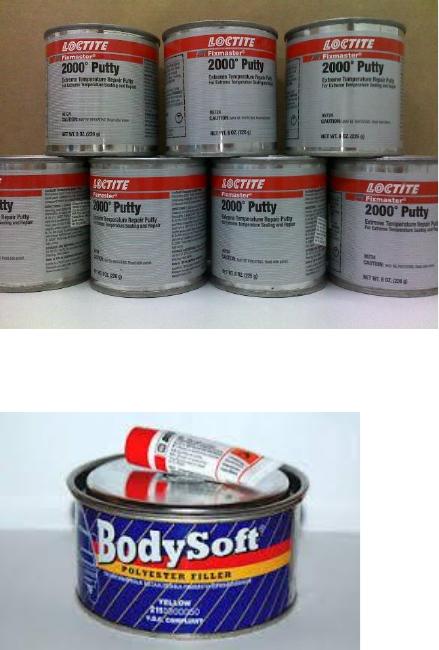
• Standard Polyester Putty – Putty used to fill large areas due to its high filling power, used in
the manufacture and repair of commercial vehicles, has the disadvantage of be porous putties.
• Fine polyester putty – Used to fill the pores left by the standard polyester filler.
• Polyester putty glass fiber – is polyester filler which is added to the glass fibers, particularly
suitable for the repair of reinforced plastics, available in high filling power.
• Polyester putty for galvanized surfaces – Especially polyester putties designed to adhere to
galvanized surfaces.