COCONUT INDUSTRY PROFILE
I. INDUSTRY OVERVIEW
Coconut production constitutes one of the four
major sectors of Philippine agriculture, the others
being rice, corn and sugar. About 85% of coconut
production is exported in the form of copra, coconut oil and dessicated
coconut.
The coconut industry is a dominant sector of Philippine agriculture.
The country has the world’s widest geographical area planted to coconut.
Of the 12 million hectares of farmlands, 3.1M hectare is devoted to
coconut and 68 out of 79 provinces are coconut areas. The Autonomous
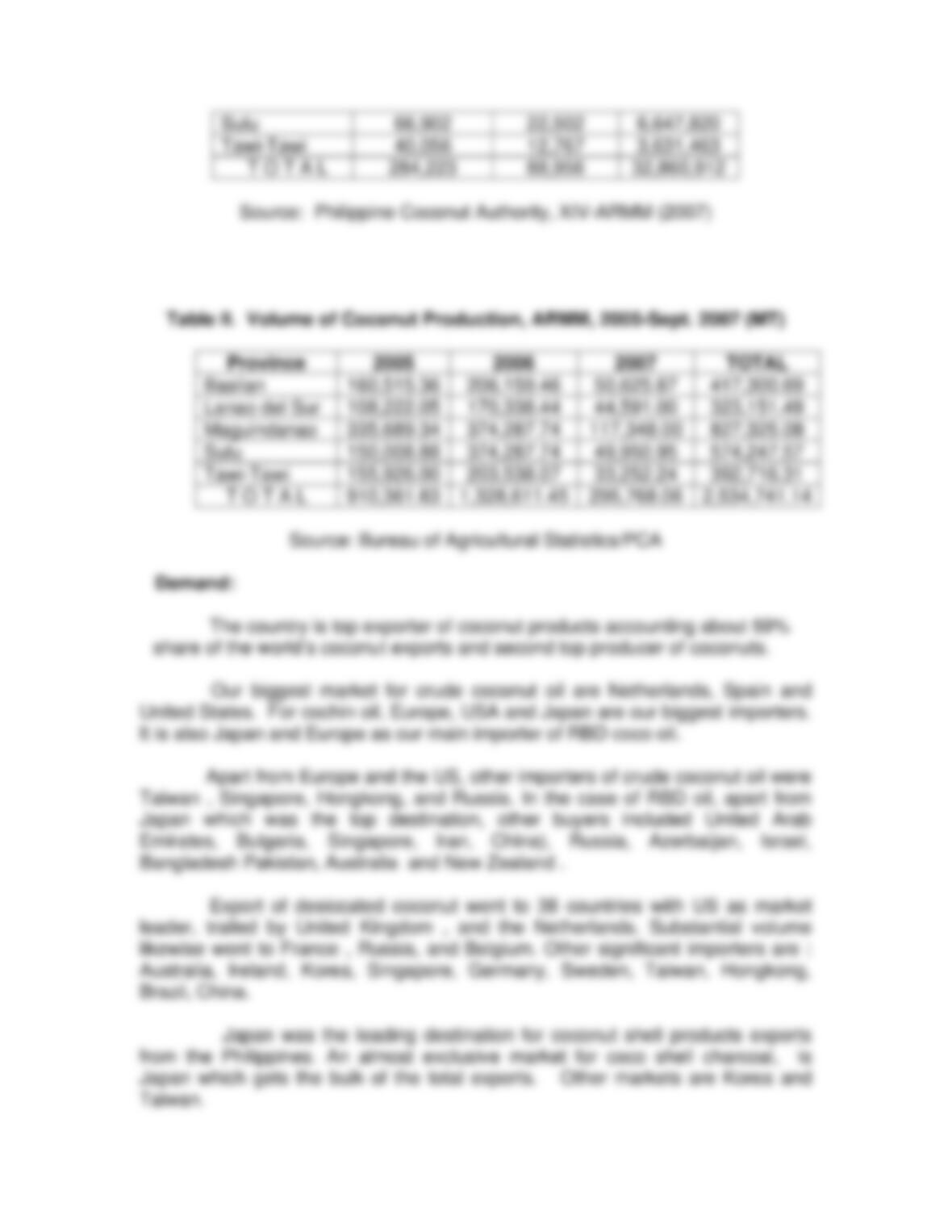
Region in Muslim Mindanao(ARMM) has a land area of 284,223 hectares
planted with coconuts with over 32M coconut bearing trees and 88,956
documented coco farmers.
Of the five (5) provinces of ARMM, the province of Basilan has the
biggest coconut areas with 67,763 hectares, followed by Sulu with 66,902
hectares, then the province of Maguindanao with 63,122 hectares, Lanao
del Sur with 55,150 hectares and Tawi-Tawi with 40,056 hectares (PCA-
BAS).
II. PRODUCT/ COMMODITY DESCRIPTION
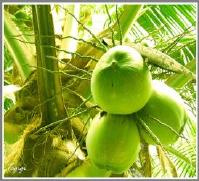
Botanically speaking, a coconut (cocos nucifera) is a fibrous one–
seeded drupe, also known as a dry drupe. However, when using loose
definitions, the coconut can be all three: a fruit, a nut, and a seed.
The term coconut pertains to the fruit while the tree is called a
coconut palm. It belongs to the Arecaceae palm family and can grow up to
6 meters tall. Called the “tree of life” in the Philippines, all parts of the palm
has uses -nothing is wasted even at the end of its fruit bearing years.. As
a result, coconuts can produce drink, fiber, food, fuel, utensils, musical
instruments, building material and many more.
The wonderful fruit of the coconut palm is rich in specific fats that
have incredible health benefits. It boosts immunity, kills bacteria and
viruses, protects against cancer and other degenerative diseases,
prevents osteoporosis by promoting calcium absorption, slows down
ageing and improves the complexion. It even helps weight loss!
In the advent of the entry of palm oil in the country, many thought
that coconut industry is now a “sundown industry” due to anti-coconut oil
campaign (health hazard) by soybean, corn and canola lobby groups in
USA and European Union. But, with the emergence of non-traditional
coconut products like virgin coco oil, cochin oil, geotextile and flour, the
industry is now on the rise.
III. INDUSTRY COVERAGE/STRUCTURE
As mentioned, everything in a coconut palm tree is useful from leaves to
bark. The whole of the coco fruit also has so many uses, to wit:
• Coconut Meat – Other than copra and dessicated coconut, the meat
can be turned into virgin coconut oil, skim milk, protein
isolate, coconut meal and flour, feeds or pulp, cochin
oil and biodiesel. A by-product of biodiesel or coco-
methyl ester is glycerin which is used as intermediate
product for many other uses.
• Coconut Husk – From the husk, coir fiber can be produced and further
turned into geotextile as well as peat, a major
component for organic plant media fertilizer. Coir