2
Executive summary
Coach, Inc. is an upscale American leather goods company known
for women’s and men’s handbags, as well as items such as luggage,
briefcases, wallets and other accessories (belts, shoes, scarves,
umbrella…). The firm was founded in 1941, in a loft in New York as a
partnership called the Gail Manufacturing Company. As of July 2, 2011, the
company operates in over 20 countries with more than 1,100 retail stores
and around 15,000 employees worldwide. Today, Coach Inc. has
distribution, product development and quality control operations in the
US, France, Italy, Japan, Hong Kong, China and South Korea.
From 2001 to 2011, Coach launched a series of activities to take
great control over the brand in the Asian markets, and it also accelerated
its European expansion with the help of its European joint venture partner
in 2011. Continuous innovation and affordable price are two keys for
Coach to conduct international business. In addition, owing to its multi-
channel retail network, Coach, Inc. has successfully enhanced its brand
image all over the world.
Luxury goods industry is highly competitive due to a low market-
entry barrier. It has experienced ups and downs during the 2000s. And in
recent years, the industry has recovered and developed rapidly. More and
more luxury goods corporations have expanded their operations in
emerging markets through Internet and e-commerce. The future outlook
of this industry is optimistic.
The competitions in the luxury goods industry are pretty intense.
Many competitors of Coach are from France and Italy such as Louis
Vuitton, Hermès, Gucci, and Prada. Having superior brand recognitions
and strong impacts on global luxury goods market make them become
dangerous rivals of Coach, Inc. Even though Coach Inc. has come up with
good strategy, it still suffered from harsh competition. The pro$t margin
was still below the level achieved prior to the onset of a slowing economy
in 2007 and its share price had experienced a sharp decline during the
first six months of 2012.
Due to the changing environment and harsher competition, it was
not clear whether the company’s recent growth could be sustained and its
competitive advantage could hold in the face of new accessible luxury
lines launched by such aggressive and successful luxury brands as
Michael Kors, Salvatore… Therefore, I recommend that Coach thinks about
spending money working on TV commercials, or cooperating with some
world-famous jewelry brands to raise the brand awareness. It also needs
to consider expanding in China so as to cut down operating expenses and
better meet the Chinese customers’ growing needs.
CASE 7 – COACH INC. IN 2012: ITS STRATEGY IN THE “ACCESSIBLE” LUXURY GOODS MARKET GROUP 4
2
Question 1. What are the defining characteristics of the luxury
goods industry? What is the industry like?
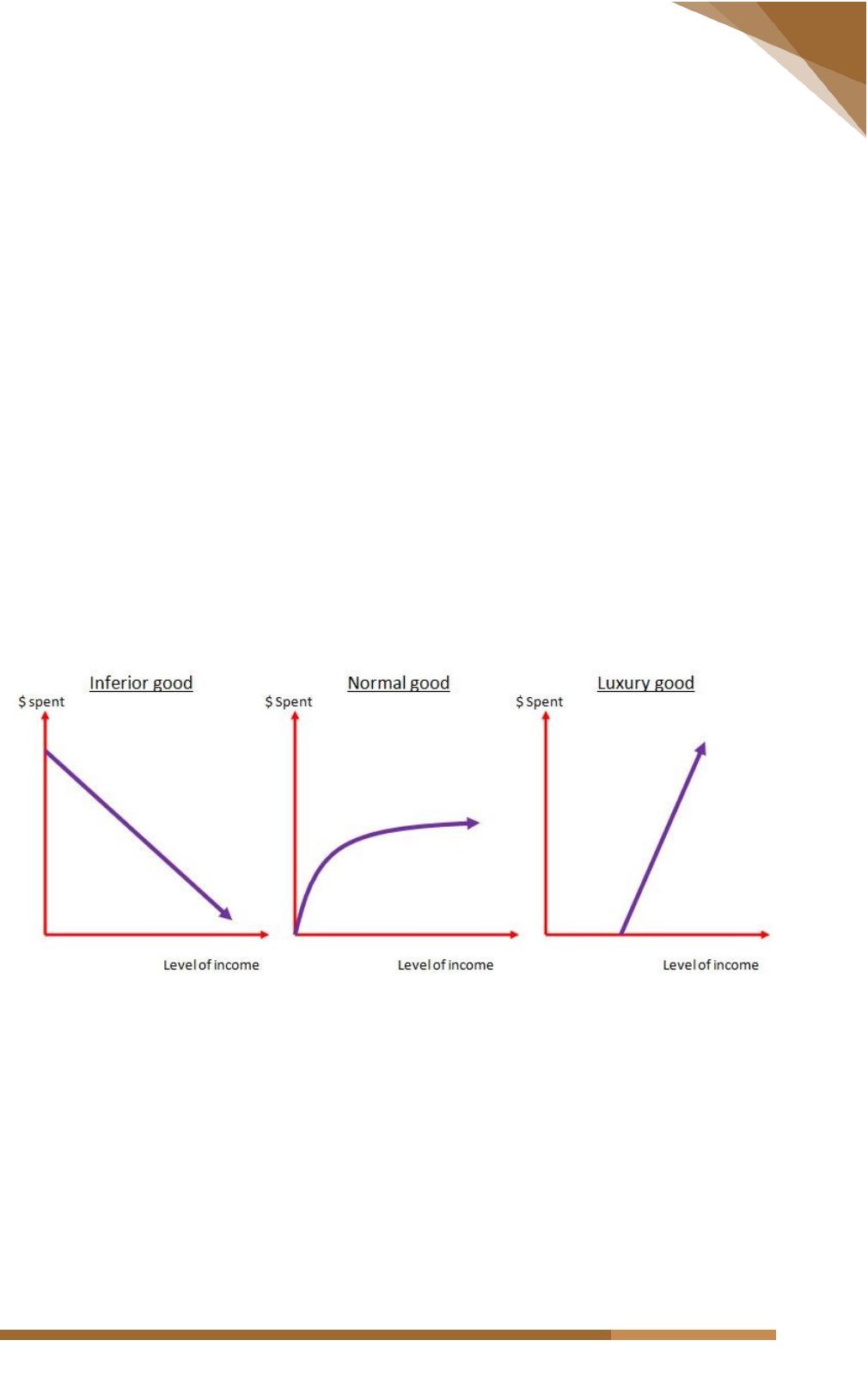
Economics de$ne a luxury good as one for which demand increase
as income increase. Luxury goods are said to have high income elasticity
of demand: as people become wealthier, they will buy more and more of
the luxury good. This also means, however, that should there be a decline
in income its demand will drop. Unlike inferior goods, they are related to
price and high-income individuals. A luxury corporation may establish its
image via pricing, exclusivity, limited availability, quality and location.
High pricing gives the product its prestigious nature, and implies high
quality. Luxuries may be services. The hiring of full-time or live-
in domestic servants is a luxury reAecting disparities of income. Some
financial services, especially in some brokerage houses, can be considered
luxury services by default because persons in lower-income brackets
generally do not use them.
Luxury brands in general, relied on creative designs, high quality,
and brand reputation to attract customers and build brand loyalty. Price
sensitivity for luxury goods was driven by brand exclusivity, customer–
centric marketing, and to large extent some emotional sense of status and
value. The luxury goods market has been on an upward climb for many
years. The market for luxury goods was divided into three main
categories: haute-couture, traditional luxury, and the growing submarket
“accessible luxury”. At the apex of the market was haute couture with it
CASE 7 – COACH INC. IN 2012: ITS STRATEGY IN THE “ACCESSIBLE” LUXURY GOODS MARKET GROUP 4
2
very high-end “custom” product o7ering that catered to the extremely
wealthy. Luxury goods manufacturers believed di7usion brand’s lower
pro$t margins were o7set by the opportunity for increased sales volume
and the growing size of the accessible luxury market and protected
margins on such products by sourcing production to low-wage countries.
Eye-catching utilization of their products by prominent $gures in society
leads to increasing demands for luxury good items and it is a growing
industry with the global luxury goods market growing 9% per year. These
consumers buy their products for satisfaction and to boost their self–
esteem rather than for ease or comfort. All these components blend in the
context of a successful business of the luxury goods.
The industry has performed well, particularly in 2000. In that year,
the world luxury goods market – which includes drinks, fashion, cosmetics,
fragrances, watches, jewelry, luggage, handbags. The luxury-goods
business needs people to feel good about spending money. The luxury
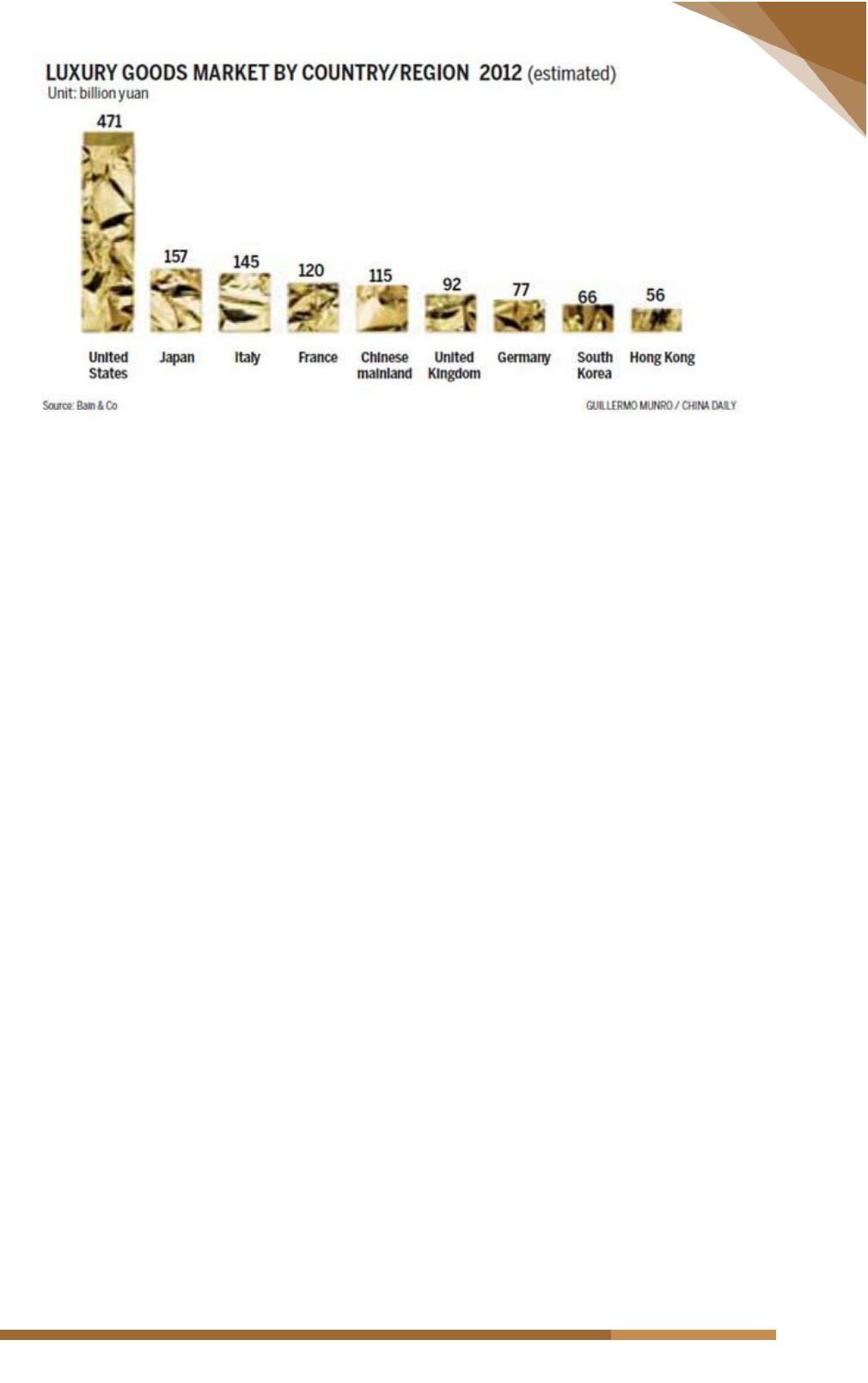
goods industry is global in scope. In 2005, Italy (27%), Replica Armani
Swiss France (22%), Switzerland (19%), US (14%) controlled a combined
82% of the worldwide luxury goods industry sales. In 2006, the industry
was expected to grow by 7%. Much of this growth can be attributed to
increasing income and wealth in developing European countries, China,
and changes in consumer buying habits. Additionally, the entry of big box
stores into the distribution chain has opened the market to middle-income
consumers, who earn substantially less that the $300,000 household.
The luxury goods industry is under drastic change and at different
levels. This has an impact on Coach’s business because they have two
different types of stores.
CASE 7 – COACH INC. IN 2012: ITS STRATEGY IN THE “ACCESSIBLE” LUXURY GOODS MARKET GROUP 4

2
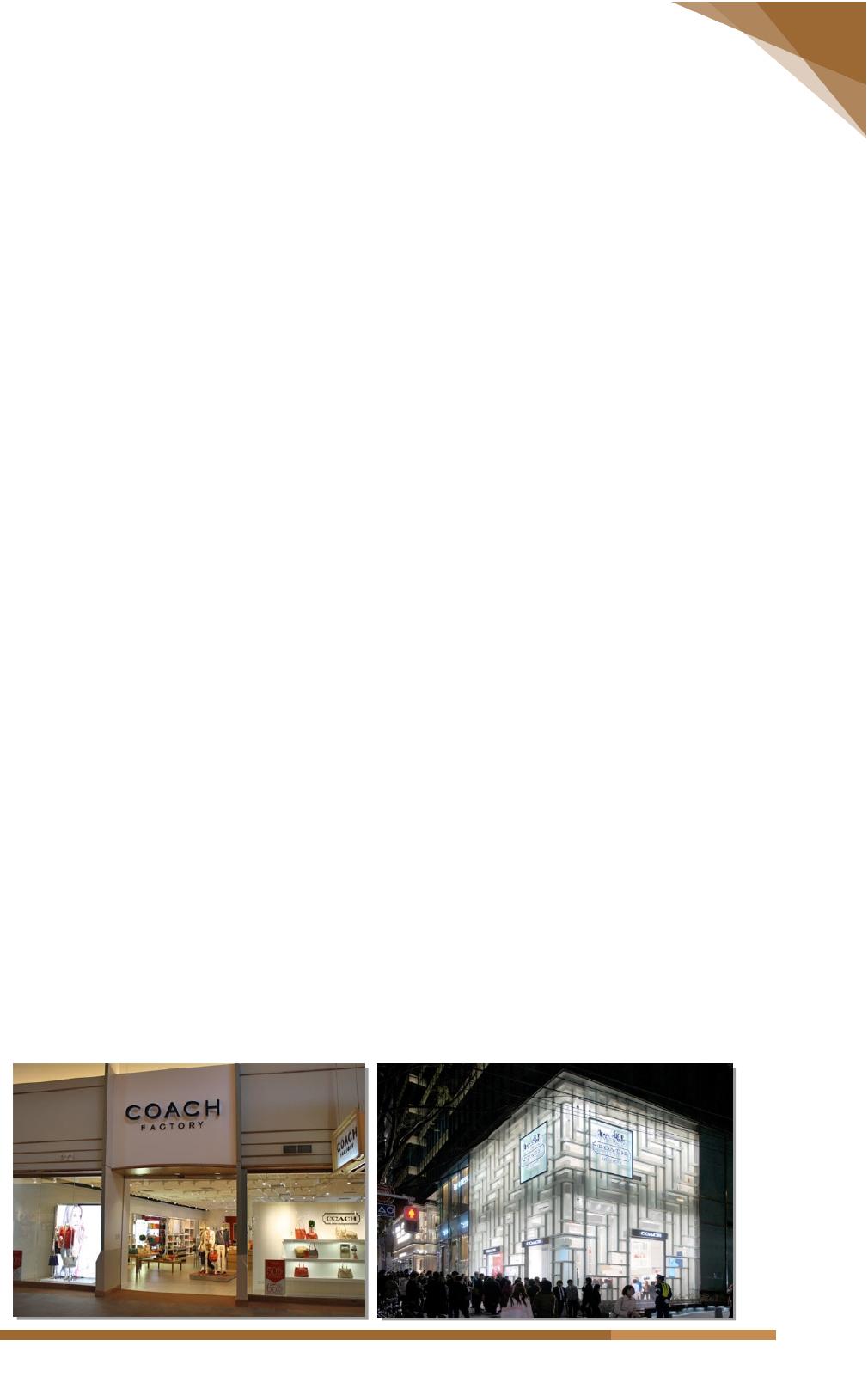
Two different types of stores of Coach
On one hand they have factory stores who sell at a discounted price and
on the other hand they have full-priced stores or Aagship stores which
cater to higher end consumers. While the factory stores are being hit by
the American financial crisis due to the lack of disposable income for the
middle class, full-price stores or Aagship stores have brighter future with
an increasing number of millionaires.
Question 2. What is competition like in the luxury goods
industry? What competitive forces seem to have the greatest
effect on industry attractiveness? What are the competitive
weapons that rivals are using to try to outmaneuver one another
in the marketplace? Is the pace of rivalry quickening and
becoming more intense? Why or why not?
The competition in the luxury goods is very strong. The $nancial
crisis (2007-2009) had a great e7ect on the luxury goods industry.
CASE 7 – COACH INC. IN 2012: ITS STRATEGY IN THE “ACCESSIBLE” LUXURY GOODS MARKET GROUP 4
2
This led to a huge decline in sale in United States, Japan and Europe.
Therefore, the competition in old market and especially emerging market
is extremely intensive. In the emerging market (China, India and
Southeast Asia), from 2% of industry sales in 2001, they had 20% of
industry sale in 2011. Thousands of companies compete in this field,
which are mainly from Italy, France, Swiss and United states. According to
Merrill Lynch, the most valuable luxury brands in terms of annual revenues
in 2011 were Louis Vuitton, Gucci, Hermes and Cartier.
The competition in the luxury goods industry is extremely intense
due to a low market-entry barrier, that is, not all the corporations in this
industry can gain great achievements. Many companies had to withdraw
from the market because of being short of effective follow-up $nancial
support. Nowadays, this industry provides services for two types of
clients: to the rational consumers, some companies choose to offer
affordable luxury goods which are classic styles and won’t be outdated for
a long time; and to the fashion-conscious customers, plenty of firms try to
supply higher–priced products whose designs are keeping up with the
newest fashion trends. Luxury goods industry has experienced ups and
downs during the 2000s. The world’s top brands such as Louis Vuitton,
Gucci, and Hermes all generated benefit of more than 100% at the end of
1999. In 2000, the industry continued performing well in the global
financial markets. However, the changes took place in the following years.
Luxury goods industry was strongly impacted by the adverse e7ects of
CASE 7 – COACH INC. IN 2012: ITS STRATEGY IN THE “ACCESSIBLE” LUXURY GOODS MARKET GROUP 4

2
wars, diseases, and global economic recession. Fortunately, it soon
started recovering with the support of its loyal customers who were eager
to buy luxuries to demonstrate their wealth and status. Recently, with the
rapid development of Internet and e-commerce, more and more luxury
goods corporations have successfully marketed their products in emerging
markets. And they will constantly optimize their goods and services to
meet the international customers’ higher demands in the future. So on the
basis of above analysis, luxury goods industry is promising.
Coach Inc. is the biggest name of luxury goods in the United States.
Coach’s market share in the U.S. handbags market fell from 19% to 17.5%
between 2011 and 2012. This share was mostly grabbed by competitor
Michael Kors, whose market share has risen from 4.5% to 7% in the same
period. This discouraging trend hasn’t been reversed in the past year as
comparable store sales fell by approximately 15% in the holiday quarter.
This drop in sales was due to lower traPc in Coach’s stores as shoppers
were turned o7 by the lack of online Aash sales over the quarter. Sales
have now fallen for the third straight quarter in succession and
management expects sales to fall further in the second half of the $scal
year. The bright spots for Coach in this quarter were sales in China, which
were up by 25%, and the sales of handbags priced above $400, in North
America. The disappointing thing for the company is that these high-
priced handbags only comprise about a $fth of their handbag products
and this means that the company is losing out to competitors on nearly
80% of their product lines in this division.
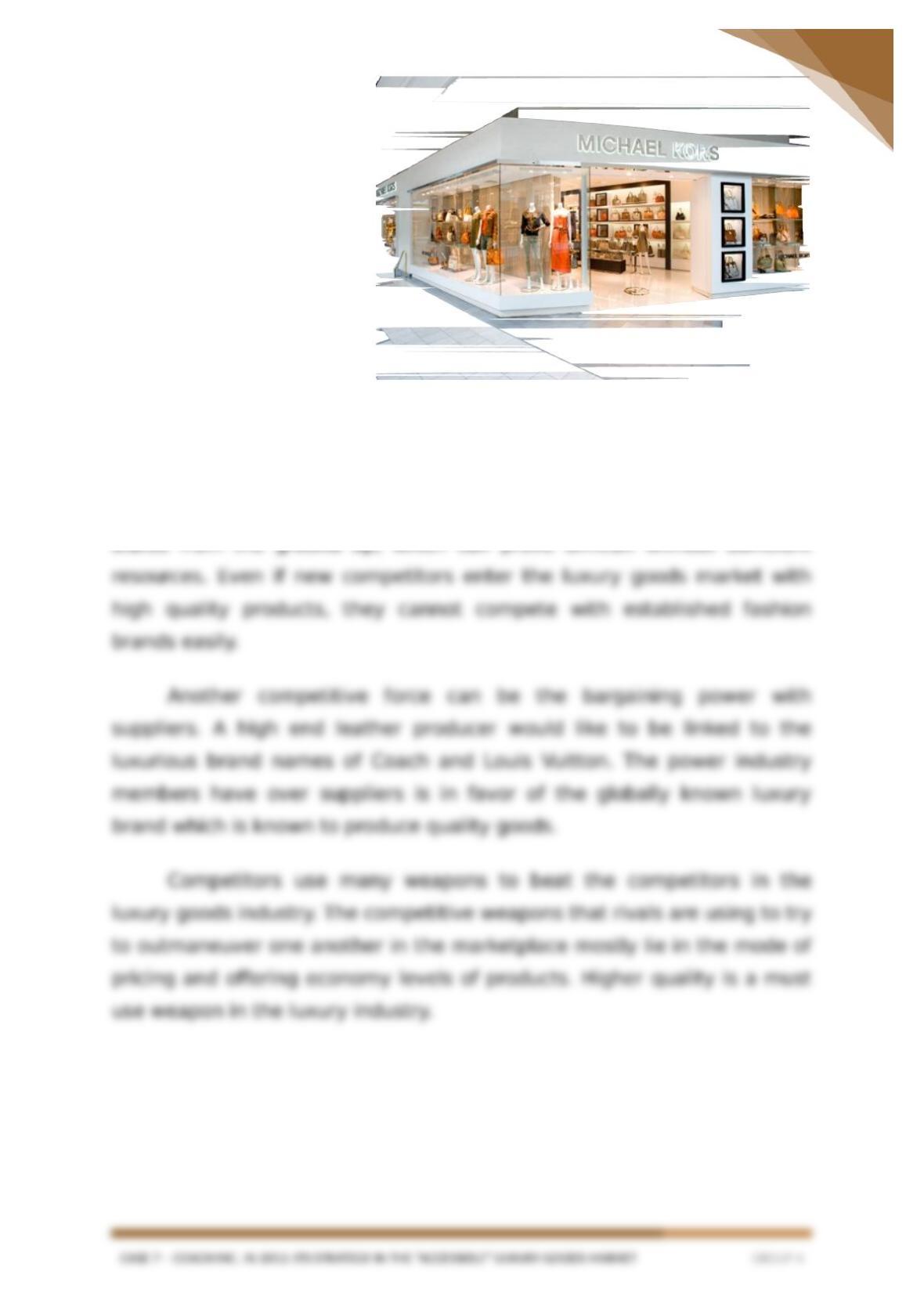
The main competitor of Coach in the US is Michael Kors, having
grown its revenues between 58% and 67% in the last three years, posted
a revenue growth of 59% in the holiday quarter. This growth is an ominous
sign for Coach as Michael Kors hasn’t reached its full store capacity yet.
The store count for Michael Kors’ stood at 284 by the end of the previous
quarter or approximately 70% of its stated long term target of 400 stores.
Without having reached its full store capacity yet, it is possible that
Michael Kors isn’t meeting the full demand for its products and there is
still potential room for growth. This is a challenging scenario for Coach.
CASE 7 – COACH INC. IN 2012: ITS STRATEGY IN THE “ACCESSIBLE” LUXURY GOODS MARKET GROUP 4
2
One of the
competitive forces that have a great
e7ect on industry
attractiveness is the
threat of new entrants and
how hard it is to build up a
brand name that can
compete with the likes of Coach, Louis
Vuitton, Dolce & Gabbana, and Versace. It takes deep
financial pockets and great
commitment to create luxury image with well-known brand and superior
quality. Thus making it costly for new entrants to gain exposure and
market share. Luxury items are known for their superior quality and to
some people, the status that they carry. New entrants must build this