Chapter 12 Intangible Assets
Lack physical substance
(patents, copyrights, franchises, licenses, trademarks, trade names, goodwill)
They are NOT financial instruments
(A/R, notes and bonds receivable,….ect.)
Valuation:
Record at cost (everything necessary to make
asset ready for intended use).
For internally-generated intangibles, only direct
costs are capitalized (e.g., legal costs for patent).

If insignificant cost, then usually expensed.
Amortization:*
Limited-life intangibles—over useful life.
Amortizable base equals cost minus residual
value.
Indefinite-life intangibles—do NOT amortize.
* Usually decrease the value of the asset directly, can use a
contra-account: Accum. Amort.

“Types” of Intangible Assets
Legal Amortization
life Period
Market-related:
Trademark Indefinate,
Company name renewable Not amortized
Customer-related:
Customer lists None Lesser of useful or
economic life.
Artistic-related:
Copyrights Life of creator Lesser of useful or
plus 70 years economic life.
Contract-related:
Franchises Length of Length of
Licences contract or contract or
Permits indefinite not amortized
Technology-related:

Patents 20 years Less of useful
or legal life.
Goodwill: None Not amortized
Recording Goodwill
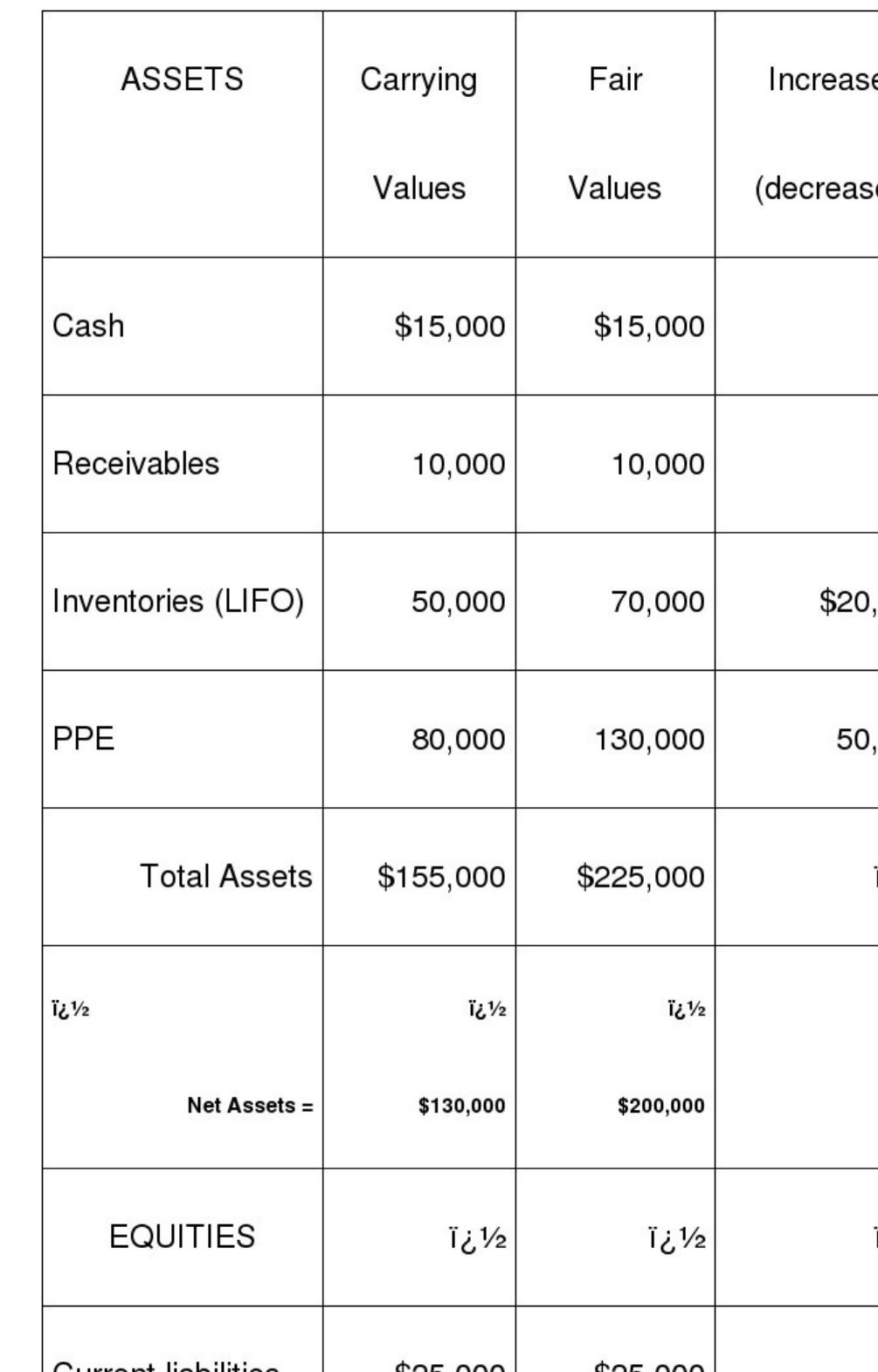
Duncun Corp. purchased the Fran Company for
$300,000 on December 31, 2003. The balance
sheet of Fran Company just prior to acquisition
and appraisal of the fair values of identifiable net
assets is listed below:
Fran Company
BALANCE SHEET
December 31, 2003
Acquisition Journal entry:
Cash $ 15,000
Receivables 10,000
Inventories 70,000
PPE 130,000
Goodwill (plug) 100,000
Current Liabilities 25,000
Cash 300,000
All identifiable net assets acquired are recorded
at FairV and Goodwill is plugged for the
difference between purchase price and FairV of
identifiable net assets acquired.
Goodwill is not amortized.
* Must annually check for impairment.
If the FairV of net assets acquired is greater than
the purchase price then you have negative
goodwill (or badwill)—FASB requires that the
excess be recognized as an extraordinary gain.
Impairments of Intangibles
Two questions:
(1) Has an impairment occurred?
(2) How much impairment loss?
Three different approaches:
(1) Limited-life intangibles—same 2-step
test as for PPE.
(2) Indefinite-life intangibles (except

goodwill)??tione-step test. Loss is the
excess of CV over FV.
(3) Goodwill—two-step test (different
than above)
Limited-life Intangibles—Impairment
Recoverability Test:
Are expected future undiscounted net cash flows
less than carrying value? If yes, then go on to
determine the amount of impairment loss.
Impairment Loss:
Assets held for use Assets held for disposal
Loss = CV – FairV Loss = CV – NRV
Amortize new cost basis No amortization
No restoration of loss Restoration of loss
permitted.
Impairment of Limited-life Intangibles—
example
Example: Patent
Carrying value $60,000,000