Climate Shocks
Swings between wet and dry landscapes pushed some of our
ancestors toward modern traits- and killed off others.
By PeterB. deMenocal
Scrambling up the steep bank of a small wadi, or gully, near the western shore of
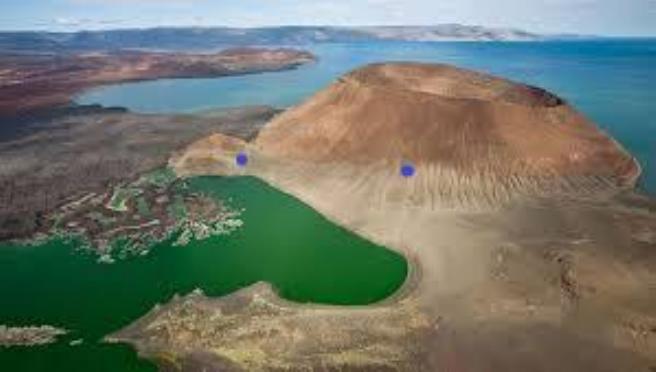
Lake Turkana in northern Kenya, I stop on a little knoll that offers a view across the
vast, mostly barren desert landscape. The glittering, jade-blue lake contrasts in every
way with the red-brown landscape around it. This long, narrow desert sea, nestled
within Africa’s Great Rift Valley, owes its existence to the Omo River, whose winding
flow delivers runoff that comes from summer monsoon rains in the Ethiopian highlands,
hundreds of miles north.
The heat here has to be respected. By noon it feels like a blast furnace. The sun
beats down, and the hot, stony ground fires it back upward. Scanning the dusty horizon,
with the lake winking in the distance, I find it hard to imagine this place as anything but a
desert.
Yet evidence for much wetter times is everywhere. Indeed, the little hillock under
my boots is a thick chunk of ancient lake sediments that date back 3.6 million years,
when a much larger and deeper Lake Turkana filled this basin to the brim. The glassy
remains of fossil lake algae make up white, sandy layers, and large fish fossils are
common. At times in the past, this rocky desert was carpeted with grasslands and trees
and lakes.
Such climate changes may have played a big role in shaping human evolution, a
growing number of scientists believe. The Lake Turkana region, together with other
sites in East and South Africa, possesses most of the fossil record of early human
origins and our evolutionary journey since our lineage split from African apes more than
seven million years ago.

Remarkably, major shifts in African climate coincide with two moments on that
ancestral path, roughly a million years apart, that mark significant changes in our family
tree. The first evolutionary shake-up happened between 2.9 million and 2.4 million years
ago. The famous ancestral lineage of “Lucy” and her ilk (Australopithecus afarensis)
became extinct, and two other, quite distinctive groups appeared. One of them had the
hints of some modern-looking traits, including larger brains. Their owners were the very
first members of our own genus, Homo. Crude stone tools appeared near these fossils.
The other group besides Homo that emerged at this time looked different: a stoutly built,
heavy-jawed, and ultimately unsuccessful lineage known collectively as Paranthropus.
The second shake-up occurred between 1.9 million and 1.6 million years ago. An
even larger-brained and more carnivorous species, Homo erectus (called Homo
ergaster by some scientists), appeared on the scene. It’s taller, more lithe skeleton was
nearly indistinguishable from that of modern humans. This species was also the first to
leave Africa to populate Southeast Asia and Europe. Stone-tool technology also got a
major upgrade: the first-hand axes showed up, with large blades carefully shaped on
two sides.
Why were these evolutionary milestones, harbingers of modern humanity, so
clustered in time? A number of scientists now think two episodes of climate change may
have been the cause. These two ecological jolts, coming after long periods of extremely
gradual change, moved the cradle of humanity toward increasingly dry and open
grasslands. While these broader shifts were happening, the climate whipsawed rapidly