Climate Change and the Future Impacts on Coffee Production and Economic Stability in
Latin America
Eric Haaksma
SMGT 740
April 5th,2018
Dr. Sakib
Introduction
Throughout the globe, the most traded agricultural crop is coffee. The coffee industry is
the foundation of the economy and significant source of revenue in many Latin-American
countries. While these countries in the southern subtropical and equatorial region are made up of
roughly 25 million small-scale farmers that produce coffee while northern hemisphere
consumers buy approximately 1.4 billion cups of coffee daily (Evans, 2018). In addition to the
consumption, its socio-economic importance has created an overall economy that is highly
depended on the small farmers in Latin America. These small farms in Latin America make up
more than 70% of the global production of coffee and is the essential element of rural Latin
America. These adverse changes stemming from global climate change will affect every aspect
of the coffee industry; from the cultivation, processing, roasting, and consumption. If these small
farms in Latin America do not make the appropriate changes to help coffee plants adapt for
climate change, humanity could see a whole industry that impacts numerous lives globally fail.
According to the International Panel of Climate Change, the predicted models indicate that
coffee products in Latin America will be impacted directly, due to unreliable sporadic
precipitation and increasing global temperatures (International Panel of Climate Change, 2014).
As the coffee industry continues to grow in the northern hemisphere, consumers, scientists, and
farmers are on a constant search to create more sustainable approach in every aspect of the coffee
industry. The challenge of climate change is inevitable, and the future impacts of coffee
production will adversely affect Latin America and the global economy unless these local coffee
farmers learn adaptation strategies.
By the late 1800s, coffee was known worldwide and had become a commodity that paved
the path to becoming the world’s favorite beverage. The coffee plant has played a diverse and
important role in molding the landscape of Latin America countries such as Colombia,
Guatemala, and Peru. As the plant naturally grows in the understory of the tropical rainforest of
Central America. It is naturally a shade-tolerant plant which the small farmers have been
successfully able to mimic the coverage and function of the tropical rainforest. As the demand
for coffee increases, these small farmers feel the pressure to produce more coffee beans and by
doing so, they have to clear parts of the rainforest to expand their coffee plantations. However,
coffee plantations have been invaluable hubs for forest dependent biodiversity and help preserve
some of the integrity of rainforest by maintain the microclimates and improving water quality.
Important abiotic factors that directly impact the coffee bean yield it mainly dependent on
temperature, rainfall, and humidity.
The increasing greenhouse gas emission is causing wide changes in atmospheric events,
which is causing unpredictable variability with the coffee bean vegetation. Climate change
models are predicting that in the three main countries in Latin America, the temperature will
increase roughly 1.7° to 6.7°C by the year 2100 (International Panel of Climate Change, 2014).
The average precipitation will see a reduction in both the wet and dry seasons and a smaller
difference between night and
daytime temperatures. Each one of
these abiotic factors are equally
important for the production of
coffee beans. Colombia, Guatemala,
and Peru are the countries with the
highest concern for negative
impacts due to global climate
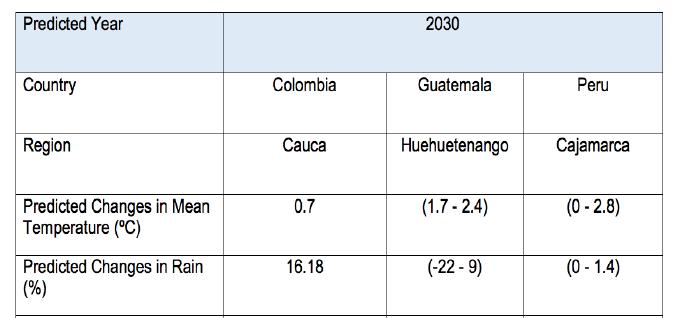
Figure 1. Predicted Environmental Changes
in 2030
Source: (Fox et al., 2015).
change. Figure 1 breaks down predicted climates due to climate change in the year 2030 for
these countries. The country of Guatemala is already facing a high percentage of its population
suffering from a food shortage, and it is predicted that it will climb due to the unrelenting nature
of global climate change (Fox et al., 2015). With coffee beans as their main export of agricultural
crops, these farmers are depended on revenue gained from selling their coffee beans. In terms of
Peru and Colombia, these two countries depend on their mountains natural glaciers to supply
their farm lands with freshwater. Rising temperatures are causing glaciers to retreat at an
alarming rate, which is concerning as each coffee bean needs roughly thirty gallons of water to
fully mature (Fox et al., 2015). As climate change progresses in these regions, the dry and rainy
seasons will be less defined. These extended periods of dry season will cause the coffee plant to
reduce the number of flowers it produces. The coffee plant heavily relies on pollinators to ensure