CLASSICAL LINEAR REGRESSION MODEL
INTRODUCTION
The classical linear regression model is a statistical model that describes a data generation
process.
SPECIFICATION
The specification of the classical linear regression model is defined by the following set of
assumptions.
Assumptions
1. The functional form is linear in parameters.
Yt = 1Xt1 + 2Xt2 + … + kXtk + t
2. The error term has mean zero.
E(t) = 0 for t = 1, 2, …, T
3. The error term has constant variance.
Var(t) = E(t2) = 2 for t = 1, 2, …, T
4. The errors are uncorrelated.
Cov(t,s) = E(t • s) = 0 for all t s
5. The error term has a normal distribution.
t ~ N for t = 1, 2, …, T
6. The error term is uncorrelated with each explanatory variable.
Cov(t,Xti) = E(t • Xti) = 0 for t = 1, 2, …, T and i = 1, 2, …, K
7. The explanatory variables are nonrandom variables.
Classical Linear Regression Model Concisely Stated
The sample of T multivariate observations (Yt, Xt1, Xt2, …, Xtk) are generated by a process
described as follows.
Yt = 1Xt1 + 2Xt2 + … + kXtk + t
t ~ N(0, 2) for t = 1, 2, …, T
or alternatively,
Yt ~ N( 1Xt1 + 2Xt2 + … + kXtk , 2) for t = 1, 2, …, T
Classical Linear Regression Model in Matrix Format
The sample of T multivariate observations (Yt, Xt1, Xt2, …, Xtk) are generated by a process
described by the following system of T equations.
Observation 1 Y1 = 1X11 + 2X12 + … + kX1k + 1
Observation 2 Y2 = 1X21 + 2X22 + … + kX2k + 2
………………………………………
Observation T YT = 1XT1 + 2XT2 + … + kXTk + T
Note the following. 1) There is one equation for each multivariate observation. 2) The
parameters are constants, and therefore have the same value for each multivariate
observation. 3) The system of T equations can be written equivalently in matrix format as
follows.
y = X +
y is a Tx1 column vector of observations on the dependent variable. X is a TxK matrix of
observations on the K-1 explanatory variables X2, X3, …Xk. The first column of the matrix X is a
column of 1’s representing the constant (intercept) term. The matrix X is called the data matrix
or the design matrix. is a Kx1 column vector of parameters 1, 2 … k. is a Tx1 column
vector of disturbances (errors).
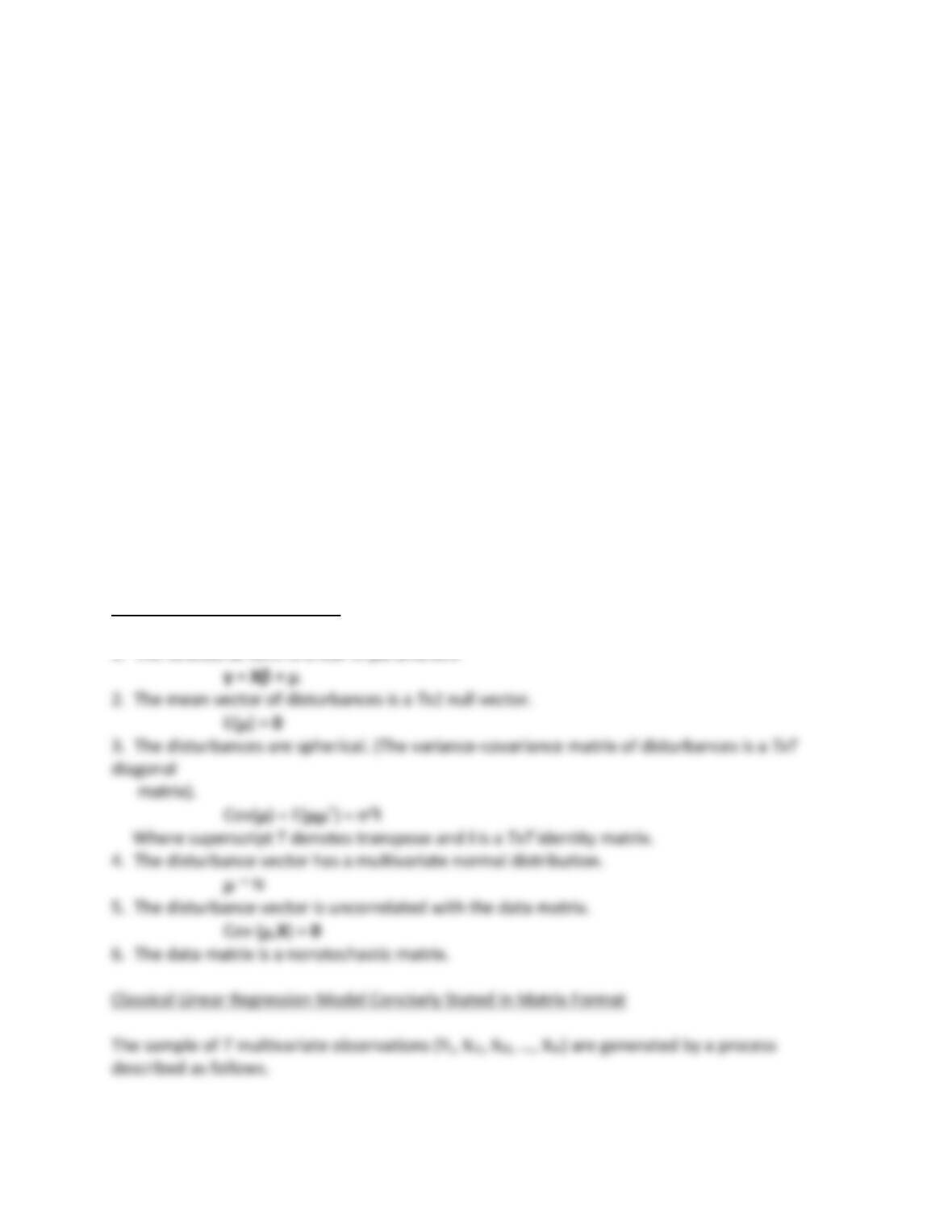
Assumptions in Matrix Format