STRAEGIC INTERACTION OF THE INDIAN CHOCOLATE INDUSTRY

CONTENT
PARTICULARS PAGE NO.
INTRODUCTION 3
MARKET STRUCTURE 4
PRODUCTS CONCERNED 5-6
DEMAND SUPPLY ANALYSIS 7-8
STRATEGIC INTERACTION 9
CONCLUSIONS 10
BIBLIOGRAPHY 11

INTRODUCTION
Chocolate, the world’s most illustrious food item has become a vital part of daily appetite
among Indians. Be it a birthday, job promotion, salary increment, examination success or
religious and traditional fiesta, every Indian is ready to nibble his / her share of chocolate to
rejoice.
Growing at a compounded annual growth rate ( CAGR) of about 25 per cent, India’s
chocolate industry size is currently worth about Rs 5,000 crores and is likely to cross Rs
7,500 crores mark in the next couple of years while globally the chocolate industry is worth
over $85 billion. Besides, India’s per-capita chocolate consumption is hovering at about 100
grams and urban centres comprise 35 per cent of the chocolate consumption in the country.
Cadbury is leading the pack with about 70 per cent market share followed by Nestle, Amul
and others.
As per a recently published report by TechSci Research, India’s chocolate market is expected
to reach $3.2 billion by 2018 due to increasing gifting culture in the country and increase in
the income bracket.
MARKET STRUCTURE
In economics, market structure is the number of firms producing identical products which are
homogeneous. Market Structure analysis of the Indian chocolate reports reveals that, it is
characterized by Oligopoly Market Structure. To understand the reason behind this
conclusion, let us relate the features of Oligopoly with the Indian Chocolate Industry.
1. Few Firms & Many Buyers
In an oligopoly market, we have very few firms and many buyers. In the Indian
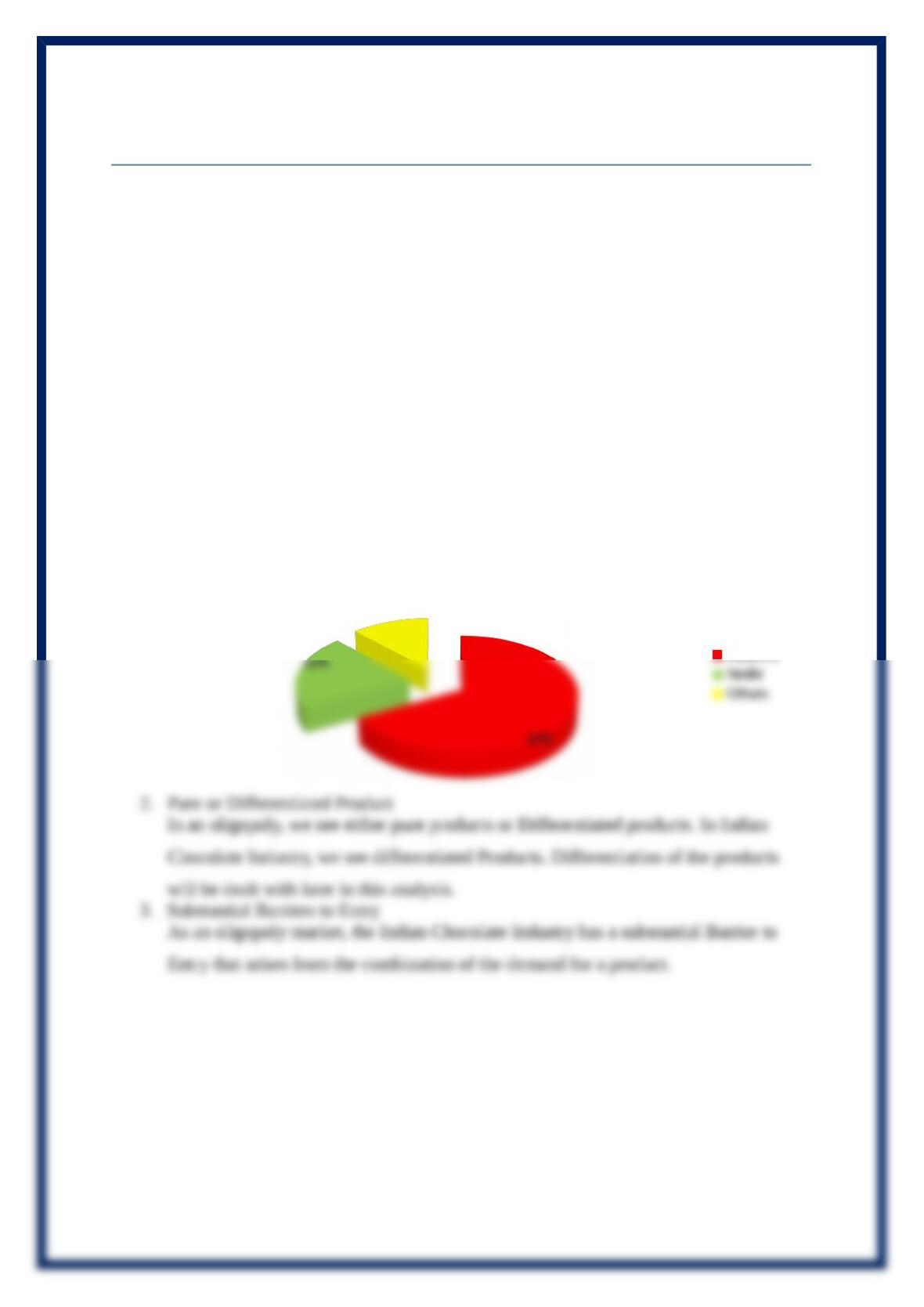
Chocolate Industry, we see that there are only Few Major players – Cadbury (67%
market share), Nestle (21% market share) & others (12% market share).
12%
Sales