Development of China’s Real Estate Market:
The Chinese Economy, vol. 43, no. 1, January–February 2010, pp. 71–92.
Written by; Hung-Gay Fung, Jau-Lian Jeng, Qingfeng “Wilson” Liu
Within the last two decades, China has experienced an extraordinary surge of growth in
real estate and in turn, the country’s overall gross domestic product (GDP) has increased
significantly, like clockwork. Real estate has grown from being a totally government
owned product to a now for profit- money hungry industry, integrating itself in China’s
GDP growth more and more, year after year. The growth of the real estate industry in
China has grown so significantly in recent years; foreign interest in this market has grown
immensely, intertwining China’s real estate market into the global economy. Serious credit
and debt issues currently face China and as a result, the stability of the nations’ policies are
extremely temperamental. The reliance of investment in real estate to grow China’s GDP
has become greater than ever and the amount of lucrative spending on this credit has
created a distribution of wealth and inequality within China to the point where government
intervention can be seen in this industry regularly. China’s poor accounting practices
currently are jeopardizing the fragile economy that is still struggling to recover from the
financial crisis of 2008, by rolling the debt over to cover losses and expenses. We will be
evaluating the Chinese economy as a whole throughout this article, while determining just
how crucial the real estate industry in China is to the country’s growth, economic well-
being and the effects it has on the population. By evaluating these variables as well as
challenges and opportunities to the Chinese real estate market, we can begin to understand
the dynamic between China and the modernized world.
The Chinese Economy
China’s economic growth has been staggering over the past decade compared to other
developed countries. As of the third quarter of 2013, China expanded 7.8% in GDP for the
year thus far, now currently representing 13.3% of the worlds’ economy. The GDP of a
country is measured through income and expenses for any country, in this case, we
evaluate all of the expenses on finished goods and services that were produced in China.
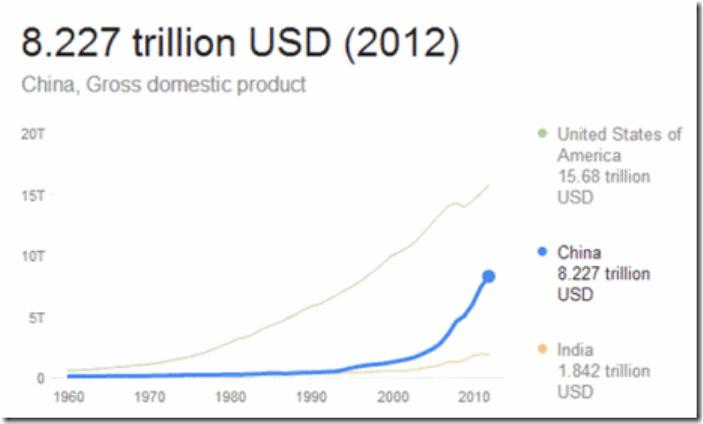
As of this year, China’s GDP amount is valued at a staggering eight trillion, two hundred
and thirty billion US dollars (China GDP, 2). In comparison, the United States GDP value
as of this year is valued at fifteen trillion, sixty eight billion dollars. The United States and
China make up the world’s largest GDP bases,
Source: WorldBank, 3
with Japan closing in third place. As you can see from this chart, China’s GDP growth in
recent years has been much more staggering than that of the United States, which has
grown mostly consistently over the past fifty years, with the exception of the Great
Recession of 2008.
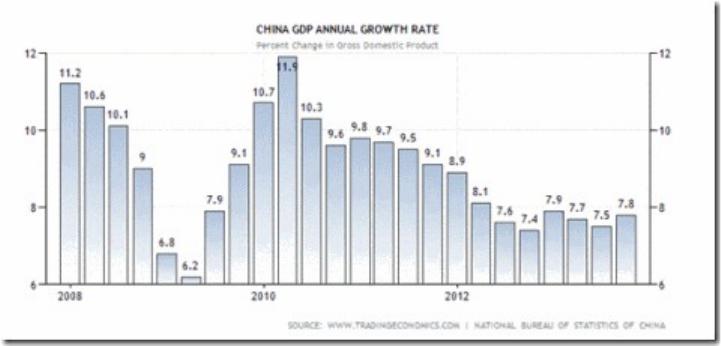
Over the past two decades, China has averaged a consistent growth rate of about 9.2% in
GDP, reaching a peak of 14.2% in 1992 and a low of 3.8% in 1990 (China GDP Annual
Growth Rate, 2). China has a different categorization strategy of GDP than the United
States, divvying up the categories into three main sections- primary, secondary and tertiary.
“The Primary Industry includes Farming, Forestry, Animal Husbandry, and Fishery and
accounts for around 9 percent of GDP. The Secondary sector, which includes Industry (40
percent of GDP) and Construction (9 percent of GDP) is the most important. The Tertiary
sector accounts for the remaining 44 percent of total output and consist of Wholesale and
Retail Trades; Transport, Storage, and Post; Financial Intermediation; Real Estate; Hotel
and Catering Services and Others (China GDP Annual Growth Rate, 2). After China’s
initial investment in the United States economy following the recession and President
Obama’s stimulus package, GDP growth has started to taper off after reaching 11.9%
growth in 2010, as you can see by this chart, later picking back up in 2010.
In comparison, we can see China outgrowing the United States in terms of GDP growth
over the past several decades consistently, as the current US GDP growth rate is only
2.8%.
This growth can be partially attributed to the real estate boom, as integration with foreign
markets has grown significantly, especially between 2003 and 2007, which went hand and
hand with other markets during this time. In evaluating China’s economy, one must take
into account the value of the nation’s currency compared to international standards. Over
the past ten years, China’s currency, the Yuan has appreciated against the dollar
significantly, especially during the financial crisis, which essentially crippled the American
dollar to foreign standards. Where ten years ago the exchange rate would have been over
eight Yuan to each dollar, as of now, the dollar trades for only just over six Yuan. In this
chart, we can see the effect of the recession in America and its’ direct improvement of the
value of the Yuan during and after this period. Although China’s practices have been
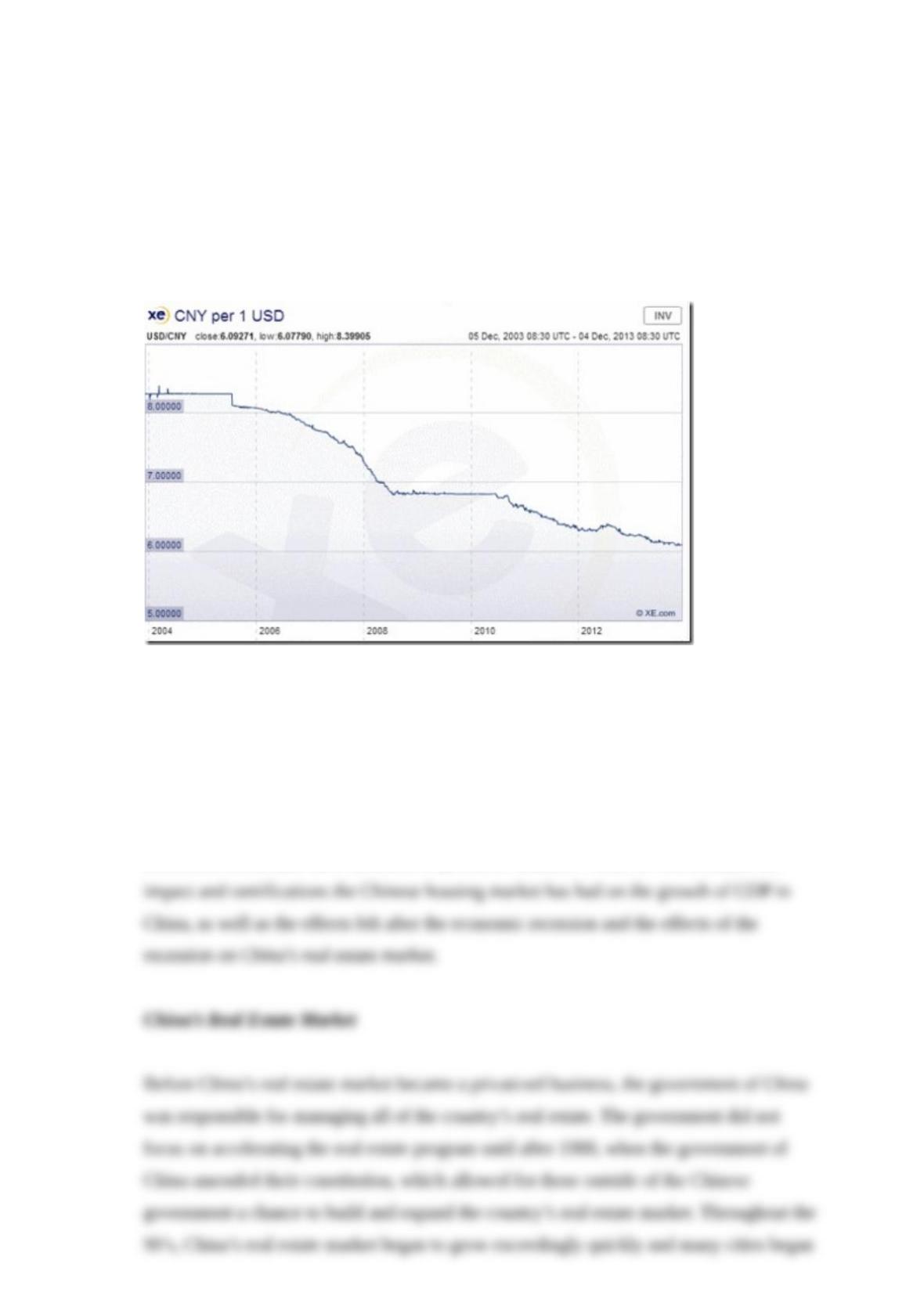
described as risky and dangerous by many in the international market, their currency
continues to appreciate against the American dollar.
Source: XE Currency Charts, 4
As a result of this data, it is obvious that the Chinese economy as well as their currency,
are improving at a far better rate than the current state of the US dollar. Based on this data,
we can tell that this trend will continue until one or both economies experience another
economic shock, such as a recession or period of inflation. Next, we will evaluate the