CHILD MARRIAGE
WOMEN AND FAMILY
DEEDY, JENNA
VIOLENCE AGAINST WOMEN
Rivier University
APRIL 10, 2017
1 Deedy
Child marriage is any form of marriage that involves any formal marriage or civil union in which
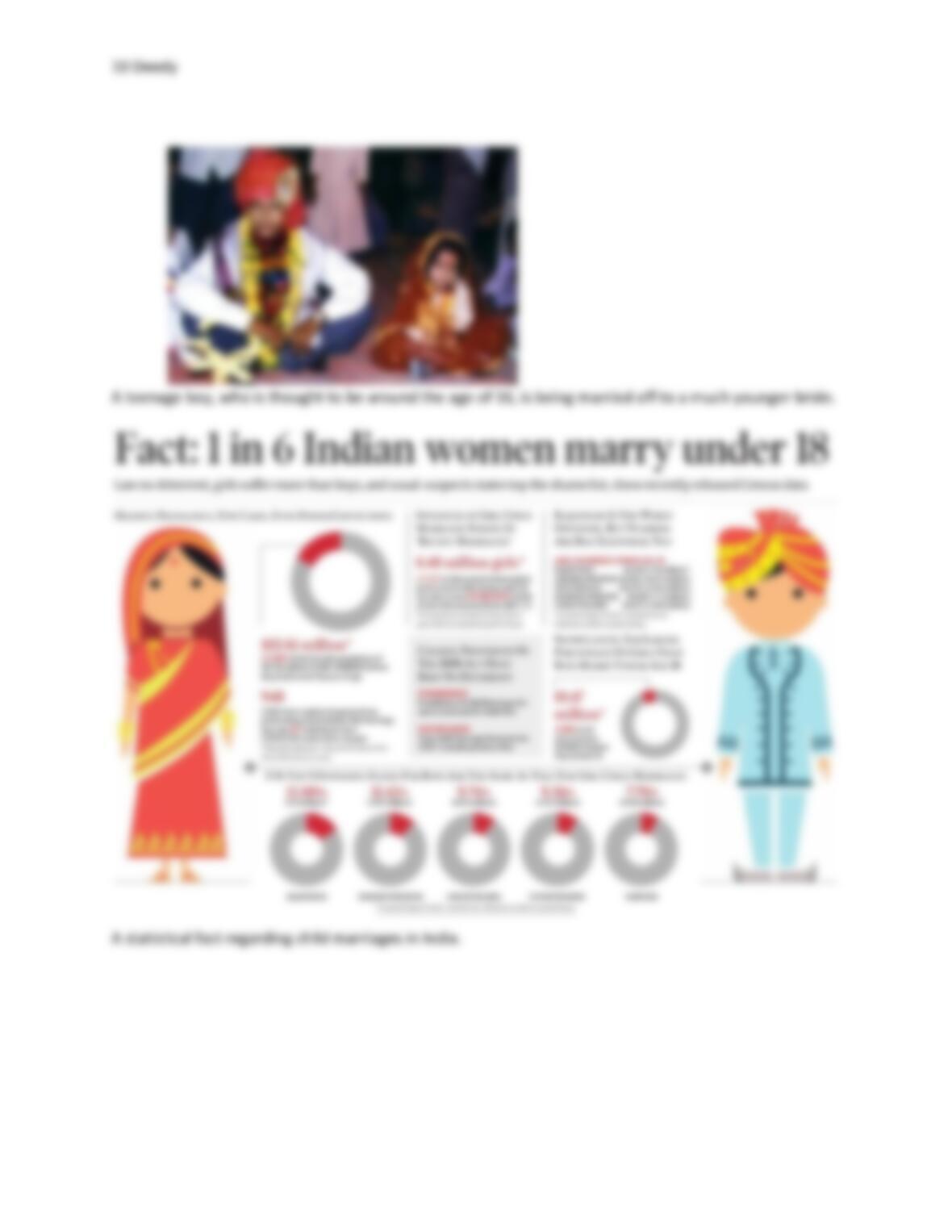
one or both party members are under the age of 18. Each year, about 15 million young girls are married
before their 18th birthday worldwide. This is estimated to be about 28 young girls every 1.2 seconds. It’s
also considered to be a violation of human rights because it results in persistent poverty, lack of access
to life saving health care, and gender inequality(UNFPA). It denies young girls the right to choose who
and when to marry, which is often seen as being an important life decision since choosing one’s partner
is a major decision that should be made freely and without fear or coercion. When it comes down to it,
virtually every country on Earth agrees. But Still, in many countries around the world, about one in three
girls are married before the age of 18. Researchers have estimated that if no action is taken to enforce
any regulation that would end child marriage, it’s possible that around 70 million young girls could end
up being married within the next five years(UNFPA).
Of all countries on Earth that is known for having the highest rate of child marriages under the
age of 18, India tends to have one of the highest rates of them all. In 2013, about 48% of all young girls
under the age of 18, which ironically is the legal age for marriage, like it is in the United States, were
married in India alone (Goodwin, 359, 2013). However, while the rates of child marriages may vary from
state to state in this predominately Hindu nation, they are thought to be as high around anywhere from
67-69% in the Indian states of Rajasthan, and Bihar (Girls Not Brides). Although a few young girls are
married before the age of 15, the number of girls who are married between the ages of 15-19 have
increased. In many Indian villages, girls are seen as economic “burdens” in the eyes of their parents.
Because of this matter, when these girls are married off, the responsibility of caring them is transferred
to their husbands and their families. In addition, poverty and marriage expenses, like dowries, may lead
parents to marry off their daughters at early ages (Girls Not Brides). Patriarchy and all other cultural
norms that are associated with the Hindu religion like social class and the caste influence the social roles
and expectations of young women in India, which is to act as objects that keep house, cook, and
reproduce, also act as a factor behind child marriages. Due to the limited cultural expectations, young
women are often viewed as being the property of their fathers and husbands (Girls Not Brides). Purity as
being a factor in an attempt to control female sexuality is thought to be another driver behind Indian
child marriages. Since virginity is thought to be considered “sacred” in the Hindu religion, the parents
often have their daughters married off when they hit puberty in order to avoid in any “dishonor” that
2 Deedy
may come to the family as a result of pre-marital sex or sexual assault. A final driver behind child
marriages in India is the lack of educational opportunities, especially in rural areas as their parents may
not be able to afford to give their daughters a much needed education even though they might prefer to
invest in the education of their brothers (Girls Not Brides). As a result, this can put these girls at risk of
being married off at early ages.
At heart, child marriages are rooted in four different issues that trigger a parent’s motive to
marry their daughters off at an early age rather than hold off on marriage until they are around 18-21
years of age. They are Gender inequality, culture and tradition, poverty, and insecurity. In many cultures
that practice child marriages, girls are not as valued as boys are for they are often seen as family
“burdens”. To ease the parents of this economic “burden”, young girls are often married off as young
ages in order to transfer the “burden” on to their husbands and their families (Girls Not Brides). Child
marriages are also driven by patriarchal communities and their values as a way to make attempts at
controlling female sexuality, for instance, how young girls should dress, where they should be allowed to
go, or who are they allowed to see. This means that families have to make efforts to guard their
daughter’s virginity and sexuality in order to protect the family’s “honor”. If these young girls are not
worthy of a broken family’s honor for whatever the reason it might be, such as seeking an education
over marriage, or having pre-marital sex, they might end up being subjective to “honor killings” by their
male relatives as a way to restore this “honor” (Karraker, 136). The concept behind the honor killings is
the idea of a male relative killing a female relative who are suspected of either going against family
wishes or committing adultery in the name of family honor. Culture and tradition also play a huge role in
child marriages as well. In many countries around the world like India, and Yemen, child marriages are
part of old ancient traditions that have been around for generations (Girls Not Brides). As these
traditions go, when it young girl begins to menstruate, which is around the age of 12, the community
deems them to be adults right away, which makes marriage as a next step towards having a partner and
becoming a parent. In some places in the world, the path to adulthood often involve harmful practices
that may result in death or injury to young girls. In Ethiopia, for example, young girls are often subjected
to being mutilated in the genital area by their parents before they end up being married off (Girls Not
Brides). Dowries are one of the reasons why young girls from poor and rural communities are often
married off more often than girls in more economically stable communities. In India, for example, a

3 Deedy
bride’s family pays dowries to the groom’s family. On the other hand, younger brides command smaller
dowries that often create an incentive for parents to marry off their daughters off at early ages (UNFPA).
In fact, studies have shown that more than half of all girls who come from poorer families are married
off at young ages and thus, marriage is viewed as being a final solution to being able to secure their
future. This is because the parents view giving their daughters through marriage would allow them to
reduce their family expenses by ensuring that one less person is fed, clothed, given health care, and
educated in their household. In addition, since many of these families don’t value the idea of their
daughters seeking an education, they tend to take more pride in their brothers’ education as being more
worthy of parental investment (Girls Not Brides). Child Marriages are often seen by poor families as
methods to pay off debt, manage disputes, and establish new alliances with other communities that are
nearby. Another reason why a parent would want to have their daughter be married off at such a young
is because they feel that it would be in her best interest to ensure her safety from human trafficking,
harassment, physical and sexual assault (Girls Not Brides). During humanitarian crises, when the parents
fear that might not be able to protect their children, they might begin to believe that a marriage would