The reaction of NO(g) with O2(g) is:
2NO(g) + O2(g)!→ 2NO2(g)
From the dependence of the initial rate on the initial concentrations of NO and O2, determine the rate law and
the value of the rate constant.
[NO] (mol·L–1)[O2] (mol·L–1)Initial Rate (mol NO·L–1·s–1)
1.0 ×10⁻⁴ 1.0 ×10⁻⁴ 2.8 ×10⁻⁶
1.0 ×10⁻⁴ 3.0 ×10⁻⁴ 8.4 ×10⁻⁶
2.0 ×10⁻⁴ 3.0 ×10⁻⁴ 3.4 ×10⁻⁵
(Answer: Rate = k[NO]2[O2], 2.8 ×10⁶L2·mol–2·s–1)
Practice Exercise: Write the rate law for the disappearance of persulfate ions in the reaction,
S2O82–(aq) + 3I–(aq) →2SO42–(aq) + I3–(aq)
and determine the value of kgiven the following data:
[S2O82–] (mol·L–1)[I–] (mol·L–1)Initial Rate (mol S2O82–·L–1·s–1)
0.15 0.21 1.14
0.22 0.21 1.70
0.22 0.12 0.98
(Answer: Rate = k[S2O82–][I–], k= 36 L·mol–1·s–1)
Rates of Reactions Tro Section 15.4
Sample Exercise 15.4 Rate and Concentration
Dependence of Concentration on Time (Integrated Rate Law)
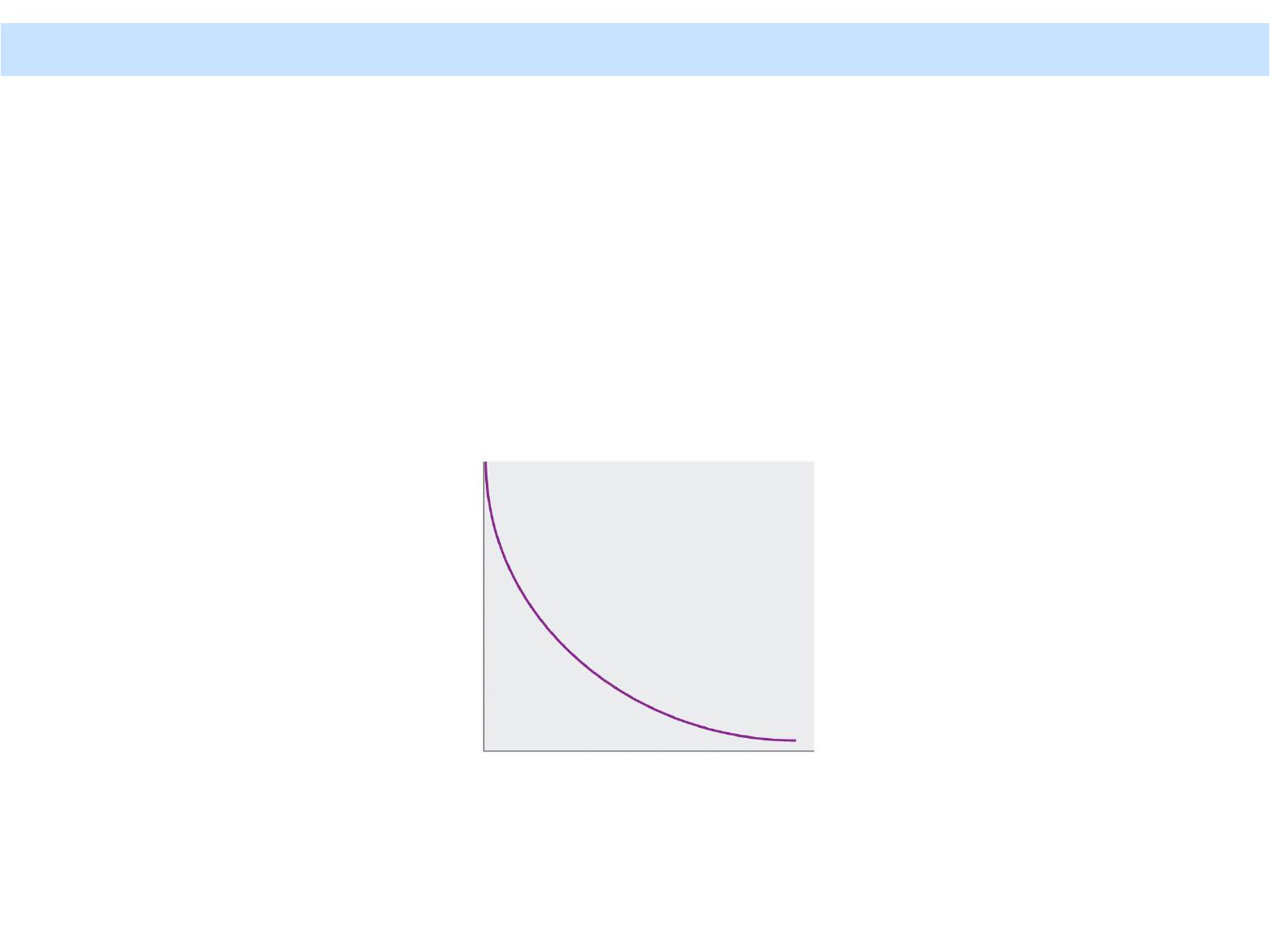
üTo measure the rate of a chemical reaction (i.e., the instantaneous rate) at any moment, we have to make
a plot of concentration vs. time and graphically determine the slope of the line tangent to the curve at that
particular moment in time.
üSometimes it can be difficult to experimentally obtain sufficiently precise data to make these
determinations. An alternative is to fit all of the data over a longer time interval with an equation that
expresses the concentration of the species directly in terms of elapsed time.
üFor any given simple rate law, a corresponding equation for the dependence of concentration on time can
be obtained.
The Integrated Rate Law Tro Section 15.5
Concentration of Reactant
Time
First–Order Reactions
üFor a reaction with a single reactant,
aA→Products
the rate law for a first–order reaction is given by,
Rate = k[A]1
−𝑑A
𝑑𝑡 = 𝑘 A
)𝑑A
A
A
A*= −𝑘)dt
+
+*
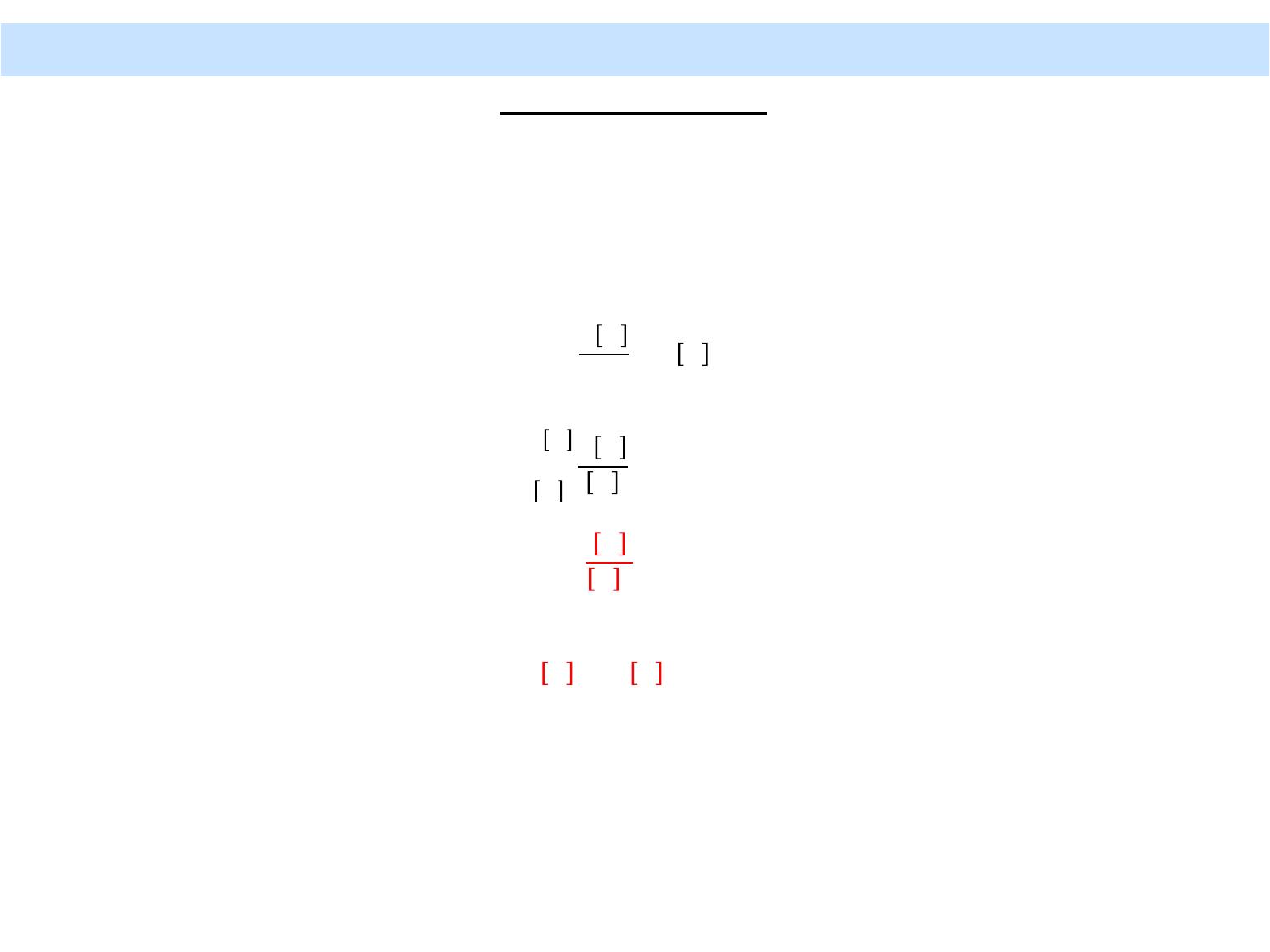
𝒍𝒏 A
A𝟎= −𝒌𝒕
(where [A]0= initial concentration of A; [A] = concentration of A at time t; t= time; k= rate constant)
𝒍𝒏 A−𝒍𝒏 A𝟎= −𝒌𝒕
üKnowing the value of [A]0and k, allows us to determine the value of [A] at any time tduring the course
of the reaction.
The Integrated Rate Law Tro Section 15.5
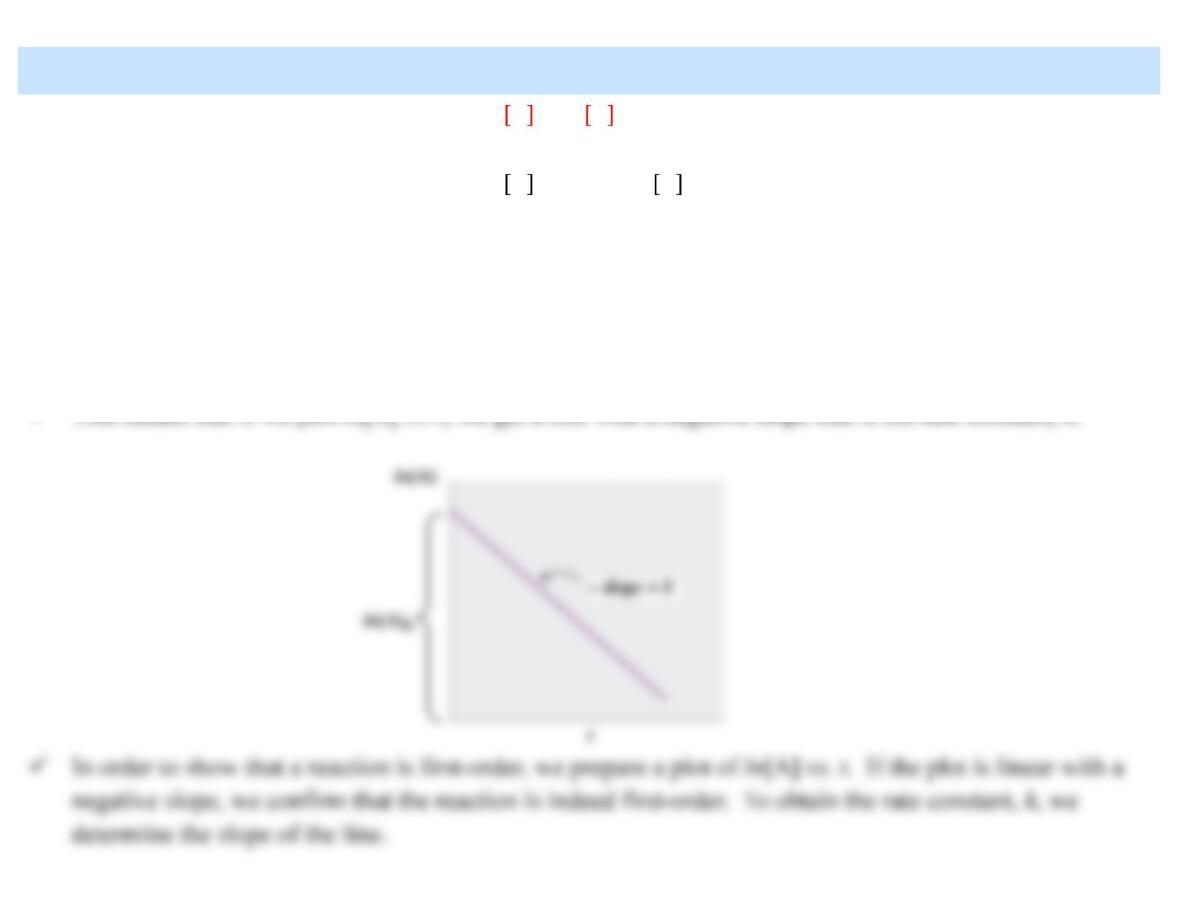
𝒍𝒏 A−𝒍𝒏 A𝟎= −𝒌𝒕
üWe can rearrange the equation, 𝒍𝒏 A= −𝒌𝒕+𝒍𝒏 A𝟎
üWhich looks like,
y = m·x+ c
(y is the y-axis, x is the x-axis, m is the slope, and c is the intercept)
üThus, y =ln[A] ; x =t ; m =–k ; c =ln[A]0
The Integrated Rate Law Tro Section 15.5